
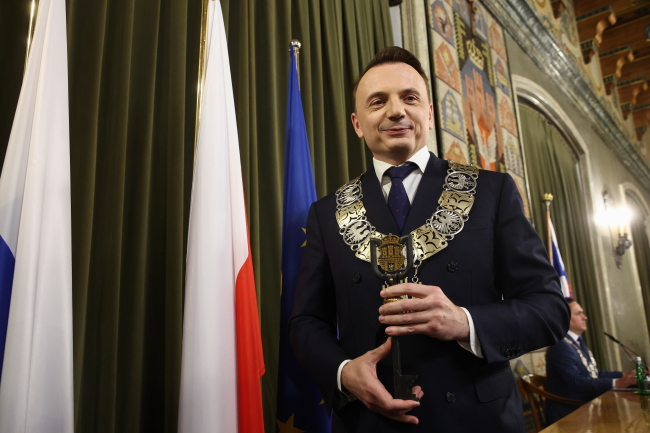

Kraków Mayor Łukasz Gibała on Wednesday proposed suspending Kraków’s partnership with Lviv during a city council session, in response to the Lviv Regional Council’s decision to declare 2027 the Year of the UPA.
On Wednesday evening, Gibała said he would withdraw the draft resolution suspending the partnership with Lviv if that city’s mayor condemns the regional council’s decision.
On Wednesday, councilors debated a draft resolution suspending the 31-year partnership with Lviv. The draft may be considered in two readings, which the mayor encouraged councilors to do.
After the debate, Gibała said he had signed a letter to the mayor of Lviv. In it, he asks the mayor to respond to the Lviv Regional Council’s decision and to condemn it.
“We have a month. If you (the councilors – PAP) want to consider the draft in two readings, which I encourage, I will inform you whether the mayor has replied or not, and whether he really will distance himself from and condemn this resolution of the Lviv region. If he does, I will withdraw this draft (on suspending the partnership with Lviv – PAP),” the Kraków mayor said.
The Kraków City Council session has been under way since 11 a.m. Votes are held in a voting block at the end of each meeting, and those often run late into the night.
At the start of the session, Gibała informed councilors that a draft resolution on suspending the partnership with Lviv had been prepared and asked them to support his proposal. He stressed that the aim is not to sever the partnership but to suspend it.
“Sometimes history surprises us. I did not expect this to be one of my first decisions,” said the Kraków mayor, who was sworn in on Tuesday.
He noted that “we all know that Ukraine is a victim of Russian aggression.” “We support Ukraine in this fight. We care about partnership relations with Ukraine, but those relations must be built on historical reconciliation, which must rest on historical truth. We cannot accept a situation in which Ukrainians want to glorify genocidaires who murdered Poles,” Gibała said.
He described his reaction to the Lviv Regional Council’s decision as “firm but measured.” “I am proposing a suspension – not a severing, but a suspension – of the partnership that has long existed between Kraków and Lviv,” the mayor said.
The Lviv Regional Council declared 2027 the year of the Ukrainian Insurgent Army (UPA), its commander Roman Shukhevych and Organization of Ukrainian Nationalists (OUN) activist Oleh Olzhych. The decision was made Tuesday at a plenary session of the Lviv Regional Council, which is the equivalent of a Polish voivodeship sejmik (regional assembly). The resolution was announced at the time on the council’s official website.
The Lviv Regional Council’s decision has drawn criticism from, among others, the Institute of National Remembrance (IPN) and Polish authorities, including Deputy Prime Minister and Defense Minister Władysław Kosiniak-Kamysz, who said Tuesday that it is unacceptable. Prime Minister Donald Tusk said Wednesday morning that the council’s decision harms Ukraine and helps those who wish it ill. Presidential spokesman Rafał Leśkiewicz, referring to the council’s decision, said Wednesday that “it smells of Russian provocation.”
Deputy Prime Minister and Foreign Minister Radosław Sikorski signed a request to place Lviv regional councilor Sviatoslav Sheremeta, the originator of the idea of declaring 2027 the year of Roman Shukhevych, on the list of undesirable persons in Poland. On Wednesday afternoon, Interior Minister Marcin Kierwiński said that, at the foreign minister’s request, Sheremeta had been entered in the register of undesirable persons, with a ban on entering and staying in Schengen Area countries until Oct. 20, 2031.
Ukraine’s Foreign Ministry said Wednesday that the Lviv Regional Council’s decision on sensitive historical issues in relations with Poland has the opposite effect of what is intended in efforts to promote understanding.
Iryna Vereshchuk, deputy head of the Office of the President of Ukraine, appealed Wednesday to Lviv Regional Council members to refrain from decisions that could harm relations with Poland, stressing that only Russia benefits from such tensions.
On Wednesday morning, the announcement about the Year of Shukhevych and the UPA, published the day before, was no longer on the Lviv Regional Council’s website. A “page not found” message appeared in its place. The council’s websites then stopped working “for technical reasons.”
Deputy Prime Minister and Foreign Minister Radosław Sikorski said Wednesday that he had signed a request to place Lviv regional councilor Sviatoslav Sheremeta, the author of the idea of declaring 2027 the year of Roman Shukhevych, on the list of undesirable persons in Poland.
The Ukrainian Insurgent Army (UPA), including the figure of Shukhevych, one of its leaders, remains one of the most contentious issues in Polish-Ukrainian relations. According to Polish historians, in July 1943 UPA units carried out coordinated attacks on about 150 villages and towns inhabited by Poles in Volhynia, which became the culmination of the crimes referred to in Poland as the Volhynia genocide. Those held responsible are members of the Organization of Ukrainian Nationalists faction led by Stepan Bandera and the UPA subordinate to it.
Poland recognizes the crimes committed against the Polish population as genocide, while many Ukrainian historians and politicians interpret them as part of a broader Polish-Ukrainian conflict for which both sides bore responsibility.
At the same time, in Ukrainian historical memory the OUN and UPA are often seen as symbols of the struggle for independence and of postwar resistance to the Soviet Union.
At the end of May, a decision by Ukrainian President Volodymyr Zelenskyy gave the name “Heroes of the UPA” to one of the military units, which led to a worsening of relations between Kyiv and Warsaw. (PAP)


