
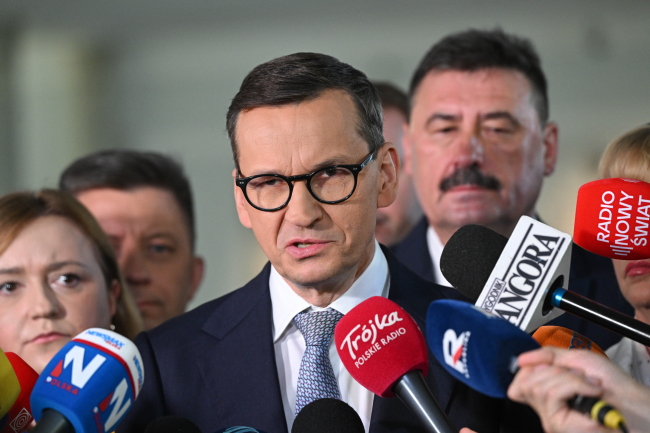

The Rozwój Plus caucus will submit a bill providing for the deportation of foreigners convicted of promoting Banderism, a ban on their entry into Poland, and prison terms for promoting the crimes of the OUN-UPA and their symbols, caucus leader Mateusz Morawiecki announced Wednesday.
The Lviv Regional Council (LRO) has declared 2027 the year of the Ukrainian Insurgent Army (UPA), its commander Roman Shukhevych and Organization of Ukrainian Nationalists (OUN) activist Oleh Olzhych. The decision was made Tuesday at a plenary session of the LRO, which is the equivalent of a Polish voivodeship sejmik, or regional assembly. The resolution was announced on the council’s official website.
Deputy Prime Minister and Foreign Minister Radosław Sikorski said Wednesday that he had signed a request to put Lviv Oblast councilor Sviatoslav Sheremeta, the author of the idea to designate 2027 the year of Shukhevych, on the list of persons undesirable in Poland. The ban on entering Poland and the rest of the Schengen Area is to last five years.
At a news conference Wednesday, Morawiecki said the council’s decision amounts to “honoring the perpetrators of genocide,” which, he stressed, Rozwój Plus cannot accept. According to the former prime minister, the Rozwój Plus bill can be summed up in the words “zero tolerance for Banderism.”
Morawiecki stressed that the proposed provisions are intended to deport foreigners convicted of promoting Banderism and to bar from entering Poland people who “promote Banderism and the Organization of Ukrainian Nationalists and deny the Volhynia massacre.”
Rozwój Plus lawmaker Krzysztof Szczucki said the bill will go to the Sejm speaker during the chamber’s current sitting.
He said the bill amends, among other laws, the act on the Institute of National Remembrance (IPN) by strengthening the IPN’s powers to investigate the crimes of the OUN-UPA. According to Szczucki, the IPN could then apply criminal sanctions to “all actions that amount to promoting the ideology of the OUN-UPA and denying the crimes carried out by members and collaborators of the OUN and UPA; promoting the symbols associated with the activity of these organizations will also be a crime punishable by up to three years in prison.”
Szczucki added that the bill provides for a ban on funding and subsidizing research programs and other activity promoting the OUN and UPA. “Of course, this is not about historical research, which is legitimate here, but about promotion, about any whitewashing of the crimes,” the lawmaker said.
He stressed that among the bill’s key provisions is an obligation for the services “to expel people who have been convicted of the listed offenses and to put on the list of persons undesirable in Poland foreigners who are not in Poland but might want to cross our country’s border and come here.”
“Anyone who commits such acts or is suspected of promoting this type of ideology will not be allowed to enter Polish territory,” he said.
Szczucki added that the bill also provides for a ban on promoting OUN-UPA symbols and an order to remove from Polish public space symbols that may glorify the crimes of those organizations. He said the bill “defines the crimes of OUN and UPA members and collaborators in fairly specific terms.”
According to the lawmaker, the bill also provides for adding the “symbols of the Organization of Ukrainian Nationalists of the Bandera faction or the Ukrainian Insurgent Army” to Article 256 of the Criminal Code, which prohibits the public promotion of Nazism, communism, fascism and other totalitarian systems of government, among others.
Prime Minister Donald Tusk said Wednesday that the Lviv Regional Council’s decision harms Ukraine and helps those who wish it ill. Addressing the Ukrainian side, he stressed that it is their responsibility to ensure that such events do not take place.
At the end of May, a decision by Ukrainian President Volodymyr Zelenskyy gave the name “heroes of the UPA” to one of the military units, which led to a deterioration in relations between Kyiv and Warsaw.
The Ukrainian Insurgent Army (UPA), including the figure of Shukhevych, one of its leaders, remains one of the most contentious issues in Polish-Ukrainian relations. According to Polish historians, in July 1943 UPA units carried out coordinated attacks on about 150 localities inhabited by Poles in Volhynia, which became the culmination of the crimes referred to in Poland as the Volhynia genocide. The perpetrators are considered to be members of the Organization of Ukrainian Nationalists faction led by Stepan Bandera and the UPA subordinate to it.
Poland recognizes the crimes committed against the Polish population as genocide, while many Ukrainian historians and politicians interpret them as part of a broader Polish-Ukrainian conflict for which both sides bore responsibility.
At the same time, in Ukrainian historical memory the OUN and UPA are often seen as symbols of the struggle for independence and of postwar resistance to the Soviet Union.
A Ukrainian document on the National Pantheon allows, among other things, for commemorating figures associated with these organizations. (PAP)


