
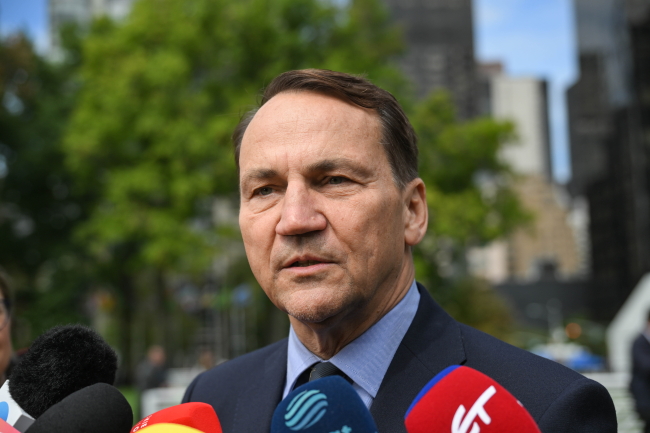

Deputy Prime Minister and Foreign Minister Radosław Sikorski has signed a request to put Lviv Oblast council member Sviatoslav Sheremeta, who initiated the idea of declaring 2027 the Year of Roman Shukhevych, on Poland’s list of undesirable persons. The ban on entering Poland and the other Schengen Area countries would last five years.
The minister said on X that he had signed the request to put Sheremeta on the list of undesirable persons. He described Sheremeta as a “reenactor of the Galizien Waffen-SS, the author of the idea of declaring 2027 the Year of Roman Shukhevych, the UPA commander who issued orders to expel and murder Poles.” In a follow-up post he added: “for five years, to the entire Schengen area.”
The Lviv Oblast Council declared 2027 the year of the Ukrainian Insurgent Army (UPA), its commander Roman Shukhevych and Organization of Ukrainian Nationalists (OUN) activist Oleh Olzhych. The decision was made Tuesday at a plenary session of the Lviv Oblast Council, which is the equivalent of a Polish voivodeship assembly (sejmik). The resolution was announced at the time on the council’s official website.
“This is our history, our heroes, and we should honor their memory appropriately,” council member Sheremeta, chair of the Committee on Culture, Information Policy and Promotion, said at the session.
Sheremeta is a member of the Lviv Oblast Council for former President Petro Poroshenko’s European Solidarity party. He is also secretary of Ukraine’s interagency commission on commemorations. In that role, he was present at all of the search and exhumation work carried out recently by the Polish side in Ukraine. He also heads “Dola,” a municipal enterprise of the Lviv Oblast Council, which formally led the search on the Ukrainian side for Polish victims of Ukrainian nationalists in Ugły in Volhynia.
Sheremeta was already banned from entering Poland once before, in 2017. That ban followed Ukraine’s decision to halt Polish search and exhumation work and the construction of new memorials on its territory. The Ukrainian side took that step after a UPA monument at the cemetery in Hruszowice in Podkarpacie (southeastern Poland) was destroyed, and after earlier acts of vandalism against Ukrainian memorial sites in Poland.
Deputy Foreign Minister Marcin Bosacki said Wednesday on TVN24 that the Polish side has assurances from associates of Ukrainian President Volodymyr Zelensky that the Lviv Oblast Council’s decision to declare 2027 the Year of Roman Shukhevych will not take effect. “It is a provocative decision; we are holding the Ukrainian side to its word,” the deputy foreign minister added. He said it was “a good sign that the resolution disappeared from the Lviv Oblast website late Tuesday evening.”
On Wednesday morning, the announcement about the Year of Shukhevych and the UPA, published the day before, was no longer on the Lviv Oblast Council’s website. A “page not found” message appeared instead. The council’s web services then stopped working “for technical reasons.”
PAP learned from circles close to Lviv politics that it is hard to imagine the council members will rescind the decision to declare 2027 the year of Roman Shukhevych and the Ukrainian Insurgent Army (UPA) he commanded in Lviv Oblast. “The deputies will not reverse their decision on their own, and there are no other mechanisms to do so. Unless through the courts, but that is unimaginable in our region,” said one source who asked to remain anonymous.
Another PAP source in Lviv, who also asked for anonymity, said that “the deputies were certainly aware that their decision on the Year of Shukhevych and the UPA would cause displeasure in Poland, but practically every year they declare a Year of Shukhevych or (Organization of Ukrainian Nationalists leader Stepan) Bandera.” “They declare a year dedicated to some figure or organization, and then nothing happens. No events or gatherings,” the source added.
Oblast councils in Ukraine are representative bodies of local self-government that represent the interests of local communities of villages, settlements and cities within a given oblast.
The Lviv Oblast Council includes representatives of the following groups: former President Petro Poroshenko’s European Solidarity, President Volodymyr Zelensky’s Servant of the People, Lviv Mayor Andriy Sadovyi’s Samopomich (Self Reliance), the Holos (Voice) party founded by well-known musician Sviatoslav Vakarchuk, former Prime Minister Yulia Tymoshenko’s Batkivshchyna (Fatherland), the nationalist Svoboda party, the People’s Movement of Ukraine, the For the Future party and the Ukrainian Galician Party, as well as one unaffiliated deputy.
The Lviv Oblast Council’s decision to declare 2027 the year of Roman Shukhevych and the UPA in Lviv Oblast drew criticism from, among others, the Institute of National Remembrance (IPN) and Polish authorities. They included Deputy Prime Minister and Defense Minister Władysław Kosiniak-Kamysz, who said as early as Tuesday that it was unacceptable.
Rafał Leśkiewicz, spokesman for President Karol Nawrocki, also said that Ukrainian services should investigate the background of the Lviv Oblast authorities’ decision to designate 2027 the year of the UPA and Roman Shukhevych. “This smells like a Russian provocation,” he said Wednesday, adding that the matter is “outrageous.”
Iryna Vereshchuk, deputy head of the Office of the President of Ukraine, appealed Wednesday to Lviv Oblast Council members to refrain from decisions that could harm relations with Poland. She stressed that only Russia benefits from such tensions.
The Ukrainian Insurgent Army (UPA), including the figure of Shukhevych, one of its leaders, remains one of the most contentious issues in Polish-Ukrainian relations. According to Polish historians, in July 1943 UPA units carried out coordinated attacks on about 150 localities inhabited by Poles in Volhynia, which became the culmination of the crimes referred to in Poland as the Volhynia genocide. Members of the Stepan Bandera faction of the Organization of Ukrainian Nationalists and the UPA subordinate to it are considered the perpetrators.
Poland recognizes the crimes committed against the Polish population as genocide, while many Ukrainian historians and politicians interpret them as part of a broader Polish-Ukrainian conflict for which both sides bore responsibility.
At the same time, in Ukrainian historical memory, the OUN and UPA are often seen as symbols of the struggle for independence and of postwar resistance to the Soviet Union.
At the end of May, by decision of Ukrainian President Volodymyr Zelensky, one of the military units was given the name “heroes of the UPA,” which led to a worsening of relations between Kyiv and Warsaw.
Under current regulations, the register of foreigners whose stay in the Republic of Poland is undesirable is kept by the head of the Office for Foreigners (UdSC).
Foreigners can be added to the register if they meet one of several criteria, including a final conviction, a decision obliging them to return to their home country, or the interests of the Republic of Poland.
A foreigner’s data is entered into the register by the head of the UdSC, either on the office’s own initiative or at the request of, among others, the Foreign Ministry, the Defense Ministry, or the heads of the National Police, Border Guard, Internal Security Agency, Foreign Intelligence Agency or National Revenue Administration.
If the head of the UdSC does not grant a request, the requesting authority may ask the interior minister to resolve the matter, and the interior minister may order the UdSC to enter the foreigner’s data in the register.
A foreigner’s data may be entered in the register without his or her knowledge or consent. (PAP)


