
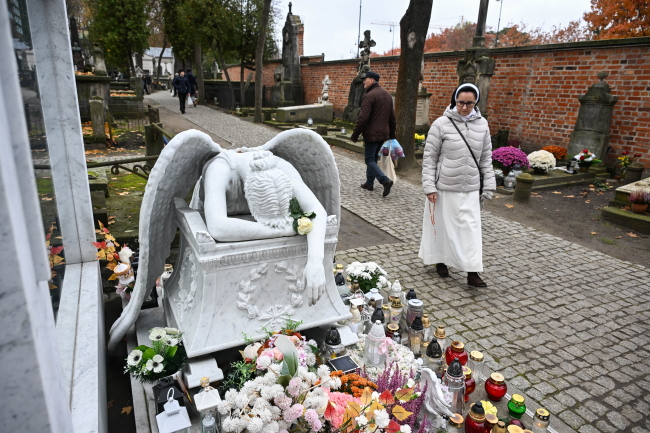


The Catholic Church celebrates the Solemnity of All Saints on Nov. 1. On this day, it remembers the faithful who attained salvation after death. It also reminds believers that every Christian is called to holiness. In Polish tradition, it is also the day for visiting the graves of loved ones.
In 1970, the Roman Missal, the liturgical book containing the fixed and variable parts of the Mass, introduced a new preface, the part of the Mass that is one of thanksgiving and praise. It states that the solemnity “includes not only canonized saints, but all the departed who have attained perfection, and thus also deceased relatives and friends.” In this way, it recalls that holiness is the calling of every baptized person.
In his reflection before the Angelus prayer on Nov. 1, 2017, Pope Francis said that the Solemnity of All Saints is “our feast: not because we are so wonderful, but because the holiness of God has touched our lives.”
“The saints are not perfect models, but people permeated by God. We can compare them to the stained-glass windows in churches, which let in light in different shades of color. The saints are our brothers and sisters who have received the light of God into their hearts and passed it on to the world, each according to his or her own ‘shade,'” he said.
According to Francis, the goal is to “let God’s light through” into our lives. Referring to the Gospel reading of the eight Beatitudes proclaimed in the Church’s liturgy that day, Francis stressed that “whoever is with Jesus is blessed, happy.”
“Happiness does not consist in having something or becoming someone. On the contrary, true happiness is being with the Lord and living for love,” the pope said.
He recalled that in the Gospel, the ingredients of a happy life are called Beatitudes: “Blessed are the simple, the humble, those who make room for God, who are able to weep for the sins of others and their own, those who remain meek, who fight for justice, who are merciful to all, who guard purity of heart, who always work for peace and remain in joy, who harbor no hatred, and who, even when they suffer, respond to evil with good.”
“Those are the Beatitudes. They do not require extraordinary gestures, they are not meant for superhumans, but for those who live through everyday experiences and struggles, for us,” he said.
He said that “the saints, like everyone, breathe the polluted air of the evil that exists in the world, but on their journey they never lose sight of Jesus’ path, shown in the Beatitudes, which are like a map of the Christian life.”
On the Solemnity of All Saints, the Litany of the Saints is sung during the liturgy. It is one of the oldest litanies of the Church. Catholics are obliged to attend Mass on this day.
According to Polish tradition, on Nov. 1 the faithful visit cemeteries where their relatives and friends are buried. The candles placed on graves on this day symbolize hope and remembrance of those who have departed, while flowers symbolize selfless love.
During the octave of the Solemnity of All Saints, from Nov. 1 to 8, a plenary indulgence can be obtained for those awaiting the fullness of salvation in purgatory. A plenary indulgence is God’s remission of the temporal punishment due to sins. The condition for obtaining it is visiting a cemetery and fulfilling the usual requirements: remaining in a state of sanctifying grace, having no attachment to grave sin, receiving Holy Communion on the day of the cemetery visit, and reciting the Our Father and the Creed (“I Believe in God”), as well as any prayer for the intentions designated by the pope for that day.
The Solemnity of All Saints is one of the oldest Christian feasts. Its origins go back to the first centuries, when the Church honored martyrs and the faithful visited their graves on the day of their birth into heaven, that is, the anniversary of their death.
In the 4th century, the practice began of honoring all martyrs on a single day: the first Sunday after Pentecost. In the East, all martyrs were commemorated on the Friday after Easter.
Pope Boniface IV gave the solemnity a distinct character in 609. It was initially celebrated in Rome on May 13. On that day, the Virgin Mary and all martyrs, people who gave their lives for faith in Christ, were remembered.
In the 8th century, the Solemnity of All Saints also began to commemorate those who were not martyrs but died with a reputation for holiness. This gave rise to the tradition of a day on which the Church rejoices that all those who have not been officially declared saints have attained God’s glory.
The Nov. 1 date appeared in 741, when Pope Gregory III founded an oratory in Rome dedicated to various saints, not only martyrs.
Pope Gregory IV, who held office from 827 to 844, established the feast for the entire Roman Empire. In 935, Pope John XI extended its observance to the whole Church. (PAP)
