Supreme Court Overturns Orders Sidelining Constitutional Tribunal’s Święczkowski, Sochański
The orders for an immediate break in the duties of Bogdan Święczkowski and Bartłomiej Sochański have been overturned, Poland’s Supreme Court announced Tuesday. Judge Anna Korwin-Piotrowska stated that the Supreme Court’s rulings have no effect on the suspensions, which are subject to review by “only the Constitutional Tribunal’s disciplinary court.”
Last Friday, the Supreme Court declared itself not competent to hear the appeals by Bogdan Święczkowski and Bartłomiej Sochański against the Oct. 30 orders for an immediate break in their duties as judges of the Constitutional Tribunal (TK), and referred the case to the Tribunal “as a separate body of the judiciary.” Święczkowski and Sochański were also said to have filed an appeal against that ruling.
In a statement Tuesday, the Supreme Court said the appeal by Święczkowski and Sochański against Friday’s ruling had been heard. It stressed that the ruling was overturned and the case was referred for consideration to the Supreme Court’s Chamber of Professional Liability, which is headed by Judge Maria Szczepaniec.
The court said that after this decision, the Supreme Court on the same day heard the appeals by Święczkowski and Sochański against the Oct. 30 orders for an immediate break in their duties, including in their roles as president and vice president of the Tribunal. The Supreme Court “decided to overturn both orders,” the statement said.
In response to the Supreme Court’s statement, Judge Korwin-Piotrowska said that any Supreme Court rulings have no bearing on the continued effectiveness of the suspension of Święczkowski and Sochański. She added that only the Tribunal’s disciplinary court can review orders on breaks in the work of Tribunal judges.
“In view of media reports that the Supreme Court’s Chamber of Professional Liability has issued a ruling overturning the Oct. 30, 2026, orders for an immediate break in the duties of judges Bogdan Święczkowski and Bartłomiej Sochański, I wish to state that any Supreme Court rulings have no bearing whatsoever on the continued effectiveness of the orders for an immediate break,” Korwin-Piotrowska wrote in a statement posted on the Tribunal’s website.
She stressed that “the only body authorized to review orders on a break issued with respect to Constitutional Tribunal judges is a disciplinary court drawn by lot from among the judges of the Constitutional Tribunal.”
Justice Minister and Prosecutor General Waldemar Żurek responded to the Supreme Court’s statement on the platform X. “I’m waiting for Ms. Szczepaniec to rule that the Earth is flat,” Żurek wrote.
Deputy Justice Minister Dariusz Mazur also commented on the Supreme Court’s statement on X.
He said that the so-called Supreme Court judges (appointed with the involvement of the politicized neo-KRS, the National Council of the Judiciary), ruling outside the Supreme Court’s jurisdiction, acting without due process and without citing an adequate legal basis, had published today something they prematurely called a “Supreme Court ruling.”
“Absurdity chases absurdity; one might as well have someone pretending to be a chess referee award a penalty kick in a boxing match. All of this is meant to resuscitate Mr. Święczkowski as the head of the Tribunal and thereby recreate a closed system in which the lack of real review of the constitutionality of laws allows the neo-judges in the Supreme Court to keep functioning. The circle closes; it’s weak and ineffective,” Mazur stressed.
On Oct. 30, representatives of the group elected as Tribunal judges by the Sejm, Poland’s lower house of parliament, in its current term announced that Anna Korwin-Piotrowska, as the longest-serving judge, had become the head of the Constitutional Tribunal and had issued an order for a break in the duties of Tribunal President Bogdan Święczkowski and Vice President Bartłomiej Sochański.
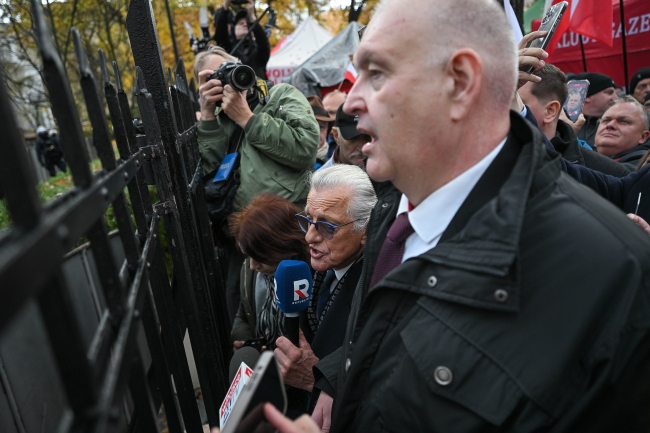
Święczkowski called this a usurpation. A protest in front of the Tribunal’s headquarters intensified, and President Karol Nawrocki cut short a trip to Senegal, returned to Warsaw late in the evening, met with, among others, First President of the Supreme Court Zbigniew Kapiński, and then went to the Tribunal’s headquarters.
Early on Saturday, Oct. 31, the president issued a statement saying, among other things, that “the constitutional order of the Republic of Poland had been violated and a constitutional state body had been seized by force.” On Saturday evening, Prime Minister Donald Tusk delivered an address in which he said, among other things, that the current Sejm had elected new Tribunal judges, but the president had not accepted the oath from some of them, President Święczkowski had prevented them from starting work, and when after many weeks of waiting they decided to take up their duties, “they were attacked.”
Both Święczkowski and Sochański appealed the orders on the break in the duties of Tribunal judges to the Supreme Court. Their appeals against the orders, along with a motion for their immediate overturning, reached the Supreme Court on Nov. 3.
The appeals were registered in the Supreme Court’s Chamber of Professional Liability and assigned to Judge Tomasz Demendecki. However, Demendecki asked to be recused from the case, which then went to Judge Zbigniew Korzeniowski.
Last Friday, the Supreme Court declared itself not competent to hear the appeals by Święczkowski and Sochański and referred the case to the Constitutional Tribunal “as a separate body of the judiciary.”
“The scope of jurisdiction of the Chamber of Professional Liability (of the Supreme Court) does not include judges of the Constitutional Tribunal,” Judge Korzeniowski stated at the time in the operative part of the Supreme Court ruling.
Judge Szczepaniec, who heads the Chamber of Professional Liability, was asked on Nov. 3 whether the Supreme Court’s registration of the appeals against the order issued by Korwin-Piotrowska meant that the order “is in legal circulation.” She replied that she would not call “this an order, nor would I call Ms. Piotrowska a judge.” According to Szczepaniec, Korwin-Piotrowska “is not a judge, and this document, which she called an order, has no legal effect.”
For her part, Korwin-Piotrowska said in a statement posted on the Tribunal’s website that “the status and systemic position of the Constitutional Tribunal and the Supreme Court are separate, and both institutions are autonomous.”
She recalled that under the constitution, a Tribunal judge may not, without the prior consent of the Tribunal, be held criminally liable or deprived of liberty. Regulations also provide that the Tribunal’s General Assembly is competent in matters concerning the immunity of Tribunal judges, and that a Tribunal judge is subject to disciplinary liability before the Tribunal.
“The Supreme Court has no powers whatsoever with respect to the Constitutional Tribunal and its judges. Individual Supreme Court panels may at most submit a legal question to the Tribunal in specific cases,” Korwin-Piotrowska noted.
She added that, accordingly, “any Supreme Court rulings issued in connection with the order for an immediate break in the official duties of Tribunal judges will have no legal effect.” (PAP)