
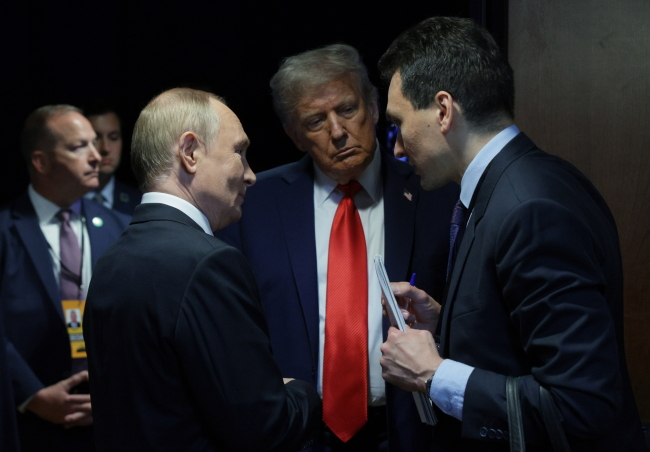


Business incentives from the U.S. administration will not push Vladimir Putin to make concessions or agree to a ceasefire in the war against Ukraine. But the Kremlin is signaling that it wants to continue its “tango” with Donald Trump, American media assessed on Tuesday.
Tuesday is the first day of talks in Abu Dhabi, the capital of the United Arab Emirates, on ending Russia’s war against Ukraine. The Americans are mediating the negotiations.
The New York Times cites assessments from Russia specialists. They share the view that the U.S. administration’s business incentives will not move Vladimir Putin to a ceasefire, let alone a peace agreement.
The Washington Post notes that the Trump administration is making a bad and risky assumption from the outset: that the only way to reach a deal with the Kremlin and end the war is to conclude a broader pact with Russia on Europe’s security architecture.
“Observers describe this step as a risky concession to Russia’s main goal, which is gaining influence over European security,” the Post reports.
Asked about the Trump administration’s approach to negotiations with Russia, Eric Green, a former Russia director on the National Security Council under President Joe Biden, told the Times: “That will not push (Putin) to compromise on Ukraine.”
Green believes the main U.S. negotiators, Steve Witkoff and the president’s son-in-law Jared Kushner, are entirely wrong to think they will find common ground with Putin.
“These are real estate investors who have had contacts with Russian oligarchs, so they assume they know how to talk to Russians and get them to compromise by promising business deals,” Green continued.
“That may be true of oligarchs, but not of Putin,” he stressed. He added that the Russian dictator operates by a different logic, and that the American negotiators are not taking his political goals into account.
Moscow is playing for time and counting on political shifts in Europe to give it the upper hand in negotiations. Among them are the prospect of Marine Le Pen, who opposes aid to Ukraine, winning the presidential election in France, and the growing popularity of the AfD (Alternative for Germany) in Germany.
The paper recalls that it was Russia that took the initiative in proposing business talks with the U.S. alongside negotiations on Ukraine, and that it did so a few days after Trump’s return to the White House.
The Times also notes that the U.S. president has not so far gone as far as to “hand Russia a victory in Ukraine,” because “domestic political pressure” has held him back.
Thomas Graham, a former National Security Council member and adviser on Russia to President George W. Bush, told the paper that Putin failed to understand the “context of U.S. domestic politics” when he assumed that a promise of business cooperation with America would let him “end the war on Russian terms.”
“If Putin’s position is that there will be no ceasefire until everything is signed, that is a recipe for an endless war,” Graham added.
The Washington paper stresses, however, that the Kremlin still hopes that “demonstrative expressions of sympathy for Trump, while ignoring the Democrats, will bring results.”
The “upgrade of the delegation” to Abu Dhabi indicates that the Kremlin wants to signal that it is “ready to continue the tango with Trump,” the Post notes.
The three-way Ukraine-U.S.-Russia talks in Abu Dhabi will run from Tuesday to Wednesday and are meant to set the terms for ending Russian aggression against Ukraine. It is the first such meeting since February 2026. (PAP)
