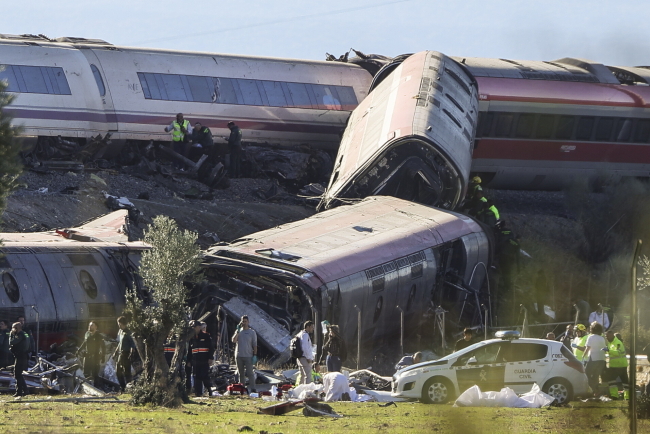
Spain Likely to Change Rail Procedures After Crash, Expert Says; Rules Must Account for Human Error
Rail safety procedures should account for the possibility of human error in decision-making, and Spain will likely change them because the system did not work properly, Prof. Pedro Plasencia Lozano told PAP after Wednesday’s train disaster, in which 69 people died.
The expert from the University of Oviedo, who specializes in transport and infrastructure engineering, told PAP that procedures for rail and air traffic are designed with redundant safeguards, so that “a single mistake does not lead to a catastrophe.” He cautioned, however, against jumping to the conclusion that a human being was to blame for Wednesday’s collision of two trains on a high-speed line.
– We are currently seeing a clear deterioration in the condition of the infrastructure, he said. In his view, the system in Spain, which is among the world’s leaders in the length of its high-speed rail network, is overloaded and needs greater investment and more staff.
– That is why, rather than a single error in procedures, I would prefer to speak of a systemic failure. The accident itself is an anomaly that could have happened under any circumstances and in any country, because no systems are entirely free of failures. But we are talking about a system that generates delays, that relatively often forces trains to stop, and in which two disasters have already occurred in 2026, he noted.
The initial cause of Wednesday’s tragedy was a failure of the LZB computerized train control system on the section of track used by two trains traveling from Madrid to Seville. When the system fails, trains are automatically stopped, and traffic is controlled through a control center.
On Wednesday, after a few minutes, a controller at the center permitted the Madrid–Seville trains on the same track to proceed, even though the driver of the first one, operated by Iryo, had twice signaled that she was unable to move. A few minutes later, a Renfe train struck the Iryo train from behind. The collision occurred near the town of Urda in Toledo province.
Plasencia Lozano stressed that it is nothing unusual for two trains traveling in the same direction to be on the same track. – Signaling systems allow trains to run at intervals of just a few minutes while maintaining a safe distance between them, he said. He added that more than 130 trains a day (in both directions) run on the Madrid–Seville high-speed line.
– Perhaps the source of the problem is not a single human error at all, but the fact that LZB failures happen relatively often and we have become accustomed to using “manual management,” and that manual management has not been properly designed, the expert said.
Manual control of train traffic is similar to that in air traffic. – Airplanes, after all, do not coordinate traffic by communicating directly with one another. Traffic is coordinated from a control center, which has a complete picture of the situation and can issue consistent instructions to individual aircraft, he explained. He stressed that under normal conditions, the LZB system continuously relays information on the permitted speed and the available route to the driver’s cab.
– If there is a stopped train ahead, the system limits the speed of the train behind it so that it stops before reaching it. If the driver does not reduce speed sufficiently, braking is activated automatically, Plasencia Lozano explained.
When the LZB system fails, procedures set out step by step in the relevant protocols are triggered, and staff must follow them.
– Part of the investigation (into the causes of the disaster – PAP) will therefore focus on establishing how the instructions were relayed, who issued them, why they were issued, and so on, he said.
The professor added that there is an intermediate level between an LZB failure and manual control. – To some extent, the ASFA system could serve that function, but I don’t know whether it worked (in this case – PAP), and if not, why. At this point I won’t venture to speculate on that, Plasencia Lozano cautioned.
The task of ASFA, which operates at specific points along the track, is to warn the driver of signals along the route and to automatically stop or slow the train if the driver does not react properly.
Despite two disasters occurring in Spain within a single year, the expert believes rail is a safe means of transport. – The numerous incidents that occur are always resolved with passenger safety in mind, the expert stressed.
From Madrid, Justyna Wojteczek (PAP)