


The narrative of a “coup” and a “forced takeover” of the Constitutional Tribunal (TK) dominated social media discussion after Friday’s events surrounding the court. Posts presenting that position gathered 83% of interactions on both sides of the dispute, according to a report by Res Futura.
According to the authors of the analysis, the night of Oct. 30-31 on social media belonged to the opposition and President Karol Nawrocki. Posts and comments were markedly more favorable to that side of the dispute than to the government.
The report by the European Analytical Collective Res Futura says one of the main turning points was the president’s post “I’m interrupting my flight to Senegal. I’m coming back,” which drew more than 242,000 interactions and 9.5 million views. In the authors’ view, it allowed the head of state to build an image as a defender of state institutions even before the government presented its legal arguments for its actions toward the Tribunal.
The analysts concluded that no figure emerged on the ruling coalition’s side who was able to impose its own narrative. At the same time, Judge Korwin-Piotrowska and Minister Maciej Berek became the main targets of criticism in online comments.
According to the report, right-wing groups acted jointly during the crisis, although no single political leader emerged. The authors noted that politicians from Konfederacja, including Sławomir Mentzen, Krzysztof Bosak and Ewa Zajączkowska-Hernik, generated more than 603,000 interactions combined, significantly more than profiles associated with Law and Justice (PiS).
The report estimates that the total reach of the discussion was 189 million and that interactions exceeded 7.8 million. More than 60% of the reach came from the platform X. The phrase “Trybunał Konstytucyjny” (Constitutional Tribunal) was the most-searched topic of the day in Poland, and among the most popular queries were questions about the president’s powers and the course of events surrounding the TK.
The authors of the analysis also pointed to strong polarization of the debate. Among comments taking a clear position, 61% supported the “coup” narrative and 39% the interpretation of “restoring the rule of law.” The dominant emotions were anger and contempt, and the discussion often focused more on images and symbolic events than on legal arguments.
In the report’s summary, the authors concluded that the government had legal arguments for the changes at the TK, while its opponents made more effective use of visual messaging and the president’s activity on social media. As a result, the opposition’s narrative kept its advantage throughout the night and carried it into the next day of public debate.
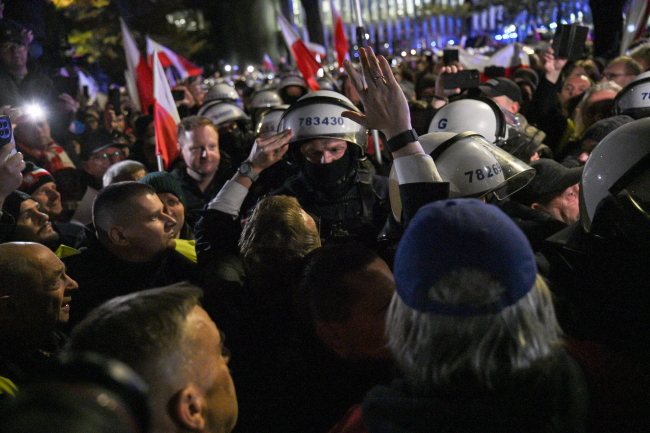
The crisis at the Tribunal came after the announcement on Friday of a pause in the duties of TK President Bogdan Święczkowski and Vice President Bartłomiej Sochański. Judge Anna Korwin-Piotrowska, who was chosen by the current Sejm, Poland’s lower house of parliament, was recognized as the person leading the Tribunal’s work. Tensions and demonstrations then broke out in front of the TK’s headquarters, and police appeared at the scene.
On the night from Friday to Saturday, President Nawrocki interrupted his flight to Senegal and came to the TK’s headquarters. Recordings were published in the media showing his entry into the building and a dispute between the president’s representatives and the people elected by the current Sejm as Tribunal judges. The sides present differing versions of what happened.
After leaving the TK building, the president announced he was calling urgent consultations with parliamentary forces, arguing that the constitutional order had been violated. Prime Minister Donald Tusk, in turn, said that “restoring the rule of law is our duty.” (PAP)
