
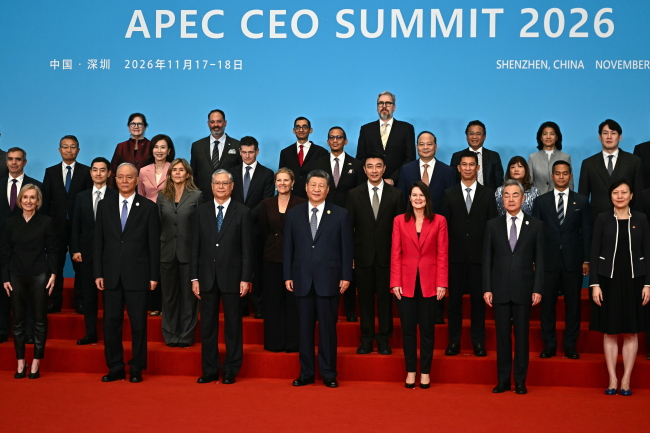


There will be no “concert of powers” in Shenzhen, Marcin Jacoby, head of the Department of Asian Studies in the Faculty of Humanities at SWPS University, told PAP. Unfortunately, the only result of the meeting may be a strengthening of Russia’s international standing, he noted.
PAP: On Thursday, Vladimir Putin, Donald Trump and Xi Jinping will meet in Shenzhen. A summit in this format was the Russian president’s idea. Trump also pushed for it. Politicians in Poland are warning of “Yalta 2.0.” Do we have anything to fear?
Sinologist Marcin Jacoby, professor at SWPS University: I don’t think so. For a simple reason: Each of the leaders meeting in Shenzhen has a completely different idea of what this summit is about. The biggest difference is between China on one side and Russia and the United States on the other. Putin and Trump would probably be glad to talk about spheres of influence, but Xi Jinping absolutely does not want to discuss it.
PAP: Why?
M.J.: China cannot reach an agreement with the U.S. on spheres of influence because of differences over the western Pacific, the South China Sea and the Taiwan Strait. Both the Americans and the Chinese want to control that region, and the Chinese regard those waters as their coastal waters. So in Shenzhen there will be no talk of dividing up spheres of influence.
PAP: Am I right in understanding that Putin and Trump have completely different expectations of the summit than the host?
M.J.: I think so. Donald Trump would like China and Russia to help him extricate himself from the war with Iran, but I don’t think Xi Jinping would lift a finger on that issue. Another topic on which the powers differ is denuclearization. While the U.S. and Russia could talk about reducing nuclear warheads, China, which has barely 250, doesn’t want to discuss it, because it isn’t ready to limit itself on this issue.
The war in Ukraine won’t be a topic of the summit either. China is not a party to the peace talks, and Xi Jinping has no intention of putting any pressure on Russia. America, for its part, is entangled in a war with Iran, with which China would like to cooperate closely. So there will be no “concert of powers.” At least for now.
PAP: Russia is the most interested in dividing up spheres of influence, but Putin is the weakest of the players, isn’t he?
M.J.: Exactly. The U.S. is still a global power, but the Trump administration has been weakened both by the war with Iran and by the Republicans’ loss in the midterm elections. Xi Jinping is in the most comfortable position. For him, the most important topics are trade, technological rivalry with the U.S., and access to raw materials.
PAP: Poland also depends on China for certain components and rare earth metals, so shouldn’t we be rooting for the U.S.?
M.J.: This dependence on China won’t disappear overnight. We have to learn to live with it. Europe is in the line of fire between the U.S. and China, so a great deal depends on how relations between those two powers develop. Europe bears the costs of these disruptions.
PAP: In this trade contest with China, should Poland side with the U.S. or remain neutral?
M.J.: The United States is our ally, and we are certainly closer to the American way of thinking about the world than to the Chinese one. But we have entered an era of rivalry in which naked interests count. So the EU, regardless of the fact that it remains in an alliance with the U.S., should above all look after the interests of Europeans. Let’s leave American priorities to the Americans and focus on pursuing European ones.
PAP: The EU’s trade deficit with China is 1 billion euros a day. Shouldn’t reducing it be the top priority?
M.J.: It’s an enormous challenge, but the EU is beginning to understand that the era of globalization is over and that it is high time to protect the European market and put up various kinds of barriers. The point is that Europeans shouldn’t lose their jobs. The old order won’t come back.
PAP: I have the impression that the discussion in Poland is focused on something else, on the threat of a second Yalta, and, as you already suggested, that comparison is somewhat overblown. At Yalta, three victorious powers met, while in Shenzhen the aggressor Putin will sit at the table with Trump, who is unable to win a war with Iran…
M.J.: The geopolitical dynamics are also different. At the beginning of 1945, Great Britain was already a somewhat weakening empire, but the U.S. and the Soviet Union remained very strong. Today China aspires to the role of an empire, the United States is a wobbling power, and Russia is very weak. It can’t win a war against a weaker neighbor that it was supposed to finish in two weeks.
PAP: Is Europe able to influence China so that it would at least reduce its aid to Russia?
M.J.: Unfortunately, no. Europe doesn’t have many tools of pressure on China at all. Perhaps it would be easier if the EU were a federation and could act in an absolutely coordinated way, for example by effectively threatening to reduce access for Chinese goods. Today that is not the case, so China is playing the Union.
As for the war in Ukraine, Beijing will do everything to make sure Russia doesn’t lose it, because that could end in the collapse of Putin’s regime. Europe has no influence over that.
PAP: Does Poland have any role to play here? Should we have our own policy toward China?
M.J.: Poland should above all expand its influence in the EU, which is already partly happening. We are too small a country to accomplish anything on our own. Of course, Poland should have its own strategy toward China, but it can’t be carried out outside EU structures. Our only hope is to align it with the EU’s actions.
In Poland we often hear that “Brussels did this” or “Brussels influenced that.” I would very much like us to be able to say that Poland did this or that within the EU. Poland should push its own priorities in the Union.
PAP: To sum up, what can we expect from the Putin–Trump–Xi Jinping summit in Shenzhen? What agreements will be reached?
M.J.: Reaching any detailed agreements among Russia, the U.S. and China will be extremely difficult. As I’ve said, each leader is after something completely different. So I think the Shenzhen summit will be symbolic and about image. The message sent to the world will be that the leaders of three powers are talking to one another, along with general statements such as “we must strive for peace in the world,” or that nuclear war must not be allowed.
Reaching agreement on certain issues would be possible in any other configuration, for example U.S.–Russia, U.S.–China or China–Russia, but let’s not expect any specifics from the triangle. Each of the leaders will want to show in Shenzhen that he has an influence on what is happening in the world.
Europe is right to fear that Putin may benefit the most from this summit. Unfortunately, the only result of the meeting may be a strengthening of the position of Russia, which, unlike China or the U.S., is not a great power, and yet has been invited to the table.
Interview by Jacek Pawlicki (PAP)
