
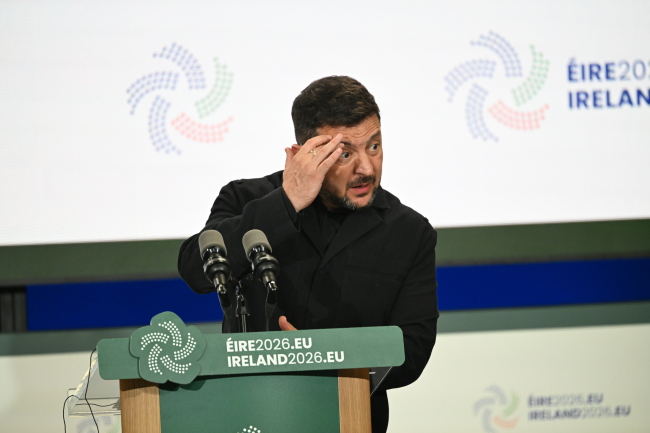


Ukrainian President Volodymyr Zelensky leads in polls ahead of a hypothetical first round of a presidential election, but he could lose a runoff to most of his main rivals, Kacper Sienicki of the Centre for Eastern Studies (OSW) told PAP.
Polls on political preferences in Ukraine point to differences between possible results in the first and second rounds of a presidential election. In a survey by the Active Group research center published Nov. 10, Zelensky could count on 18% support in the first round, more than Valerii Zaluzhnyi (10.5%) and former President Petro Poroshenko (9.6%). In a hypothetical runoff, however, Zaluzhnyi would get 36.4% of the vote and Zelensky 25.3%.
Similar trends also emerged from earlier surveys, especially October polls by the Kyiv International Institute of Sociology and the New Image Marketing Group.
Besides Zaluzhnyi, the former commander-in-chief of Ukraine’s armed forces and now Ukraine’s ambassador to the United Kingdom, the potential rivals of the current head of state who are named include Kyrylo Budanov, head of the Office (chancellery) of the President, and former Defense Minister Mykhailo Fedorov.
According to Sienicki, an OSW analyst who specializes in Ukrainian affairs, Zelensky’s weaker position in the runoff stems primarily from his large negative electorate. Public fatigue with his long time in power, the concentration of power in his hands, discontent over mobilization and the lack of clear prospects for ending the war all contribute to the negative views of Zelensky.
“The sitting president’s term has already lasted seven and a half years. That is long enough for people to grow tired of a politician’s face, especially one who holds all the power in his hands,” the expert said.
He added that some Ukrainians are also critical of the pace of reforms needed on Ukraine’s path to European Union membership, as well as the scale of corruption. Corruption scandals involving people from Zelensky’s innermost circle are a particularly serious problem for his political future, Sienicki said.
He noted that in wartime, corruption is seen not only as an abuse of power but also as an act that harms the state, because stolen funds could have been spent on the army’s needs.
In his view, a belief is growing in Ukrainian society that the president must have known about the actions of his associates. Public opinion surveys confirm this.
The expert said that after Andriy Yermak was dismissed as head of the Office of the President, Zelensky “lost a kind of lightning rod” that had previously absorbed some of the criticism over how his circle operates. “After his dismissal, most Ukrainians believe the president is personally responsible for actions harmful to the state,” he said.
Sienicki said that although there are no prospects for holding elections, the Ukrainian political scene remains active, and representatives of various groups are preparing for the possible resumption of the electoral process. Fedorov has spoken publicly about the need to develop a mechanism for voting in wartime, and the future political involvement of Zaluzhnyi and Budanov has already been the subject of media reports.
According to the news site Ukrainska Pravda, government representatives tried to persuade Zaluzhnyi to give up his political ambitions, arguing that direct competition with Zelensky could lead to divisions in society. The site reported, citing Zaluzhnyi himself and sources in the president’s circle, that these attempts were unsuccessful.
Sienicki stressed that current polls should be treated with caution because they also include people from outside politics, such as boxer Oleksandr Usyk, whose entry into big-time politics remains purely hypothetical. He emphasized that it is far too early to forecast election results with any degree of confidence, especially since it is not known when an election might take place.
“Polls are nevertheless important because they help us understand public sentiment and also influence the actions of politicians, who try to respond to the expectations of potential voters,” the interviewee told PAP.
He also noted that the outcome of the war and the terms on which it ends will be crucial for the election results. “That is what the overall assessment of Volodymyr Zelensky’s presidency will depend on,” Sienicki concluded.
Ihor Usatenko (PAP)
