
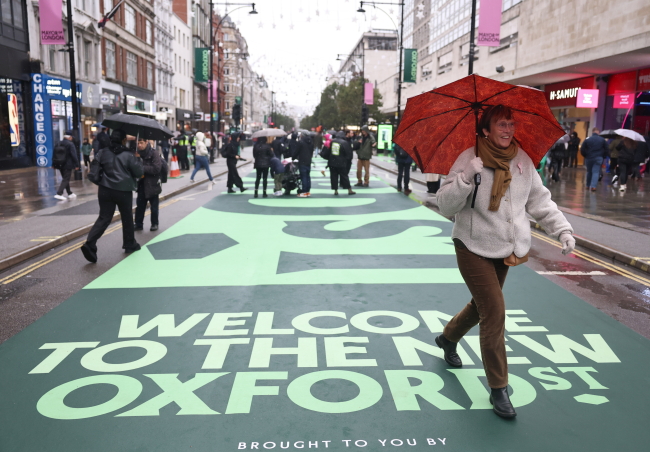


Oxford Street, one of the world’s most famous shopping streets, was partly closed to cars and buses on Monday. The thoroughfare is to be turned into a green, quiet urban promenade. Those behind the project say they drew on examples including the Polish city of Wrocław.
A cacophony of music from the shops, dozens of languages, footsteps, the rattle of small suitcase wheels – on Monday afternoon, the soundtrack of Oxford Street was recognizable in many ways. This time, though, the sounds and voices came through more clearly. The backdrop of squealing brakes, roaring engines and the rhythmic beeping of pedestrian crossing signals was gone. At least on the first stretch covered by the changes, nearly 1 kilometer (0.6 mile) long.
“This was really needed. Most European cities have streets like this (…) so it’s high time it happened here, too,” Miriam told PAP right after she finished recording on her phone the first walk along the strangely calm street.
Although the buses and taxis that usually sit here in gigantic traffic jams were gone (private cars were banned long ago), it was still not easy to squeeze through the street. A crowd of curious people had taken over in place of vehicles.
One more thing has not changed: the crowd is full of many languages and accents.
“You can see right away that there’s more room, there’s no more squeezing between cars,” said Jeff, who lives in Washington but came to London to visit his daughter.
“Bigger cities in the U.S. are doing similar things now, too. I think the whole world is slowly heading in a similar direction,” he added.
“It’s a historic day!” said Nabeel Khan of the Oxford Street Development Corporation, who is leading the redevelopment, making no secret of his enthusiasm. He acknowledged at the same time that, compared with most European cities, the British capital “is behind” when it comes to limiting car traffic.
“We learned from many wonderful cities around the world, including in Poland. Just a few weeks ago my team visited Wrocław. We looked at the beautifully developed public spaces there, the wonderful squares, and how you transformed the city center into a space for pedestrians. We drew lessons from it and brought them back to London,” he told PAP.
Khan cautioned that what residents and tourists see this week is only the beginning.
“A street of this scale and this size, with so many people passing through it, can’t be rebuilt in one go. That’s why it’s important to introduce changes in stages, test them and evaluate them. By next spring we will complete the transitional phase. There will be more places to sit, more trees and two completely new public squares. Then we will begin a period of testing these solutions,” he said.
“Our national shopping street” is how Khan describes Oxford Street. He also admits that many Londoners, as well as tourists, have until now visited the street only briefly, because they were soon “overwhelmed by the noise and pollution.”
That is nothing new. “Oxford Street is not a place one could call refined,” writer Virginia Woolf noted in 1932, adding: “it is a breeding ground of the most varied sensations. Ghastly tragedies seem to sprout from its pavements.” Essayist Thomas de Quincey was not an excessive admirer of the street either. More than 100 years earlier, in 1821, he called the thoroughfare a “stony-hearted stepmother.”
The street has declined somewhat, particularly in recent years. Researchers from King’s College London found in 2014 that it had one of the highest concentrations of nitrogen dioxide in the world. Oxford Street was hit especially hard by the Covid-19 pandemic. In 2019, roughly one in 20 retail units on Oxford Street was empty; four years later, it was one in six. For a time, the media reported on a plague of American candy shops that were evading tax law and selling illegal products.
The street’s ills, however, have been recognized for a long time. Ben Weinreb’s London Encyclopaedia dates the first project to turn it into a “tree-filled mall” to 1972. In 2006, the left-wing mayor Ken Livingstone dreamed of closing the street and running a shuttle tram along it. It would have been the only tram line in central London. His conservative successor, Boris Johnson, abandoned the idea, arguing that it was too expensive. Instead, he cut bus traffic by 10 percent.
The first version of Mayor Sadiq Khan’s plans, under which the entire street was to be closed to cars, also did not come to fruition. Among others, the Westminster borough council protested. On the second attempt, the mayor effectively removed the area from the local council’s control over spatial planning and created a special investment zone. Now the street’s historians can add another chapter.
“Today is one of the most important days in the history of Oxford Street, a street whose origins go back to Roman times and which has been a center of commerce for more than 200 years,” Dee Corsi, head of the business association for London’s West End, said in a statement. She added that local business owners hope the project succeeds and that the street will “become an accessible, welcoming and clean space.”
The changes were also backed by the heads of two famous Oxford Street department stores, John Lewis and Selfridges. Meave Wall of the latter said she was convinced the street would now be “buzzing with life.”
Not everyone is reacting with enthusiasm, however. For the first time in history, London’s famous black cabs will permanently vanish from part of the street, and many drivers have serious doubts.
“Chaos” is the outcome predicted by Paul Brennan, head of the Licensed Taxi Drivers Association (LTDA). “The streets they plan to redirect taxis and buses onto are already congested. You can barely drive down them today,” he warned in an interview with The Times.
Many associations of residents of neighboring streets also expressed concern. “The result will be more congestion, noise, air pollution and additional delivery vehicle traffic,” representatives of the residents’ association in nearby Marylebone wrote.
In the crowd, which thickened as evening came, it was hard to find voices of discontent. That was especially true after nightfall. It even stopped raining, and the unaccustomed calm was underscored by the monumental Christmas display of the famous Selfridges department store, which lit up with hundreds of lights.
“It’s great that this happened before the holidays. I usually avoided Oxford Street completely in December, but this year that will probably change,” said Stephen, who was standing at the entrance to a Tube station taking a photo with his phone – a keepsake of a historic day for the centuries-old street. The day the engines fell silent on Oxford Street.
From London, Adam Dąbrowski (PAP)
