
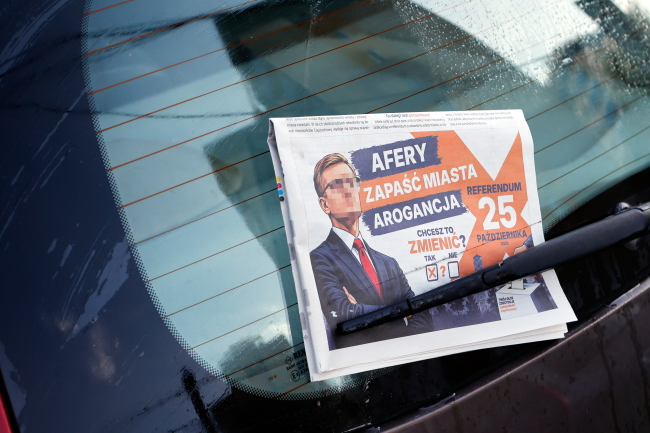


A total of 51,863 people voted in the referendum on recalling Częstochowa Mayor Krzysztof Matyjaszczyk of the Left (Lewica), against a minimum of 46,625 required for it to be valid, a local office of the National Electoral Office announced early Monday. Ninety-seven percent of the votes were cast in favor of removing the mayor from office.
The city council was also recalled. In that vote, 51,844 people took part on Sunday (96.2% backed the recall of the council), against a validity threshold of 48,754 voters.
Under the rules, the thresholds are calculated as 3/5 of the number of people who voted in the election of the mayor (the runoff) and the city council.
– The Łukasz Gibała effect worked in Częstochowa – said Marcin Nocoń, the representative of the referendum initiative, assessing the results.
Until early elections are held, Częstochowa will be run by a commissioner appointed by the prime minister.
– Even before the referendum, we sent a letter to Donald Tusk appealing that it not be anyone from the local power structure, because the city council, in which a coalition of the Left and the Civic Coalition (KO) holds the majority, legitimized the mayor by giving him a vote of confidence despite the corruption allegations – Marcin Nocoń told PAP.
Częstochowa Mayor Krzysztof Matyjaszczyk had been unable to perform his duties for eight months, enter City Hall or contact employees – these are sanctions imposed by prosecutors. His duties were carried out by First Deputy Mayor Zdzisław Wolski.
The Central Anticorruption Bureau (CBA) detained the mayor of Częstochowa on Feb. 25 of this year. Prosecutors charged him with accepting at least PLN 40,000 in exchange for changes to the city budget that allowed a public contract to be carried out to the benefit of one of the businesspeople, and with accepting financial benefits from numerous people totaling no less than PLN 129,000.
More than 20 people have been charged in the same investigation. The first to be detained and arrested, in October 2024, was Bartłomiej S. of KO, deputy marshal of the Silesian Voivodeship – also in connection with his earlier post as a deputy mayor of Częstochowa. Those charged include several businesspeople and two city councilors (from the Left and KO).
Krzysztof Matyjaszczyk says he is the victim of slander. He consented to the publication of his surname. He has not spoken publicly since June.
Pending the resolution of the case, party leaders suspended his membership rights in the New Left (Nowa Lewica).
The initiators of the referendum also accused the mayor of nepotism in City Hall and municipal companies. Among other things, they pointed out that Krzysztof Matyjaszczyk’s partner (now his wife) was made head of the newly created Corporate Governance Office (the acting mayor shut it down a few weeks ago). They also cited Częstochowa’s debt and the lack of key investments, such as a stadium for Raków.
During the pre-referendum campaign, city authorities stressed that Częstochowa’s debt relative to the size of its budget is lower than in many large cities. They focused on showing how Częstochowa has developed not only in this term but also in previous ones.
The referendum committee was formed by a group of city activists and people who ran for the city council on the Third Way (Trzecia Droga) list in the last local elections (the group won no seats).
The most active politician in the referendum campaign was Piotr Strach, a member of parliament and Częstochowa native elected on the Third Way list from the Gliwice district. The initiative was backed by Law and Justice (PiS) – party leader Jarosław Kaczyński spoke on the matter – and by other right-wing groups.
Krzysztof Matyjaszczyk was mayor of Częstochowa for 16 years. He took the post in 2010, in an early election after the right-wing mayor, Tadeusz Wrona, was recalled in a referendum. Matyjaszczyk was reelected mayor of Częstochowa in 2014 (in a runoff), 2018 (in the first round) and 2024 (in a runoff).
He is 52 and trained as a civil engineer at the Częstochowa University of Technology, and he completed postgraduate studies in management. He was active in student organizations and the Federation of Young Social Democrats, and in 1999 joined the Democratic Left Alliance (SLD). He was elected a city councilor in 2002 and 2006. In 2007, he won a seat in the Sejm, Poland’s lower house of parliament, from the left-wing list in an early election. In 2008, he became a member of the parliamentary inquiry committee on pressure on the special services. (PAP)
Prime Minister: On Matyjaszczyk, Częstochowa Residents Held a Similar Opinion to Prosecutors and Security Services
Prime Minister Donald Tusk said he “can only express satisfaction” that, in the case of Krzysztof Matyjaszczyk, who was recalled as mayor of Częstochowa in a referendum, the city’s residents held “a similar opinion to prosecutors and the CBA.”
Częstochowa Mayor Krzysztof Matyjaszczyk (Left) and the city council were recalled in Sunday’s referendum.
As a local office of the National Electoral Office announced early Monday, 51,863 people voted in the referendum, against a minimum of 46,625 required for it to be valid. Ninety-seven percent of the votes were cast in favor of removing the mayor from office.
The city council was also recalled. In that vote, 51,844 people took part on Sunday (96.2% backed the recall of the council), against a validity threshold of 48,754 voters.
Prime Minister Donald Tusk was asked in Hanoi, the capital of Vietnam, where he is on an official visit, whether announcements from the right about further referendums to recall city mayors are, in his view, “an element of” an election “campaign.”
– I hope not, because it would be a pity for local governments – Tusk replied. In his view, Warsaw showed that a referendum “doesn’t have to be an effective tool of destabilization at all.”
As for Matyjaszczyk himself, the prime minister noted that the mayor of Częstochowa had been detained by the CBA as part of a corruption investigation and had been charged even before he was recalled. – He was removed from office at a time when I am prime minister, when my people are handling these matters – meaning those working for our government, for my government – Tusk said.
He said he can “only express satisfaction that the residents of Częstochowa held a similar opinion to prosecutors and the CBA.” – Nobody defended him, including his own party. I wouldn’t draw any generalization from this in any way – the prime minister said.
He assessed that such a referendum is “a grateful tool for showing that something is collapsing, something is falling apart,” and that for PiS and Confederation (Konfederacja), “the worse things are in Poland, the better,” because, as he put it, those parties believe it might then “be easier for them to win elections.”
– I absolutely cannot accept this logic that the worse, the better, and I hope people will also see that it isn’t worth betting on those who are ready to drown and set fire to the house as long as they win elections. I’m not even able to tolerate such guys – he added.
Częstochowa Mayor Krzysztof Matyjaszczyk had been unable to perform his duties for eight months, enter City Hall or contact employees – these are preventive measures imposed by prosecutors. His duties were carried out by First Deputy Mayor Zdzisław Wolski.
The Central Anticorruption Bureau detained the mayor of Częstochowa on Feb. 25 of this year. Prosecutors charged him with accepting at least PLN 40,000 in exchange for changes to the city budget that allowed a public contract to be carried out to the benefit of one of the businesspeople, and with accepting financial benefits from numerous people totaling no less than PLN 129,000.
Krzysztof Matyjaszczyk says he is the victim of slander. He consented to the publication of his surname. He has not spoken publicly since June.
Pending the resolution of the case, party leaders suspended his membership rights in the New Left.
The initiators of the referendum also accused the mayor of nepotism in City Hall and municipal companies. Among other things, they pointed out that Krzysztof Matyjaszczyk’s partner (now his wife) was made head of the newly created Corporate Governance Office (the acting mayor shut it down a few weeks ago). They also cited Częstochowa’s debt and the lack of key investments, such as a stadium for Raków.
During the pre-referendum campaign, city authorities stressed that Częstochowa’s debt relative to the size of its budget is lower than in many large cities. They focused on showing how Częstochowa has developed not only in this term but also in previous ones.
The referendum committee was formed by a group of city activists and people who ran for the city council on the Third Way list in the last local elections (the group won no seats).
A high-profile referendum was held earlier, on May 24, in Kraków. As a result, Aleksander Miszalski (KO) was recalled as mayor of the city. On Oct. 11, Łukasz Gibała won the runoff election for the new mayor.
As recently as July 30, a signature drive began in Warsaw for a petition to hold a referendum on recalling Warsaw Mayor Rafał Trzaskowski and the city council. At the end of September, however, it was announced that the result of the drive fell below the minimum required; as a result, there was no referendum on recalling the city’s authorities. (PAP)
