
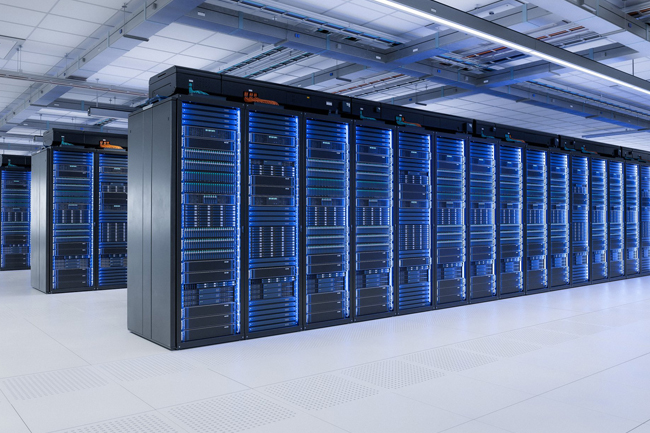


The electricity demand of large-scale data centers in the United States accounted for about 1.8% of total U.S. electricity consumption, Harvard researchers have estimated. The centers were powered mainly by electricity generated from burning fossil fuels: natural gas and coal.
Researchers at the Harvard T.H. Chan School of Public Health calculated how much carbon dioxide the largest so-called hyperscale data centers (HDCs) in the United States emit. They published their findings in the peer-reviewed journal Nature Sustainability.
For the study, the scientists compiled a list of 403 large-scale data centers in the U.S. and used satellite images to assess their size. They then estimated the annual electricity consumption of each facility from May 2024 to April 2025 under various operating scenarios.
Next, they used information from the Environmental Protection Agency about power plants connected to the electric grid in the region where each facility operated. On that basis, they estimated how much carbon dioxide each of the large-scale data centers emits. The concentration of the gas in the atmosphere intensifies global warming.
Depending on how intensively individual HDCs operated, they consumed between 68 and 99 terawatt-hours of electricity. The researchers noted that the higher of those two figures is roughly what states such as Indiana, Michigan or Tennessee consume in a year.
During the period covered by the study, the electricity demand of large-scale data centers accounted for about 1.8% of total electricity consumption in the United States.
The Harvard researchers estimated that this was associated with emissions of about 25.7 million metric tons of CO2. They point out that since the study ended, new data centers have been built and some existing ones have been expanded.
The New York Times noted that emissions at that level are roughly what countries such as Denmark or Bolivia emit in a year.
The study found that about 54% of the electricity powering large-scale data centers came from burning fossil fuels. Natural gas accounted for the largest share (38%), followed by coal (15%). The researchers noted that many of these facilities were concentrated in areas where electricity is generated largely by coal-fired power plants.
The scientists also noted that just four states — Virginia, Oregon, Ohio and Iowa — accounted for more than half of the electricity consumption examined in the study.
They acknowledged that they encountered a number of limitations that prevented them from narrowing the scope of their research. Because of a lack of suitable data, they were unable to analyze all HDCs in the United States. The data available to them also did not allow them to estimate how much energy the centers use solely for artificial intelligence operations and how much for everything else.
In future studies, the researchers plan to estimate the health impacts associated with the operation of HDCs.
“Data centers are growing at an incredible pace, mainly thanks to artificial intelligence, and decisions about where to build them and how to power them are being made right now. But facility-level information on their environmental impact is lacking,” said the study’s lead author, Gianluca Guidi, a doctoral student in the Department of Biostatistics, quoted in an official Harvard University press release. He added that his team’s research will help “fill that gap” in knowledge.
Data centers process information that internet users send to the cloud and run artificial intelligence. Their expansion in the United States was one of the issues in the campaign for special elections to Congress. In recent years, American media have reported on local protests against the construction of additional data centers. Residents’ main concern is that the facilities use large amounts of water. (PAP)
