
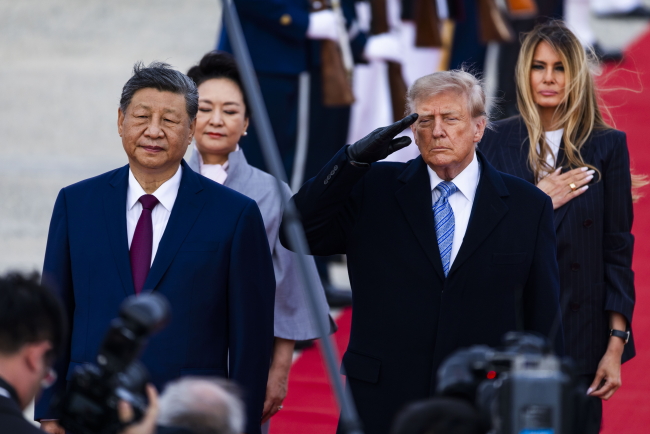


A planned meeting of the leaders of the United States, Russia and China may be political theater, but it also raises fears of a new division of the world into spheres of influence, foreign media say. Donald Trump, Vladimir Putin and Xi Jinping have different goals, and commentators disagree about who stands to gain the most.
The three leaders are to meet Thursday in Shenzhen, China, at the close of the Asia-Pacific Economic Cooperation (APEC) summit. It will be the first such meeting of leaders of the world’s three largest nuclear powers.
Reuters assesses that the chances of a breakthrough are slim because each participant has different goals. Putin hopes to end the war in Ukraine on terms favorable to Moscow. Trump, weakened by the Republicans’ defeat in the congressional elections, is seeking a historic diplomatic success, above all an agreement on nuclear arms control. For Xi, by contrast, the meeting is full of risk, Reuters says.
China does not want to negotiate limits on its nuclear arsenal, which is much smaller than those of the U.S. and Russia. “The Chinese hate this topic,” Edgard Kagan of the Center for Strategic and International Studies told Reuters, explaining that Beijing does not intend to accept the same restrictions as the other two powers.
The Associated Press notes that for Putin, the meeting itself is a success, because it allows him to present Russia as a superpower on par with the U.S. and China. Xi, in turn, can use it to show China’s growing power, though taking part in talks among three major powers runs counter to China’s narrative of defending multilateralism and the interests of smaller countries.
“This shows who matters in the world: us, China and the West,” Russian nationalist ideologue Aleksandr Dugin said this week on Radio Sputnik. In a passage quoted by the AP, he described the meeting as symbolic confirmation of a multipolar world order.
According to Ryan Hass of the Brookings Institution in the U.S., Putin will succeed simply by taking part in the meeting, but the risk for Trump is much greater. He could be outmaneuvered by better-prepared counterparts, and the meeting itself will unsettle American allies.
Jonathan Czin of the Brookings Institution points to another weakness for Trump: time. The American president has just over two years left in office, while Putin and Xi can plan their policies for decades. In the expert’s view, both leaders may decide it is not worth striking deals with Trump if his successor could offer them more.
The Guardian, meanwhile, notes that Putin has long dreamed of repeating the 1945 Yalta Conference, at which the leaders of the U.S., Britain and the USSR decided the postwar order in Europe. According to the newspaper, the Russian president would like the Shenzhen meeting to launch a series of talks in which the major powers would establish a new security order based on spheres of influence rather than liberal values.
The British daily stresses, however, that China does not necessarily share Russia’s ambitions. Beijing wants neither to betray Putin nor to back a settlement on Ukraine without the consent of Europe, with which it is trying to improve relations. It could, however, help Trump end the war with Iran, because it cares about the security of oil transport routes.
“Russia’s war with Ukraine is a strategic mistake by the Russian president. The war with Iran is a strategic mistake by President Trump. China is dealing with the consequences of these conflicts,” said Professor Minghao Zhao of Fudan University, quoted by The Guardian.
Japan’s Nikkei Asia argues that Xi may be the biggest beneficiary of the meeting, even if it produces no agreement. According to the outlet, the Chinese leader wants to maintain good and stable relations with Trump ahead of next year’s Communist Party congress, where he will seek another term.
The joint photo alone, with Xi as host standing between Trump and Putin, could create the impression that the world revolves around the Chinese leader, Nikkei Asia notes. Beijing could also use the meeting to make Trump feel indebted to it. An additional advantage for China would be the chance to act as an intermediary in future talks between Trump and Kim Jong Un.
Meanwhile, Ukraine, Eastern European countries and Taiwan are voicing fears of a “new Yalta.” President Volodymyr Zelenskyy warned that he does not want another division of spheres of influence carried out over the heads of smaller countries.
Not all experts see talks among the major powers as a threat, however. Charles Kupchan of the Council on Foreign Relations argues in The Guardian that the West must learn to work with autocracies because America’s democratic allies no longer dominate the world. He admits that Trump could sacrifice the interests of Ukraine and Taiwan, but considers that unlikely. In his view, such talks are necessary, and Trump deserves credit for initiating them. (PAP)
