Supreme Court’s First President: Tribunal Events Unprecedented, Raise Serious Constitutional Doubts
Supreme Court First President Zbigniew Kapiński expressed “utmost outrage and firm opposition” to actions taken Friday regarding the Constitutional Tribunal. Such events are unprecedented in a democratic state governed by the rule of law, he added, and raise serious doubts about their compliance with the principles of Poland’s constitutional order.
In a statement published on the Supreme Court’s website, Kapiński noted that in Poland the limits of the authorities’ powers are set by the Constitution and statutes, “not by ad hoc political decisions, official orders or a show of force.”
“Silence in the face of actions that undermine the independence of constitutional bodies amounts to consent to practices that threaten the foundations of the constitutional order of the Republic of Poland. Today, the target of such actions is the Constitutional Tribunal,” the First President of the Supreme Court added.
At about 6 p.m. on Friday, a notice appeared on the Constitutional Tribunal’s website regarding an order imposing a break in the duties of Tribunal President Bogdan Święczkowski and Vice President Bartłomiej Sochański.
According to information provided to PAP by Maciej Taborowski, Magdalena Bentkowska and Maciej Berk, Anna Korwin-Piotrowska, as the judge with the longest judicial service, became the person heading the Constitutional Tribunal and issued orders suspending the official duties of Święczkowski and Sochański for a month.
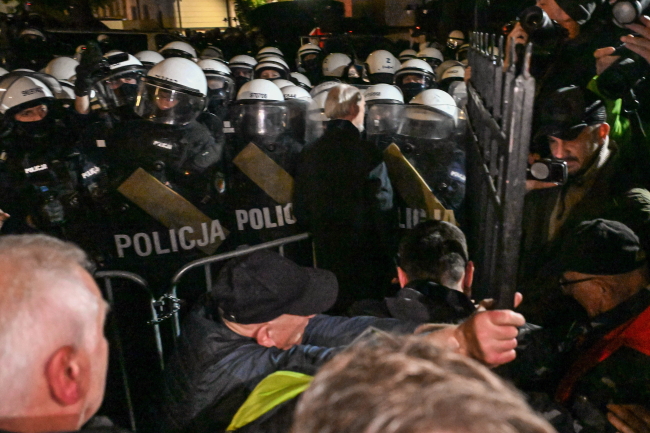
The Warsaw Metropolitan Police Headquarters said officers are carrying out statutory activities at the Constitutional Tribunal’s seat, following information provided by Tribunal Judge Anna Korwin-Piotrowska about possible threats to the lives or health of the Tribunal’s judges and staff. The police are not in the Tribunal building.
In the statement, Kapiński stressed that he received with outrage “in particular” the reports of “the deployment of police officers to its seat, preventing the Tribunal’s vice president from entering the building, and the issuance of a document titled ‘order’ providing for a break in the performance of official duties by the Tribunal’s President and Vice President.”
He emphasized that the events in question “are unprecedented in a democratic state governed by the rule of law and raise serious doubts about their compliance with the fundamental principles of the constitutional order of the Republic of Poland.”
“It is impossible to accept a situation in which disputes over the functioning of a constitutional organ of the state become a pretext for actions leading to its effective paralysis and the stripping of any authority,” Kapiński added.
He stressed that this is a “particularly dangerous” precedent, which in his view strikes “at the foundations of a democratic state governed by the rule of law.”
He added that Article 7 of the Constitution “requires public authorities to act on the basis of and within the limits of the law,” while another provision establishes the principle of the separation and balance of powers, and yet another guarantees the separateness and independence of courts and tribunals from other branches of power.
In his view, it follows that “no public authority may, bypassing statutory procedures, arbitrarily restrict the activity of a constitutional organ of the state or deprive the persons holding office in it of the ability to perform their duties.”
“There is not, and cannot be, consent to a situation in which police officers become a tool for effectively restricting the activity of constitutional bodies, and in which the ability of those holding the highest state offices to perform their duties is decided by the use of force or the threat of it,” the First President of the Supreme Court stressed.
He added that the police “cannot be used as an instrument of pressure on the judiciary and tribunals,” while legal and constitutional disputes should be resolved through the means provided for in the Constitution and statutes.
“In a democratic state governed by the rule of law, the police cannot be a tool for carrying out the political will of those currently in power,” he stressed.
He added that he feels “equally firm opposition” to the fact that Constitutional Tribunal Vice President Bartłomiej Sochański was prevented from entering the Tribunal’s seat, and to Anna Korwin-Piotrowska’s issuance of a document titled “order” on a break in the performance of official duties by the Tribunal’s President and Vice President.
“Giving a particular act the form of an order cannot legalize exceeding or usurping powers, nor lead to circumventing the statutory guarantees of the Constitutional Tribunal’s independence,” Kapiński said.
“As First President of the Supreme Court, I firmly condemn all attempts to subordinate the activity of the state’s constitutional bodies to the use of force or to decisions made outside the statutory legal order,” he stressed.
He noted that Poland is a democratic state governed by the rule of law, in which the limits of public authorities’ powers are set by the Constitution and statutes, “not by ad hoc political decisions, official orders or a show of force.”
“Silence in the face of actions that undermine the independence of constitutional bodies amounts to consent to practices that threaten the foundations of the constitutional order of the Republic of Poland. Today, the target of such actions is the Constitutional Tribunal,” he added.
As he put it, consenting to similar practices would mean “creating a precedent that in the future could be used against any other constitutional organ of the state.”
Earlier on Friday, President Karol Nawrocki, referring to the situation at the Constitutional Tribunal, wrote on X that “at such a moment the President must be in Poland. I am cutting short my flight to Senegal. I am coming back.”
Paweł Szefernaker, head of the President’s Cabinet, said in turn that “right after returning to Poland, President Karol Nawrocki will meet with First President of the Supreme Court Zbigniew Kapiński.” (PAP)