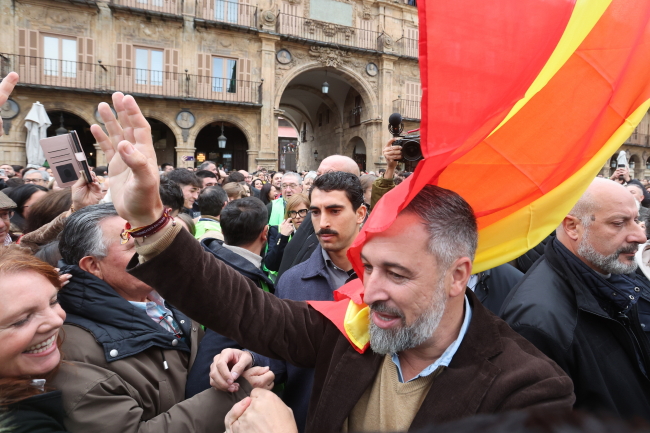


Housing, immigration and the economy are the three main problems facing the country, according to Spaniards. The parliamentary election campaign, now winding down, has centered on those issues, as well as on corruption, which the opposition People’s Party (PP) has emphasized. The election takes place Sunday.
According to the October barometer of the Institute for Sociological Research (CIS), respondents named housing as Spain’s biggest problem. Socialist Prime Minister Pedro Sanchez decided to call the early election amid mass protests in which participants demanded affordable housing.
According to the organization Oxfam Intermón, having a job in Spain does not guarantee relative prosperity if a person does not own a home. The Bank of Spain estimates the country is short 750,000 homes. According to data from Spain’s national statistics office (the equivalent of Poland’s GUS), housing prices rose by almost 85 percent between 2015 and 2025, while wages rose by less than 28 percent.
In this situation, the PP of Alberto Nunez Feijoo, which leads in the polls, and the far-right Vox of Santiago Abascal are betting on liberalizing the housing market and cutting taxes. Vox also wants a “national priority” rule that would give Spaniards precedence in access to social housing. Both parties oppose the current rent-control regulations. In Spain, when a lease is renewed, rent can rise only by a state index that is below inflation.
The Spanish Socialist Workers’ Party (PSOE) of current Prime Minister Pedro Sanchez and the Frente Amplio bloc of left-wing groups favor stronger state intervention in the market and an expansion of the stock of social housing. Frente Amplio also wants a tax on owning multiple properties.
The campaign took place three and a half months after the crisis in Ceuta, a Spanish exclave in North Africa, where more than 70,000 migrants crossed from Morocco. During the campaign, about 11,000 migrants reached Hierro, in the Canary Islands archipelago, an island with about 12,000 residents.
Both the PP and Vox used these events to criticize Sanchez. Feijoo and Abascal describe the influx of migrants as an “invasion” and the migrants themselves as “invaders.” Left-wing leaders argue that these are people entitled to human rights.
Vox calls for a drastic reduction in immigration and for deportations. According to Jose Carlos Diez, a professor of economics at the University of Alcala, quoted by the Reuters agency, investors are worried by these proposals. “This party could enter the government, and its proposals are catastrophic for the economy,” he said.
Since 2022, the number of foreign workers has risen by more than 1.2 million in Spain, a country of nearly 50 million people; about 17 percent of those employed are immigrants, mainly from Latin America. According to the Bank of Spain, between 2022 and 2025 immigrants accounted for about half of GDP growth and more than two-thirds of employment growth. Reuters reported that, according to the firm Oxford Economics, tighter immigration rules could “erode Spain’s economic growth advantage over the eurozone average faster than we currently assume.”
Last year, Spain’s economy grew by 2.6 percent, twice as fast as the eurozone average. Sanchez has boasted of that growth, but Feijoo has replied that “Spaniards don’t live off GDP, but off their paychecks and what is left to them at the end of the month.”
More than half of those surveyed by CIS say the country’s economic situation is bad or very bad; at the same time, about 65 percent of Spaniards rate their own economic situation as good or very good.
The main economic proposals of the PP and Vox are tax cuts, while Frente Amplio wants an additional tax on the wealthiest. PSOE, for its part, wants to invest more in public services.
One of the sharpest issues of the campaign was corruption. The PP accused the prime minister of tolerating irregularities in the government’s circle. Feijoo claimed that “Spain deserves a decent prime minister.”
According to the Socialists, the PP has the least standing of anyone to make such accusations, given the historic corruption scandals associated with that party. Sanchez stressed that “there is no such thing as zero corruption, but there is zero tolerance for corruption,” pointing out that he has not blocked the investigation of scandals in his circle.
Spain’s early parliamentary election takes place this Sunday. Polls show the People’s Party leading, ahead of the Socialist PSOE. Vox is in third place, and in the event of a PP-Vox coalition, the right has a chance of winning a majority in the 350-seat parliament.
Reporting from Madrid: Justyna Wojteczek (PAP)