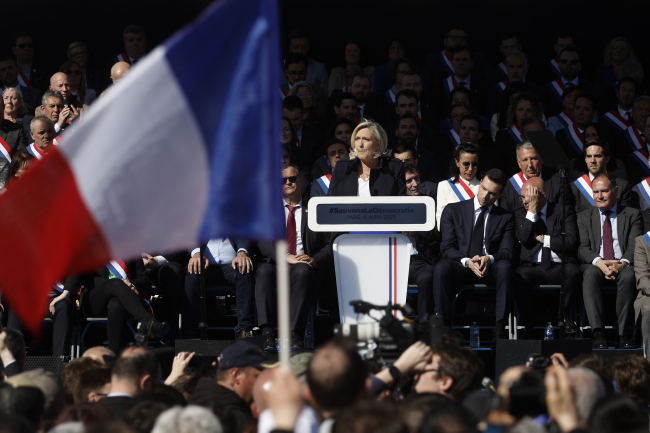


A victory by Marine Le Pen could embolden the right in Poland and change the course of European integration, Paweł Zerka, an expert at the Paris office of the European Council on Foreign Relations, told PAP. He stressed that, contrary to pessimistic scenarios, her presidency would not be “the beginning of the end of the EU.”
Antigovernment protests are held in France every weekend. Marine Le Pen, leader of the National Rally, has led the polls for many weeks ahead of the presidential election scheduled for April next year. PAP asked Paweł Zerka, an economist and international relations expert, about the situation in France and the consequences of a possible Le Pen victory.
PAP: Is France the “sick man of Europe”?
Paweł Zerka: France is in economic trouble. You could say the specter of a debt crisis hangs over the country, but when it comes to the overall picture of its economy, it is far too early to call it the “sick man of Europe.” France is still an advanced, wealthy country whose strengths include modern industries such as aviation, defense and space. The stories about France’s decline are therefore exaggerated.
If we look at indicators that matter to ordinary people, such as life expectancy, it is on average five years longer than in Poland – 83 years compared with 78 here. It is similar with GDP per capita – in France it is 98 percent of the EU average, and in Poland 81 percent. But the country is struggling with a growing public finance crisis. France is therefore at risk of a debt crisis. The treasury has to pay more and more to roll over its debt and to cover the budget deficit.
What’s more, there is strong competition in the bond market, because other EU countries also have to somehow finance additional spending on defense or the energy transition. Interest rates in the markets are higher today than a few years ago. But France is a special case, because the markets have growing doubts about the country’s direction and are demanding more and more for the risk of lending to the government in Paris.
It could happen that, say, next year at one of the French bond auctions, the government in Paris fails to sell its bonds at an acceptable price. Then a pressing question will arise: “How do we pay for current spending?” To avoid a partial default by the state, international financial institutions would probably come to the rescue – in exchange demanding reforms from France.
France managed to avoid such a scenario for a very long time. And that is despite the fact that for 50 years the country has not had a balanced budget, and the budget deficit regularly exceeds 5 percent amid negligible economic growth. French public debt is one of the highest in the EU – after Greece and Italy. What’s more, the authorities have little room to maneuver to increase budget revenue, because France is already the most heavily taxed country in the EU. The gap in the budget therefore cannot be filled by raising taxes.
PAP: Some Polish commentators argue that France remains in a permanent political crisis and therefore risks paralysis. Do you agree with that view?
P.Z.: “Permanent crisis” is too strong a term. Let’s remember that the protests we are seeing were initiated by high school and university students only after the summer vacation. And it is not the case that people are taking to the streets every week because they think the situation in the country is hopeless. The motivation of the high school and university students was the worsening situation in education, deteriorating teaching conditions and a poorly functioning platform that high school students use to apply for the university programs they want.
The young people’s protests were joined by people united by anger over rising living costs. I live in France and I don’t feel that so much, but I know that others may see it differently. I fear, however, that the situation in France could deteriorate dramatically if, for example, a debt crisis occurs. Then living costs would indeed rise. Opinion polls show that the French are pessimists. The annual IPSOS survey “Fractures françaises” (“French Divisions”) was published recently. It shows that they have probably never been so negative about their situation. The traditional French pessimism is turning into “colère,” or rage.
PAP: Does this “rage” increase Marine Le Pen’s electoral chances? Polls show that in May the National Rally leader and the far-left candidate Jean-Luc Mélenchon will advance to the runoff…
P.Z.: Public anger favors them. What’s more, French bonds are increasingly hard to sell precisely because no one knows which direction France will take. Buyers are demanding a higher risk premium. The chances that a stable government that gets the state’s finances in order will appear in Paris anytime soon are slim. Every year the country spends several percent more than it brings into the budget. This cannot go on indefinitely. In the presidential race, only two names really count. The far-right Marine Le Pen has had a clear lead in the polls for months (about 35 percent of French voters are ready to vote for her in the first round – PAP). The radical-left Jean-Luc Mélenchon is second with 17 percent.
It is hard to say who would be “safer” for France and Europe. It seems that French entrepreneurs and employers would vote for the National Rally leader.
PAP: Why?
P.Z.: Marine Le Pen has made an enormous effort to gain credibility in business circles. She has done her homework since the first presidential debate with Macron 10 years ago, when she simply discredited herself. Mélenchon is not doing much to win over those who fear his radicalism. Recently, however, he met with a group of the richest French people, which would have been unthinkable just a few months ago.
PAP: Does Mélenchon have any idea for getting France back on track?
P.Z.: He is calling for writing off part of the French public debt held by the European Central Bank (ECB). Legally this is impossible, because the EU treaties forbid it. But this is not a new idea. A very similar solution was proposed during the pandemic by a group of left-wing intellectuals led by the French economist Thomas Piketty. Unlike them, Mélenchon limits himself to throwing out a slogan and does not explain how it could be done.
PAP: Let’s assume Le Pen wins next year’s election, which is very likely. What would that mean for the EU and Poland? The National Rally leader talks, for example, about reducing France’s contribution to the EU budget…
P.Z.: Le Pen’s room to maneuver will depend on whether she has a majority in parliament and whether she can focus on putting out the debt crisis. Financial markets may take fright at a Le Pen presidency, and as a result France may be unable to find buyers for its bonds. The second scenario assumes that panic sets in even before the election because of the prospect of a radical-left or far-right victory. If a crisis occurred, France, like Portugal in 2011, would have to reach an agreement with the European Stability Mechanism (ESM) in Luxembourg, which would allow the ECB to intervene. The agreement with the ESM would have to include a commitment to reforms.
It is hard to speculate about this today, but we should start to imagine it. Marine Le Pen comes to power, but her hands are tied, because the country must introduce reforms imposed by international institutions. I don’t think she would accept that. Perhaps it would be easier for her if she herself negotiated the terms of the agreement with the ESM. It would be somewhat reminiscent of what happened in Greece. In 2015, Alexis Tsipras went into the election with bombastic left-wing slogans, and after taking power he had to back down and reached an agreement with international institutions and creditors.
PAP: Unlike Greece, France is a pillar of the Union – does that give Paris more room to maneuver?
P.Z.: That’s right. Marine Le Pen could blackmail the EU by threatening to take France out of the eurozone. It seems to me, however, that a crisis would make it much harder for her to carry out her various ideas. Much will depend on whether she has a majority in parliament. President Macron does not have one, which is why France has trouble passing a budget every year. For the past 20 years, presidential and parliamentary elections in France were synchronized. By calling early elections in 2024, Macron broke that synchronization. If the current parliament were to serve out its term, the next election would be held only in 2029.
But if Le Pen becomes president, she can call early elections and try to win a parliamentary majority on the wave of her victory. If the National Rally leader had a government with a majority, headed by her trusted ally Jordan Bardella, and France avoided a debt crisis, Le Pen could focus on delivering her promises. One of them is, for example, a significant cut in France’s contribution to the EU budget for 2028-34, on which negotiations are under way right now.
The problem is that if France makes such a demand, other countries may follow suit. The European mainstream today agrees that the common budget should be larger, in order to finance digitalization and key policies – industrial, climate and defense. The emergence of a heavyweight player who would call for a smaller budget would change the dynamics in the EU. All those right-wing ideas that today pass for wishful thinking, such as a Europe of homelands, a Europe of nations or reducing the EU to a common market, could turn into concrete policy. Let’s remember that Le Pen could count on allies in, for example, Spain, if the Eurosceptic party VOX becomes a coalition partner of the People’s Party.
What’s more, if she became president of France, Giorgia Meloni would probably change her approach to the EU. Contrary to fears, Meloni did not become a problem for Europe after her 2022 election victory; she also faces an election next year. It could also embolden the right in Poland. If Law and Justice (PiS) and Confederation took power in Warsaw, by the end of 2027 we would have three or four large EU countries in favor of switching the tracks in the integration process.
To sum up, the election in France is therefore key to the future of the Union. Of course, the prospect of fundamental changes in the EU caused by a Le Pen victory may mobilize pro-European forces in various EU countries, including Poland. That scenario is also possible. But I do not share the fears that a National Rally victory would be the beginning of the end of the EU. I see no reason why Marine Le Pen would want to kill the European project or to take France out of the EU.
I therefore assume that if those dark scenarios come true, the EU will survive but turn even further to the right on migration or climate change. The fundamental question is how lasting this switching of the tracks of integration will be. Looking at what is happening in the U.S. during Trump’s first and second terms, I conclude that the change in the EU could be just as lasting.
Interview by Jacek Pawlicki (PAP)