


Russia must be engaged from a position of strength, presidential minister Marcin Przydacz said when asked about Thursday’s meeting of the leaders of China, the U.S. and Russia: Xi Jinping, Donald Trump and Vladimir Putin. He stressed that he is not a supporter of “this kind of imagery and meetings.”
The two-day 33rd Asia-Pacific Economic Cooperation (APEC) summit opened Wednesday in Shenzhen, China. It brings together representatives of the region’s 21 economies and is being held in China for the first time in 12 years. On Thursday, shortly after 9 a.m. Polish time, an unprecedented meeting of the leaders of China, Russia and the U.S. got under way. Before the three-way meeting, Xi Jinping held bilateral meetings with Donald Trump and Vladimir Putin; Trump and Putin also held talks.
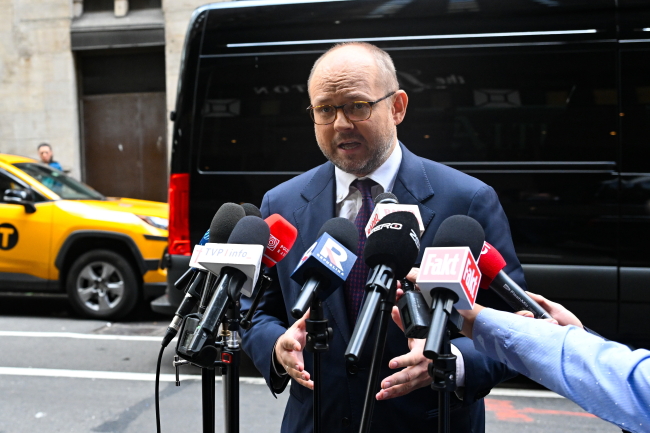
Marcin Przydacz was asked Thursday morning on Polish Radio’s Program Three what to expect from the Xi-Trump-Putin meeting. “Of course, I’m not a supporter of this kind of imagery and meetings,” he said.
In his view, Donald Trump’s statements calling both Xi Jinping and Vladimir Putin his friends are “diplomatic courtesy.” He also said that the measures the American side is using to persuade the Russians to reach a peace agreement with Ukraine “will ultimately not lead to success.”
“You can’t persuade Vladimir Putin to make concessions just by being nice to him and saying he’s my friend, or that he’s this or that. Russia has to be talked to from a position of strength, and the United States of course has that strength,” Przydacz stressed.
He added that, in his opinion, Wednesday’s footage of the Chinese leader greeting the presidents of the U.S. and Russia showed that “Chairman Xi is the main actor.” “The second most important person, essentially the most important guest, is President Trump, and Vladimir Putin is treated completely, completely differently. It is Trump who stands to Xi’s right, so the most important place in these talks is reserved for President Trump. Vladimir Putin, in this case, is treated by Chairman Xi as a ‘junior partner,’ a kind of subcontractor,” said the head of the presidential International Policy Bureau (BPM).
He also noted that any talks about Europe’s security architecture over the heads of Europeans, including over Poland’s head, must “provoke opposition and dissatisfaction.” “So here, too, the Presidential Palace, the president above all, is advocating that Europe, and above all Poland, also be active and that our views be taken into account,” he added. (PAP)
—
Our commentary:
For Washington, Beijing and Moscow, sitting down at one table (for example, on the sidelines of the APEC summit in Shenzhen) is a shared expression of pragmatism, a way to manage global rivalry, discuss nuclear arsenals or crises (such as the war in Iran) and delineate spheres of influence. From the great powers’ perspective, morality and the earlier isolation of Russia take a back seat to immediate interests.
