
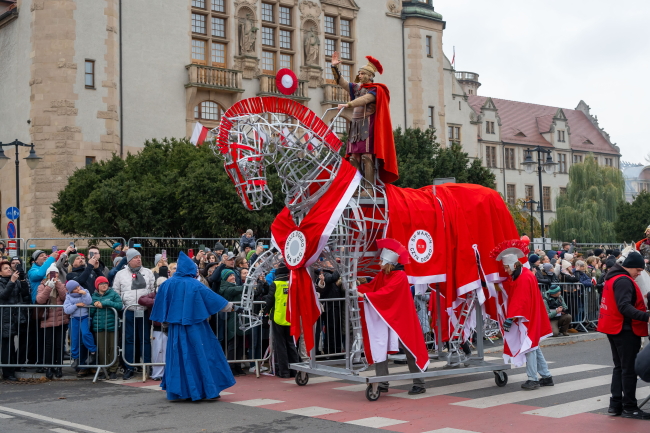


About 10,000 people took part in the climax of the Name Day celebrations for Święty Marcin Street in Poznań, according to police estimates. The event was held under heightened security. Police reported no incidents connected with Wednesday’s events in the capital of the Greater Poland region.
On Nov. 11, in addition to Independence Day, Poznań residents celebrate the name day of one of the city’s main streets, Święty Marcin Street. In recent years the event has drawn tens of thousands of people to downtown Poznań. Since last year, the Name Day celebrations have had the status of a mass event.
Poznań police spokesman Sub-Inspector Łukasz Paterski told PAP that, according to officers’ estimates, about 10,000 people took part in Wednesday’s celebrations at the peak, just after 2 p.m.
The high point of the Święty Marcin Street Name Day was a colorful parade. This year, for the first time, it followed a changed route. The procession, made up of stilt walkers, musicians, artists presenting various contraptions and representatives of Poznań’s Bambers, among others, formed on Wieniawskiego Street. From there it went along Święty Marcin Street, Al. Niepodległości and Składowa and Taborowa streets, and returned to its starting point.
Last year, the organizers of the Name Day celebrations gave up on preparing a parade. The decision was related to the need to meet the requirements of the law on mass events. Earlier editions of the event did not have that status. According to the organizers, this year’s route change was meant to provide enough space for both the parade participants and spectators.
This year, because of the attack in Kraków in which six people died, the Name Day celebrations were secured by substantial police and security forces. The event area in the very center of the city was fenced off with barriers, as was the parade route. People entering the event area were subject to personal checks. Streets leading to the Name Day site were physically blocked, among other things, by vehicles of the city’s public transit company, MPK.
In previous editions, the procession along Święty Marcin Street ended with a symbolic handing of the keys to the city to the street’s patron. This year, that staged ceremony came before the march.
– We are celebrating the Name Day in the shadow of the dramatic events in Kraków. I apologize for the inconvenience regarding certain security measures, but the security of the state is key for us — said Poznań Mayor Jacek Jaśkowiak, before handing the keys to the city to the patron of Święty Marcin Street.
Wednesday’s street Name Day celebrations began at 11 a.m. The center of the event was located near the intersection of Święty Marcin Street and Al. Niepodległości. Visitors were offered, among other things, a St. Martin’s fair and artistic shows. A number of concerts were prepared on the stage at Plac Adama Mickiewicza, including a performance by Katarzyna Nosowska.
In front of the Zamek Culture Center building, a “Charity Street” was set up, a zone for nongovernmental organizations. The Name Day celebrations are held under the slogan “Do Good.”
Elsewhere in downtown Poznań, at Plac Wolności, the regional observances of the National Independence Day began at 11 a.m. Local government officials, members of parliament, veterans and representatives of the uniformed services, among others, took part in the ceremony. A roll call of remembrance was read during the observances. In her address to those gathered, Greater Poland Voivode Agata Sobczyk, the central government’s representative in the region, referred to Saturday’s attack in Kraków.
– Today the thoughts of many of us are not here but in Kraków, in solidarity with the families of the victims, with the injured, in deep sorrow over lives needlessly lost. At the same time, we are full of pride and admiration for the actions of the services and of bystanders — the voivode said, and asked for a minute of silence to honor the victims of the attack.
A letter from Deputy Prime Minister and Defense Minister Władysław Kosiniak-Kamysz was also read during the ceremony. In it, the politician noted that our country is currently facing a historic test. “The decisions we make now will determine Poland’s security in the coming years,” he stressed.
“The history of our nation has repeatedly shown what a high price must be paid for lost freedom. That is why today it is our duty to do everything so that future generations of Poles never again have to shed blood in defense of their homeland,” wrote the head of the Defense Ministry.
The event at Plac Wolności ended with a parade of military units, followed by a picnic prepared by the uniformed services.
The 5th Poznań Independence March also ended after 3 p.m. Its participants walked from Rynek Wildecki to the city center. According to police estimates, about 1,800 people took part in the march. Sub-Insp. Łukasz Paterski told PAP that officers had no objections to the way the demonstration went. “It is very calm,” he said of Wednesday’s events in Poznań. (PAP)
St. Martin’s Croissant Is Poznań’s Sweetest Symbol
The tradition of St. Martin’s croissants, called Poznań’s sweetest symbol, was born in the second half of the 19th century. The traditional treat is an inseparable part of the celebrations of the day of St. Martin, the patron of the city’s main street, which fall on Nov. 11.
The Poznań treats are baked from semi-puff pastry, with a filling of white poppy seeds, vanilla, sugar, nuts, raisins, margarine, orange peel and other additions. Their weight should not exceed 250 grams. Since 2008, the traditionally baked Poznań St. Martin’s croissant has been a “Product with Protected Designation of Origin in the European Union.”
– St. Martin’s croissant is certainly a symbol of the city and our traditional baked good. But of course, this tradition of baking croissants is not just about selling them at this time of year. The tradition really arose with the idea of sharing these croissants, of simply doing good, following St. Martin, and that is why I think the Nov. 11 celebrations are exceptional on the scale of our country — Mateusz Kril of the Poznań Croissant Museum told PAP.
He added that, according to legend, the very shape of the croissants comes from a horseshoe lost by St. Martin’s horse. The saint is a symbol of charity, and the tradition of sharing and eating croissants is recalled and cultivated every year on Nov. 11, on the day of St. Martin, the patron of one of Poznań’s main streets. Interestingly, the street’s name is Święty Marcin, not Świętego Marcina (of St. Martin). That is because it comes from the name of a settlement founded there in the 12th century.
St. Martin was a frequent subject of November sermons in Poznań churches. According to legend, during one of them in 1891, the Rev. Jan Lewicki, pastor of the St. Martin parish, called on the faithful to support those in need, following the example of the saint from Tours. Confectioner Józef Melzer attended the service and, inspired by the clergyman’s words, decided to bake several trays of treats. He later sold them to wealthy residents and gave them away to the poor. In the following years, other Poznań confectioners and bakers joined the initiative.
The history of the croissants is older than the legends, however. Celebrations of St. Martin’s Day go back to the 16th century and are tied to the end of the year’s fieldwork. The oldest mention found of croissants baked for St. Martin’s Day was published on Nov. 10, 1852, in the Gazeta Wielkiego Księstwa Poznańskiego (Gazette of the Grand Duchy of Poznań) by Antoni Pfitzner’s confectionery, founded three years earlier on Wrocławska Street in Poznań: “Tomorrow, Thursday, stuffed croissants, at various prices at A. Pfitzner’s confectionery, Wrocławska Street.” The first recorded use of the name “St. Martin’s Croissant” is a newspaper notice from Nov. 11, 1860.
After the end of World War II, the tradition of baking “St. Martin’s Croissants” was continued by private confectioneries and bakeries in Poznań. From the 1960s, newspapers often reported on the number of croissants eaten by Poznań residents on Nov. 11. Thanks to those sources, it is known today that consumption rose from a dozen or so tons in the early 1960s to about 42.5 tons in 1969. Today, craftsmen belonging to the Guild of Confectioners and Bakers in Poznań sell an average of 250 tons of croissants on St. Martin’s Day, and 500 tons over the whole year, or about 2.5 million pieces.
Although Poznań’s croissants are associated with the figure of the saint, the origin and shape of the pastry are sometimes also linked to a pagan tradition, in which horned oxen were sacrificed to the gods. In leaner years, residents baked a special sacrificial cake for the deities, shaped like horns. According to other sources, the shape of the croissants is connected with King Jan III Sobieski. In 1683, King of Poland Jan III Sobieski captured many Turkish banners bearing a crescent, whose shape was supposedly used as the model for baking the St. Martin’s croissant to commemorate that victory.
The Brothers Grimm are also said to confirm this version. Not in their famous fairy tales, however, but in the “German Dictionary,” where under the entry Kipfel, or croissant, the date of the Battle of Vienna is given, though with the caveat that pastries of this kind were already being baked in the 13th century.
A recipe for St. Martin’s croissants can be found, among other places, on the website of the Guild of Confectioners and Bakers in Poznań.
Every year, the best confectioners in Poznań and Greater Poland receive certificates that allow them to produce authentic St. Martin’s croissants. Nearly 100 producers can boast such certificates. The procedure for obtaining the right to sell the traditional St. Martin’s croissant begins with a bakery or confectionery submitting a formal request for an official inspection to the Regional Inspectorate of Commercial Quality of Agricultural and Food Products (WIJHARS).
After the product is successfully verified as conforming to the specification, the inspectorate issues an official quality certificate – valid for one year after the first inspection and up to three years for subsequent certifications (subject to later unannounced inspections during the validity period). On the basis of that certificate, the Guild of Confectioners and Bakers issues the producer, once a year around November, an annual decorative confirmation that serves as visual proof of the pastry’s authenticity. (PAP)
