
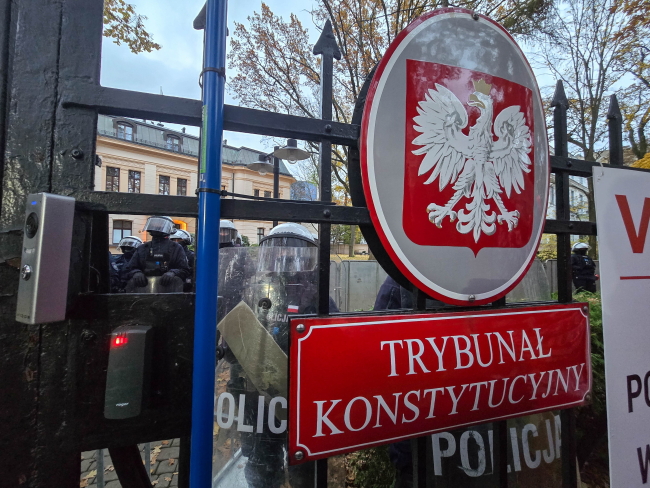


Amending the constitution and choosing a new panel of judges for the Constitutional Tribunal (TK), or reaching a deal on the judges’ oath of office, are among the ideas for ending the dispute over the Tribunal. Politicians from various parties who spoke with PAP offer differing proposals, but they judge the chances of carrying them out to be slim.
Prime Minister Donald Tusk said Tuesday, after a meeting of the National Security Council, that he had offered President Karol Nawrocki a one-on-one meeting later this week to discuss ways to lastingly lower political tension in the country.
He explained that the conversation would cover, among other things, the dispute over the Tribunal. He conceded that “nothing is simple here,” but said the most important thing is “a readiness for a serious conversation about how to prevent political emotions from escalating.” He added that a solution that would satisfy all sides in the conflict over the Tribunal “may be impossible today.”
“But an honest, sincere conversation is certainly possible. Even if we each stick to our positions, perhaps we will find some solution that everyone can accept,” Tusk said, adding that “a few people are working on it.”
Politicians from various parties who spoke with PAP acknowledge that finding a solution to the dispute over the Tribunal that all sides can accept will be very difficult.
The idea that comes up most often is a constitutional reset, meaning changes to the provisions of the constitution that concern the Constitutional Tribunal.
One such reset proposal was prepared by Sen. Kazimierz Ujazdowski of the Trzecia Droga (Third Way) caucus. The Polish People’s Party (PSL) and Poland 2050 support its general outline.
“The constitution is amended, and under that amendment the terms of all judges expire. After a break of several months, the Sejm, the Senate and the president each choose five Tribunal judges, who are sworn in by the bodies that elected them. The publication of rulings by a Tribunal formed in this way is handled by the Tribunal’s president, and the executive branch has no part in it,” Ujazdowski told PAP.
The senator explained that under his proposal all newly elected judges would serve nine-year terms, as they do now. He noted, however, that the terms could be staggered in the first round of appointments, for example by having the Sejm, the lower house of parliament, elect three judges for nine years and two for six. “The details are open to discussion,” Ujazdowski stressed.
In his view, having the president, the Sejm and the Senate choose the judges would be a better solution than requiring a 3/5 majority in the Sejm, because given the current political polarization such a vote could easily be blocked.
Election of Tribunal judges by the Sejm with a 3/5 majority, on the other hand, is the premise of the reset proposal put forward by the Rozwój Plus caucus. Under that plan, the Tribunal would have 12 judges elected to 12-year terms. The exception would be the first panel, in which individual judges’ terms would run from one to 12 years, with their length decided by lottery.
The Rozwój Plus proposal also provides for a significant strengthening of the president’s powers. If the Sejm failed to elect Tribunal judges within 100 days, the head of state could cut short its term.
Konfederacja has also presented its own reset concept. As Deputy Sejm Speaker Krzysztof Bosak explained to PAP, it calls for ending the terms of the current Tribunal judges and electing a new panel by a 3/5 majority for terms of varying length, from one year to nine. Unlike the Rozwój Plus proposal, if judges could not be chosen by the required majority, they would be selected by lottery from among candidates nominated by at least 46 lawmakers.
Election of Tribunal judges by a 3/5 majority, a ban on appointing active politicians to the Tribunal, and a three-year term for the Tribunal’s president were also provided for in a Senate initiative to amend the constitution, submitted at the start of the current term of parliament.
“Today we are in a different situation. The Sejm properly elected judges who have begun their work, but we should always talk about how to lower the level of political emotions in Poland,” Sen. Krzysztof Kwiatkowski (KO), one of the initiators of that proposal, told PAP.
He added that any changes concerning the Tribunal should “serve the interests of citizens, not politicians who feel that a convenient political tool has just been taken away from them.”
The reset is also supported by Paweł Śliz of Poland 2050, who chairs the Sejm’s justice committee. In his view, the start of work at the Tribunal by judges elected during the current Sejm term is not enough to repair the Tribunal. “There will always be someone saying: this Tribunal is poorly staffed, these judges aren’t there, and so on. We have to find a solution that will lead to the Tribunal being respected by everyone,” Śliz said.
Other concepts for fixing the Tribunal that do not involve amending the constitution have also appeared on social media. One calls for all current judges to voluntarily give up their posts after the president first recognizes the five disputed judges as well, followed by the election of a new Tribunal panel by a 3/5 majority. Another envisions the president accepting the oath from all judges elected by the Sejm in exchange for a guarantee that Bogdan Święczkowski remains president of the Tribunal.
According to politicians from various parties, the chances of these proposals being carried out are even smaller than for a constitutional reset, because they would require a basic level of trust between political forces, which is currently lacking.
Zbigniew Kuźmiuk (PiS), commenting on the possibility of a meeting between the president and the prime minister, said the condition for talks should be restoring the earlier legal status at the Tribunal.
“For such a meeting to happen, the usurpers must leave the Tribunal, the police must withdraw, and it seems Donald Tusk is not ready for that. Generally, the legal status from before the assault on the Tribunal must return, and only then can we talk about the Tribunal’s future. But I don’t think there is the will in this Sejm to amend the constitution,” Kuźmiuk said.
Robert Kropiwnicki (KO), for his part, said that a precondition for changing the way Tribunal judges are chosen is recognition of the judges elected during the current term. “Let Karol Nawrocki and PiS say why they do not recognize these judges. Because if they recognize this Tribunal, we can talk about changing the way judges are chosen in the future,” Kropiwnicki told PAP. “In my view, there is no room or need for a reset today, because the dispute over the Tribunal is purely political. Besides, there is no guarantee that a reset would produce better judges, and the current judges could feel aggrieved that they have been judges for half a year or a year and then go into retirement,” he added.
The authors of reset proposals are also skeptical about the chances of carrying one out. “Nobody wants to talk about it realistically,” Krzysztof Bosak admitted. “Of course, we are maintaining our proposal as a project for the future,” he added.
In the Konfederacja politician’s view, the meeting between Donald Tusk and Karol Nawrocki may not take place at all, and the prime minister’s announcement may have been meant only as a distraction. “Based on what I saw yesterday at the National Security Council meeting, I think it was a cynical move,” Bosak said.
“Today it is hard to talk about a reset given the stance of Donald Tusk, who is bringing judges into the Constitutional Tribunal together with the police. In my opinion, the political arrangement must change first before we can talk about a real constitutional reset,” Szymon Szynkowski vel Sęk (Rozwój Plus) told PAP.
“Today the chances of a reset are slim, because we have a situation of two Tribunals lacking a legal basis. Given the degree of political tension, that state of affairs may persist, but I see no other path to rebuilding the Tribunal than a reset,” Ujazdowski said. (PAP)
