
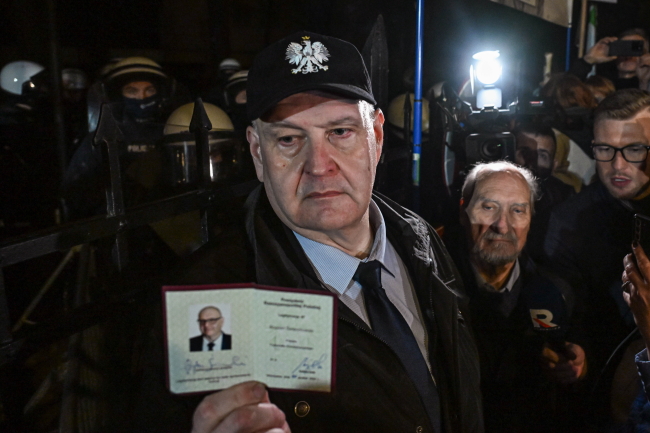


Constitutional Tribunal President Bogdan Święczkowski said that requests to lift his immunity are “embarrassing” and that the charges they contain are “nonsense and slander.” He also said that if the current situation at the Constitutional Tribunal drags on, he will consider renting an office outside the Tribunal’s headquarters.
Prosecutor General Waldemar Żurek announced Tuesday that he had sent the Constitutional Tribunal another request, the sixth so far, to lift Bogdan Święczkowski’s immunity. The requests filed Friday and Tuesday reportedly concern, among other things, the Pegasus and Hermes systems.
Święczkowski was asked about the requests Wednesday evening on Radio ZET. “I’m waiting for more. Żurek will come up with another twenty or so,” he said. Pressed on whether he was taking the prosecutors’ findings too lightly, he said the proceedings against him are “embarrassing.”
Asked about the specific requests to lift his immunity, which concern, among other things, the unauthorized use of materials from operational surveillance and the disclosure of classified information in the Pegasus investigation, Święczkowski replied that, in his view, they are “nonsense and slander” and “political charges.”
Święczkowski argued that courts decided on the use of operational surveillance. He added that the requests sent to the courts did not name a specific system but used the term “terminal device.” “You have to ask the judges why they ordered this operational surveillance,” he said.
According to Święczkowski, Żurek “dreams of putting him in prison.” “So far, thank God, Prime Minister Donald Tusk hasn’t yet done away with the presumption of innocence. A person is considered innocent until he is convicted with a final ruling. And I am an innocent man,” he said.
He also addressed the current situation at the Constitutional Tribunal. He said that if it continues, he will consider renting an office outside the Tribunal’s headquarters. “Perhaps, if they keep paying me a salary, I’ll rent an office in the city myself, with my own money,” he said.
At the same time, he expressed hope that the people currently in the Tribunal’s building will leave, and that, as he put it, the “legal president of the Tribunal” and the “legal vice president of the Tribunal” will return to work.
On Friday evening, representatives of the group chosen as Constitutional Tribunal judges during this term of the Sejm, Poland’s lower house of parliament, announced that Korwin-Piotrowska, as the longest-serving judge, now heads the Constitutional Tribunal and had issued an order for a break in the duties of Tribunal President Bogdan Święczkowski and Vice President Bartłomiej Sochański.
A protest in front of the Tribunal’s headquarters then intensified. Święczkowski appeared there and declared that, as president of the Tribunal, he is the sole administrator of the Tribunal’s building and that “all decisions made by usurpers are unlawful from beginning to end.”
President Nawrocki then cut short a trip to Senegal and returned to Warsaw late Friday night. He met with, among others, First President of the Supreme Court Zbigniew Kapiński, and then went to the Tribunal’s headquarters. Early Saturday, the president issued a statement saying, among other things, that “the constitutional order of the Republic of Poland was violated and a constitutional organ of the state was seized by force.”
On Saturday evening, Prime Minister Tusk delivered a televised address in which he said, among other things, that “the state must be strong and capable of enforcing justice.” Before Tuesday’s Cabinet meeting, Tusk stressed that no one from the executive branch has the right to “enter by force” the Tribunal’s premises, “as the president did,” referring to Nawrocki. (PAP)
