


Members of the European Parliament from Poland’s Law and Justice party (PiS) announced at a news conference at the European Parliament in Brussels that they have sent an open letter to EP President Roberta Metsola in connection with her visit to Poland. “We want the president of the European Parliament to be objective and not allow manipulation by the December 13 coalition,” PiS MEP Anna Zalewska said.
“We are sending her a letter asking her to be a representative of the entire European Parliament and not to remain indifferent to what is happening in Poland,” she added at the conference.
In the letter delivered to the EP president, Zalewska said, the PiS delegation’s lawmakers wrote that the ongoing dispute over the Constitutional Tribunal (TK) has taken a “dramatic turn” and that the actions of the Polish authorities “bear the hallmarks of a coup.”
In the letter, the MEPs asked that Metsola’s official program in Poland include meetings with representatives of the Chancellery of the President of Poland, the Supreme Court, Constitutional Tribunal President Bogdan Święczkowski, the parliamentary opposition and citizens protesting outside the Tribunal’s headquarters. In the authors’ view, omitting these items would mean squandering the values whose observance the European Parliament consistently demands.
MEP Arkadiusz Mularczyk (PiS) criticized at the conference that while PiS was in power in Poland, the European Commission took action concerning the rule of law, and that it is now taking none.
“Poland did not join that kind of Union – a Union of double standards, a Union where those in power decide what is the rule of law and what is not. We do not agree to that,” Mularczyk said.
MEP Bogdan Rzońca (PiS) also spoke at the conference. He said that MEPs from other EU countries are asking him about the course of events in Poland.
“The very fact that they are asking (MEPs from other countries – PAP) means that we will tirelessly explain to them what happened (…) why the Polish prime minister used the police against the Constitutional Tribunal,” Rzońca said.
MEP Marlena Maląg (PiS) also took part in the conference.
“The December 13 coalition went into the elections with the slogan on its lips that everyone is equal before the law (…) Bringing the police into the Constitutional Tribunal (…) is one of the steps meant to lead to a situation in which the Polish state, in reality, will not be democratic,” Maląg (PiS) said.
MEP Maciej Wąsik (PiS) stressed that PiS MEPs in the European Parliament are not demanding that the EU impose financial sanctions on Poland or freeze EU funds. “We only want European public opinion and the political elite of the European Union to have full knowledge of what is happening in Poland,” he said.
MEP Mariusz Kamiński (PiS) said that “an anti-democratic coup is taking place in Poland.” “This is not a matter of political fights between parties – it is a matter of the basic principles of how democratic states function,” he said.
The conflict over the Tribunal escalated last Friday, after representatives of the group elected as TK judges by the current term of the Sejm, Poland’s lower house of parliament, announced that Anna Korwin-Piotrowska had become the person leading the Constitutional Tribunal and had issued an order for a pause in the duties of TK President Bogdan Święczkowski and Vice President Bartłomiej Sochański.
President Karol Nawrocki cut short a trip to Senegal and returned to Warsaw. Among others, he met with First President of the Supreme Court Zbigniew Kapiński, and then went to the TK headquarters. Recordings were published in the media showing President Nawrocki entering the TK building and a dispute between the president’s representatives and the people elected as Tribunal judges by the current Sejm. The sides give differing accounts of how the incident unfolded. Early Saturday, the president issued a statement saying, among other things, that “the constitutional order of the Republic of Poland was violated and a constitutional state body was taken over by force.”
On Saturday evening, Prime Minister Donald Tusk delivered an address in which he said, among other things, that the current Sejm had elected new TK judges, but the president did not take the oath from some of them, and President Święczkowski prevented them from starting work, and that when, after many weeks of waiting, they decided to take up their duties, “they were attacked.” He expressed confidence that the TK would begin to function as it should: independently, with self-governance and in accordance with the constitution.
On Tuesday, the General Assembly of TK Judges, convened by Korwin-Piotrowska, took place. It was attended by eight judges elected by the current term of the Sejm – three from whom President Nawrocki took the oath, and five others who took their oaths in the Sejm using the formula “before the president” and then submitted them in writing to the Chancellery of the President (KPRP). It was determined that 12 people are entitled to take part in the assembly and that the number present met the quorum of at least two-thirds of the total number of Tribunal judges. Among other things, the TK’s budget plan for next year was then adopted.
In connection with what it called the “event” at the TK convened on Tuesday, the Chancellery of the President announced that it would notify prosecutors of the possibility that a crime was committed. KPRP head Zbigniew Bogucki said that only the TK president can convene the General Assembly, and also argued that the required quorum was not present on Tuesday.
On Thursday, Deputy Prime Minister, Defense Minister and leader of the Polish People’s Party (PSL) Władysław Kosiniak-Kamysz announced that his party had prepared a bill amending the Constitution of the Republic of Poland in order to “bring about calm, social peace, the rule of law and the renewal of the Constitutional Tribunal’s credibility.” The PSL proposal provides, among other things, for ending the terms of the current TK judges; a motion with candidates for judges submitted with the president’s consent; and then a one-time selection of a new 15-member TK by the National Assembly with a 3/5 majority, with five judges chosen for terms of 3, 6 and 9 years. Submitting a bill amending the constitution requires collecting the signatures of at least 92 lawmakers.
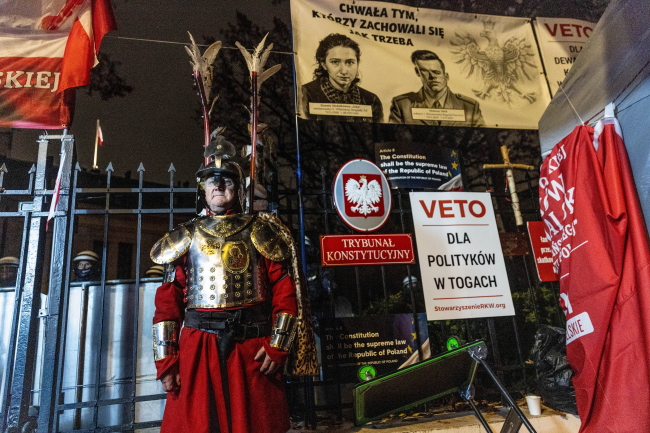
On Thursday, demonstrators were still gathered outside the Tribunal’s headquarters, including people from Gazeta Polska clubs, the “Ruch Obrony Granic” (Border Defense Movement) and “Solidarity.” Opposition politicians, mainly from PiS, join the demonstrators from time to time.
Experts are warning of disinformation in connection with the crisis surrounding the Polish TK. The Disinformation Analysis Center at NASK assessed that there is a high likelihood that further disinformation narratives about these events will appear in the near future. (PAP)
From Brussels, Łukasz Osiński (PAP)
