
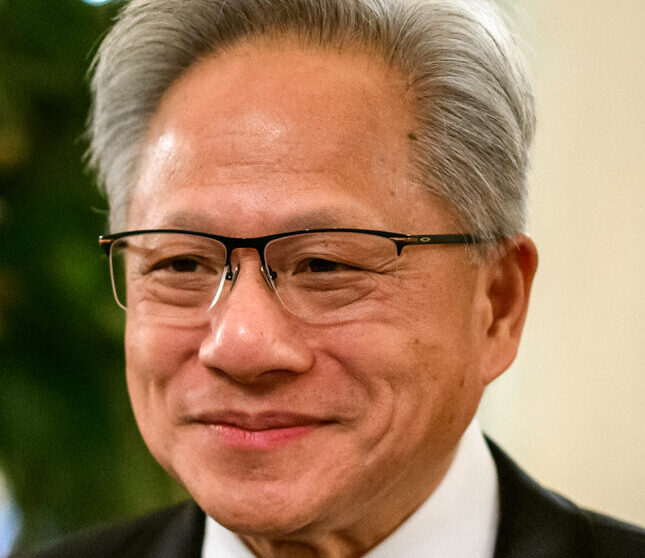


Chinese intelligence services still use tried-and-true honey traps, and in an era of technological rivalry between China and the U.S., Jensen Huang, the head of the company that makes the most advanced integrated circuits, may have fallen into one, says intelligence expert Dr. Przemysław Gasztold.
American billionaire Jensen Huang, CEO of Nvidia, which makes processors used in artificial intelligence, has admitted to an affair with a woman suspected of spying for Beijing.
In a letter published on Nvidia’s website, Huang apologized to his wife, with whom he has been in a relationship for 41 years.
President Donald Trump said Monday that the FBI is investigating Huang’s suspicious relationship. He added that, in his opinion, Huang has no reason to worry and that “everything will end well for him.”
On Sunday, the board of Nvidia, whose processors enable enormous computing power and are used by, among others, Western armed forces, announced that it had launched its own investigation and is examining whether national security was breached.
“Knowing how Chinese services operate, we are probably dealing with a long-term operation aimed at building a bond and using it to obtain information,” Dr. Przemysław Gasztold of the National Security Faculty at the War Studies University and an employee of the Institute of National Remembrance (IPN) told PAP, the Polish Press Agency.
He cautioned that final conclusions must wait for the Americans’ findings, but said the Nvidia chief’s relationship looks like a classic honey trap set by Chinese services, in which the source may have passed on information even unwittingly.
According to Gasztold, this method of gathering information is as old as time; even the biblical Samson fell into a romantic trap. He added that Western services now use the method less often, but Chinese intelligence, which grew out of services modeled on the Soviet ones, still uses it all the time.
The expert recalled, among other cases, that of Christine Fang, a Chinese woman also known in the U.S. as Fang Fang, who was suspected in 2020 of working with China’s Ministry of State Security.
As a student at California State University, Fang managed to get close to American politicians. According to sources cited by the U.S. news site Axios, she had affairs with at least two mayors.
In Gasztold’s view, in the case of the Nvidia chief, the Chinese may have been interested not only in economic information but also in political and military information. Jensen Huang is one of the few businesspeople who can meet with President Trump at any time.
Huang did not reveal the identity of his lover in his open letter. According to The New York Times, she is Alice Huang, a Chinese woman who previously worked for China’s state broadcaster CCTV (the two are not related).
Huang is also the founder of Megaspeed, a Singapore-based data center company.
According to the Times, in 2024, when the acquaintance with the Nvidia chief was already said to be underway, the small and almost unknown Megaspeed became the American giant’s largest customer in Southeast Asia. And as U.S. media have noted, a significant portion of the computing power of Megaspeed’s data centers was rented out to other entities, including the Chinese tech giant Alibaba.
This has raised questions about whether Megaspeed was sending some of the processors it bought to China, which would violate U.S. export rules.
Asked whether the heads of strategic companies, like diplomats, are trained to avoid intelligence threats, Gasztold said that human nature is such that people fall into the traps set by intelligence services anyway.
“Research on the behavior of Western diplomats in communist-era Poland shows that, despite training, they entered into dangerous relationships on their own,” the expert noted.
PAP also asked about the possible consequences of the scandal surrounding the Nvidia chief for the AI market.
Paweł Dobrowolski, director of the analysis office at the Polish Development Fund (Polski Fundusz Rozwoju), believes that for now the matter of the Nvidia CEO’s lover is still just a scandal straight out of the gossip columns.
“If it really involved a threat to U.S. security, the CEO would already be waiting for his trial in handcuffs,” Dobrowolski stressed in an interview with PAP.
In his assessment, financial markets, which usually react quickly to news affecting company valuations, also see no threat portending any serious slump in the market for AI companies.
In his view, the Americans have a different problem, one that a Polish saying captures well: “the Cossack caught a Tatar, and the Tatar has him by the head.” He recalled that the United States wanted to impose restrictions on China’s access to the latest technologies but had to back down, because Beijing threatened to halt exports of rare earth metals to the U.S., which would have paralyzed the American defense industry.
Among the most high-profile and unconventional honey traps set by Chinese services was the story of Bernard Boursicot and the Chinese singer Shi Pei Pu, which took place during the Cold War.
Boursicot, a 20-year-old employee of the French embassy in Beijing, fell in love with Shi Pei Pu, believing that Shi was a woman.
According to French investigators, Shi worked for Chinese services and supplied them with materials from French diplomatic posts in Beijing and Ulaanbaatar, passed along by his lover.
Women have fallen into romantic traps as well. Markus Wolf, the head of East Germany’s Stasi, devised the concept of “Romeo spies”: handsome men who spoke foreign languages and were sent to the West. They were to make women fall in love with them and recruit them, most often secretaries in institutions key to security.
That was the case with Ursel Lorenzen, an assistant to a British director of operations at the NATO General Secretariat, who had access to documents on defense planning.
She was recruited in 1962 in West Germany by an East German agent code-named “Bordeaux.” He began an affair with her and used the relationship to obtain information for East German services.
Anna Gwozdowska (PAP)
