
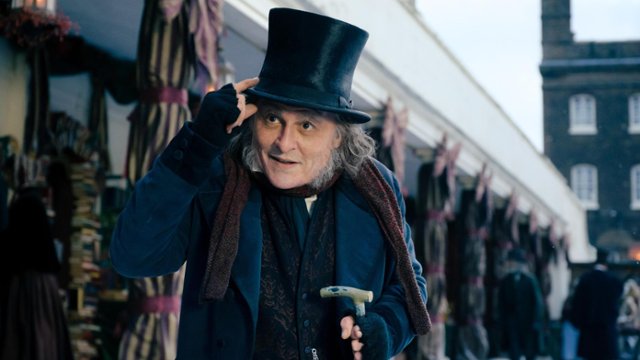


“Ebenezer: A Christmas Carol,” directed by Ti West, a new, dark version of the novel by Charles Dickens, opens in theaters on Friday. Johnny Depp stars in the title role, marking his comeback after a turbulent trial and years of absence from Hollywood productions.
The film’s official tagline reads: “You know the name, but you don’t know the story.” That story dates back to Dec. 19, 1843, the day Charles Dickens’s “A Christmas Carol” was published. The tale of Ebenezer Scrooge, a bitter miser and egoist who values money above all else, quickly became enormously popular, not only in Dickens’s native England but also across the ocean. “That such a book should have found a lasting place in the tender admiration of mankind is the inevitable result of its supreme moral excellence,” The Atlantic wrote in a review in 1868.
“Conceived in a spirit of great human compassion and expressed in a delicately fanciful yet wonderfully simple form of art, it speaks to the uneducated and the educated alike, touches both the humblest and the highest levels of the mind, and meets every criterion of good taste,” the magazine concluded 158 years ago.
Those words seem relevant today as well, which is probably why filmmakers keep returning to “A Christmas Carol.” There are already more than 120 adaptations. “It is a story everyone knows well, so every new adaptation has to look for its own key,” Katarzyna Czajka-Kominiarczuk, a writer and film expert and the author of the blog “Zwierz Popkulturalny,” told PAP, the Polish Press Agency.
“Viewers primarily associate Dickens’s story with a warm, family Christmas tale. But when we go back to the original, we find quite a few elements that let us see it as something much darker, even Gothic, full of ghosts, shadow and mystery. The original was not nearly as polite as many adaptations suggest,” she added.
The first adaptation appeared 125 years ago, in November 1901. It was the short British film “Scrooge, or, Marley’s Ghost,” directed by Walter R. Booth, one of the pioneers of British cinema. On Dec. 23, 1910, an American version titled simply “A Christmas Carol” premiered. In 1938, during Hollywood’s golden era, Edwin L. Marin directed a version of the story with Reginald Owen as Scrooge. It was a more family-friendly take on Dickens’s novel: the ghosts were not meant to frighten viewers in any special way, and talk of poor children was toned down.
In 1951, “Scrooge,” starring Alastair Sim, arrived in theaters. Considered one of the best adaptations ever made, it focuses on the main character and shows what led to his transformation into a hardened, miserly old man. Twenty years later, in 1971, a short animated version of the story appeared, with Alastair Sim again voicing Scrooge.
In 1983, Disney’s “Mickey’s Christmas Carol” was released, and a year later Clive Donner directed “A Christmas Carol” with George C. Scott in the lead role. His performance is still considered one of the best. The film with Patrick Stewart (1999) and Robert Zemeckis’s 2009 version, made with motion-capture technology, were also highly rated. In 1992, “A Christmas Carol” was presented by… the Muppets, with Michael Caine as Ebenezer. In 2022, Netflix also turned to Dickens’s work, releasing an animated musical version on its platform titled “Scrooge: A Christmas Carol.”
The story has also inspired numerous stage productions, radio plays, comic books and musicals. “I think today we look at all versions of ‘A Christmas Carol’ as more personal stories, grounded in the belief that an individual’s transformation, for worse as well as for better, is possible. I suspect many people don’t reflect more deeply on the fact that Dickens was more interested in showing an entire social mechanism than the soul of a single capitalist,” Czajka-Kominiarczuk stressed in her conversation with PAP.
Now, 125 years after the first adaptation, American director and screenwriter Ti West presents his own version. The creator of the “X” trilogy is known mainly for horror and dark cinema, with films such as “The Roost” (2005), “Trigger Man” (2007), “The House of the Devil” (2009), “The Innkeepers” (2011) and “In a Valley of Violence” (2016). The screenplay for his new film was written by Nathaniel Halpern, known for such series as “Legion” and “Tales from the Loop.” The choice of creators suggests that this time we will be dealing with a darker version of Scrooge’s story.
“The focus on the main character is in fact proof that today we read Dickens as a story about a man who went astray, and not as a broader reflection on how class differences work and how unrestrained capitalism takes away our humanistic instincts,” the expert concluded.
Johnny Depp is returning to cinema after years away. His “Ebenezer” is his first major project since 2022 and the high-profile court trial with his ex-wife Amber Heard, after which his career slowed sharply and the previously beloved actor had to face a massive image crisis. Depp was dropped from the “Fantastic Beasts” series, and Disney broke off talks with him about a sixth “Pirates of the Caribbean” film. “Will parents be willing to take their children to see him in a holiday classic, one of the most characteristic stories of redemption in our culture? A large part of Generation Z knows Depp as much from the defamation trial, which was a phenomenon on social media, as from his films. Will those people want to go to the theater?” wonders Brooks Barnes of The New York Times.
“I see a chance for him, especially since Hollywood needs such a comeback. Today there is a shortage of attractive top-tier stars who could guarantee a film’s success around the world,” said Miranda Banks, a professor in the Department of Film, Television and Media at Loyola Marymount University in Los Angeles.
In Katarzyna Czajka-Kominiarczuk’s view, Depp’s return in a big production shows that the well-known star’s exclusion from major projects was temporary. “This film is a clear sign that the ‘banishment’ is ending and that there is a place for him in Hollywood again,” said the creator of “Zwierz Popkulturalny.”
“Does this mean a return to big roles? A lot depends on how audiences react. If the film is popular, the actor won’t have to worry about future castings. Depp chose a role strongly rooted in comedic acting, but also in an actor’s metamorphosis, something he has specialized in during recent years of his career. In that respect, Scrooge is a fairly safe choice,” Czajka-Kominiarczuk concluded.
The style proposed by the filmmakers also seems significant. It is somewhat reminiscent of the film style of Tim Burton, which Depp knows well and in which he thrives. “Depp as Scrooge is a devilishly delightful character; he creates a performance full of life, combining the playful charm and emotional gravity we have missed so much,” said Tom Chatalbash of FilmSpeak.
“With a feel for horror conventions and visual sweep, West gives the film an engrossing, Gothic atmosphere. The director successfully balances the macabre thrills with the emotional message of Dickens’s beloved novel, while enriching Ebenezer’s story with fresh, new layers. It’s wonderful to see Depp on the big screen again,” Variety wrote.
In addition to Depp, the film stars Ian McKellen (Jacob Marley), Daisy Ridley (Clara), Rupert Grint (Bob Cratchit) and Tramell Tillman (the Ghost of Christmas Present).
On Christmas Eve, Ebenezer Scrooge is visited by the ghost of his late partner, Jacob Marley, who suffers bound in a chain forged from the sins of his life. He warns Ebenezer that he is well on his way to repeating Marley’s terrible fate. At first, Scrooge thinks he is imagining things. His skepticism changes after visits from three more spirits, who show the old man his past, present and future from the perspective of Christmas. As a result of these visions, a profound transformation takes place in him.
To recall the film’s tagline, “You know the name, but you don’t know the story,” the question arises: will the version proposed by Ti West help us get to know it better?
Mateusz Wyderka (PAP)