German Liberal Press Puts All Blame for Constitutional Tribunal Crisis on PiS, Nawrocki
In the dispute over Poland’s Constitutional Tribunal, the blame lies unequivocally with the Law and Justice party (PiS) and President Karol Nawrocki, according to Viktoria Grossmann, a columnist for Süddeutsche Zeitung. German law professor Frauke Rostalski, writing in Die Welt, argues that the suspension of the Tribunal’s president was a violation of the constitution.
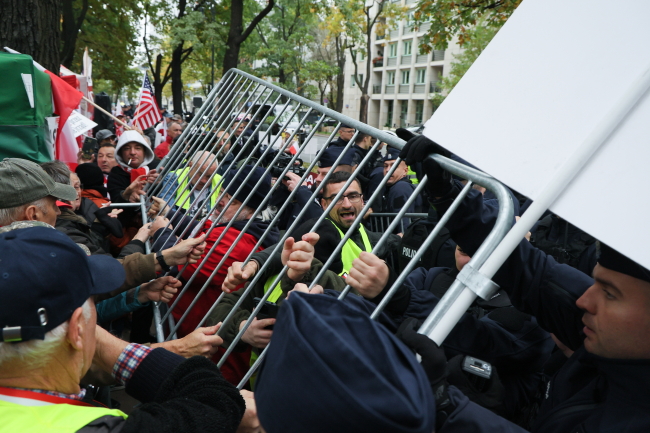
“The events unfolding outside the Constitutional Tribunal, which over the past weekend degenerated into undignified scenes, give the impression of chaos. There is reason to fear that the constitutional crisis will turn into a crisis of trust,” Süddeutsche Zeitung’s Warsaw correspondent Viktoria Grossmann wrote on Wednesday.
She stressed that Donald Tusk’s government is trying to restore the Tribunal’s independence by legal means. Its actions are being closely watched by pro-European and pro-democracy voters. “Tusk has lost some of the trust of this electorate,” Grossmann said. In her view, the reasons are the “deliberate disregard for the right to asylum on the border with Belarus” and the failure to keep the promise to legalize abortion.
In the dispute over the Constitutional Tribunal, there are “unambiguously guilty parties”: the former PiS government and President Karol Nawrocki. “From 2015, the PiS-led government degraded the Tribunal to the role of its own executive body,” the commentator wrote.
Describing the actions of Tusk’s government, SZ notes that it avoided confrontation, waited until the judges’ terms expired and chose their successors in the manner provided by the constitution. Nawrocki and the Tribunal’s president did not allow them to work, so the elected judges entered the Tribunal building after working hours, taking advantage of the president’s absence. The police are protecting the Tribunal and acting defensively, Grossmann stressed.
“Tusk’s coalition is dealing with people who are acting unlawfully. A fresh start in the justice system with them appears to be hopeless,” SZ wrote.
“Stay calm, act consistently and do not use force” – this, in Grossmann’s view, is the stance the government has taken. “That has won it trust. If it does not slide into populism and proposes a way to resolve the dispute, it will emerge from this crisis stronger,” Viktoria Grossmann concludes in Süddeutsche Zeitung.
On Tuesday, the daily Die Welt published on its website an analysis of the situation in Poland by Frauke Rostalski, a professor of criminal law at the University of Cologne. The author set out at length the origins of the dispute over the Tribunal, which goes back to 2015, and asked the question: “Who broke the constitution?”
“The legal suspension of the Tribunal’s previous leadership last Friday rests on shaky foundations (literally, it stands on feet of clay – PAP),” the German legal scholar wrote. In her view, the status of judge Anna Korwin-Piotrowska is “doubtful” because she did not take an oath before the president. Suspending the Tribunal’s president is not within a judge’s powers, Rostalski argues, but should be done by the justice minister or by the president himself. She added: “Korwin-Piotrowska appointed herself, which from a legal standpoint is hardly tenable.”
“There is much to suggest that, at the very least, the action carried out last Friday by a judge who authorized herself amounts to a violation of the constitution,” she wrote. The use of police shows that the action was politically backed by Donald Tusk’s government.
Rostalski stressed that Poland’s Constitutional Tribunal suffers from a lack of recognition, and that the conflict has gone so far that only a “new beginning” may offer a way out.
The crisis at the Constitutional Tribunal began after a notice was posted on the Tribunal’s website on October 30 announcing a break in the duties of Tribunal President Bogdan Święczkowski and Vice President Bartłomiej Sochański. Judge Anna Korwin-Piotrowska, who was elected by the current Sejm, the lower house of parliament, was announced as the person leading the Tribunal’s work.
In response, on the evening of October 30, President Karol Nawrocki cut short a flight to Senegal and arrived at the Tribunal’s headquarters during the night. Media outlets published recordings showing him entering the building and a dispute between the president’s representatives and Tribunal judges elected by the Sejm.
After leaving the Tribunal, Nawrocki announced urgent consultations with parliamentary forces, arguing that the constitutional order had been violated. Prime Minister Donald Tusk, for his part, said that “restoring the rule of law is our duty.”
On Saturday evening, October 31, Prime Minister Donald Tusk gave a televised address in which he said, among other things, that “the attack on the Constitutional Tribunal and its judges is another stage in the process of destroying the rule of law in Poland by PiS and Presidents Andrzej Duda and Karol Nawrocki,” and that “the state must be strong and able to enforce justice.”
President Karol Nawrocki described the situation at the Constitutional Tribunal as a serious constitutional crisis. Prime Minister Donald Tusk proposed that the president meet to lower tensions.
Experts, in connection with the crisis surrounding Poland’s Constitutional Tribunal, are warning of disinformation. NASK’s Disinformation Analysis Center assessed that there is a high likelihood that further disinformation narratives about these events will appear in the near future. (PAP)