
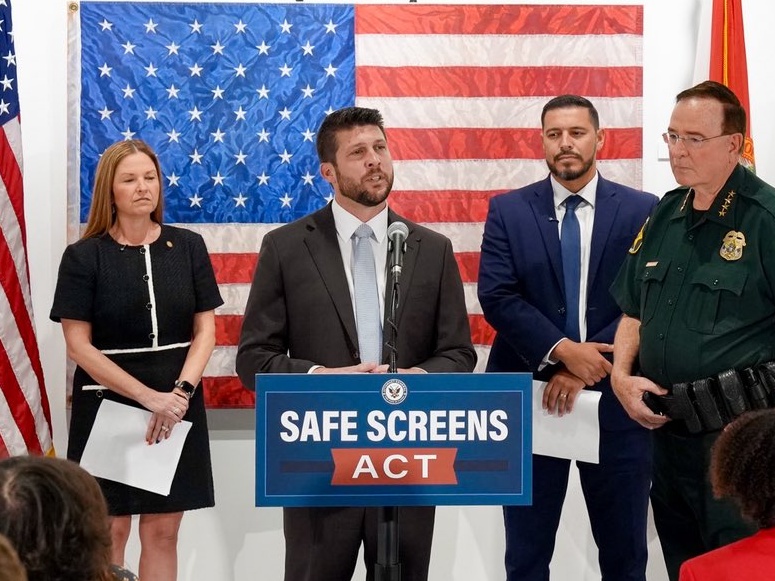


Teenagers in Florida could use social media for a maximum of two hours a day, and access to the apps would be blocked at night and during school hours. That is what the Safe Screens Act would provide, a bill presented Oct. 22 by Florida Attorney General James Uthmeier. The new rules would cover not only social media platforms but also app stores, operating systems and chatbots that use artificial intelligence.
Uthmeier presented the proposal at a press conference at Polk State College in Winter Haven. Under the bill, users ages 14 to 17 could spend no more than two hours a day and 60 hours a month on social media. Platforms would have to introduce a mandatory Quiet Mode that blocks access to accounts between 11 p.m. and 7 a.m. year-round, and from 8 a.m. to 3 p.m. on school days. The bill also provides for breaks after 60 and 90 minutes of app use, as well as reminders displayed every 15 minutes.
The bill would also limit features that, in the view of Florida officials, can encourage excessive use of social media. Autoplay videos, infinite scrolling, likes, comments and reaction counters would be turned off by default on teens’ accounts. Turning them back on would require parental consent. Platforms would also have to regularly offer young users the option of browsing content without algorithmic personalization. Filters that simulate the effects of cosmetic procedures would be banned as well.
Additional requirements would apply to age verification. App stores would have to check users’ ages and obtain parental consent before allowing minors to download or purchase apps. Operators of AI chatbots would be subject to similar obligations, and makers of operating systems would have to provide age-appropriate restrictions at the level of the entire device.
The bill also prohibits recommending teens’ accounts to unfamiliar adults and allowing such people to send messages to young users. Reports of child sexual exploitation would have to be reviewed by a human within 48 hours.
A separate part of the proposed regulations deals strictly with artificial intelligence. Chatbots could not offer minors features that simulate close emotional relationships or suggest that they are real people. Encouraging self-harm, suicide, eating disorders or illegal activity would also be prohibited, as would generating sexual content. AI systems could not discourage children from seeking help from their parents or other trusted adults. Companies that violate the new rules would face penalties of up to $50,000 per violation.
“Parents deserve real control, and companies must design with safety in mind, not addiction,” Uthmeier said. He noted that Florida already passed a law in 2024 prohibiting children under 14 from having accounts on certain social media platforms. For 14- and 15-year-olds, the current law requires parental consent. In October 2026, a federal appeals court lifted an earlier injunction blocking enforcement of those regulations, finding them likely constitutional. That does not mean, however, that the legal dispute is definitively over.
Ed. JŁ
Source: Słoneczne Radio
