
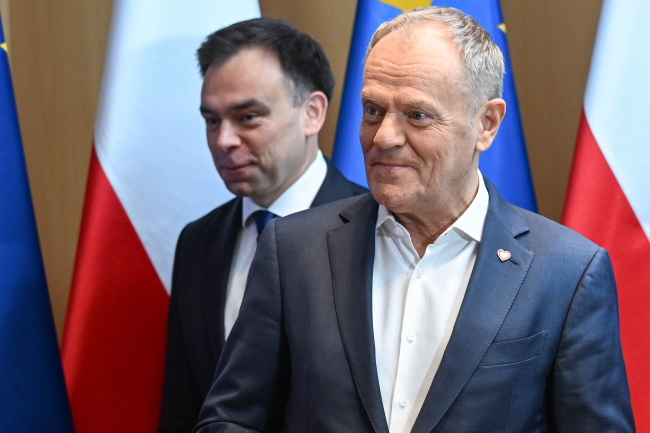


Political scientists Wawrzyniec Konarski and Anna Materska-Sosnowska say appointing Andrzej Domański as deputy prime minister is justified because he runs a critical ministry. Prof. Jacek Zaleśny disagrees, calling the prime minister’s decision a show of force. In his view, it is unlikely that the president would block the promotion.
Prime Minister Donald Tusk said on Tuesday, during a Sejm (the lower house of parliament) debate on a motion to dismiss Finance and Economy Minister Andrzej Domański, that he had signed a request to President Nawrocki to nominate the finance minister as deputy prime minister. The head of government said then that he is “very proud of the finance minister’s work” and that Domański is “truly an outstanding minister, because, balancing on certain risks, he manages to keep the Polish state and the state of its finances secure, while at the same time spending a lot of money where it is needed – for people, for those most in need and on Poland’s security.” Under the constitution, the president appoints members of the government at the prime minister’s request.
PAP asked experts about Prime Minister Tusk’s decision. According to political scientist Dr. Anna Materska-Sosnowska of the University of Warsaw, Domański’s nomination as deputy prime minister is an attempt to strengthen the economic dimension of government policy, as well as the country’s economic security.
Asked to assess Domański’s work as finance minister, she said that, in her view, “given the difficult budget situation we have, he tries, as much as possible, to keep the budget in check.” – The question is whether he also tries, politically, to “ease up” where he should. I have the impression that he is more of a politician who keeps a tight grip on that – Materska-Sosnowska said in an interview with PAP.
Asked whether President Nawrocki might refuse to appoint Domański as deputy prime minister, she said that, in this context, one should ask whether we are focusing on the legal aspect of the matter or on the president’s conduct so far.
– The letter of the law and the spirit of the law are one thing, but the president has already shown many times that he is not someone who abides by the law; he rather tries to bend it or reinterpret it in some way. So I can imagine that, in his political dispute, he will not want to make this appointment – the expert said.
She noted that Domański’s nomination is not a “test” of President Nawrocki, but rather “an attempt to carry out one’s own plans and to show what kind of system we have.” – What the president proposes to do is try to change Poland’s political system without changing the provisions of the Constitution. The prime minister has all the tools, at least on this issue, to oppose him – Materska-Sosnowska said.
Prof. Wawrzyniec Konarski, rector of the Vistula Academy of Finance and Business, told PAP that although he is critical of some of Donald Tusk’s personnel decisions, “in the case of Minister Domański, his opinion coincides with the prime minister’s.” He stressed that the current finance minister manages a critical area of the government’s and the state’s activity, namely public finances, which requires “enormous psychological resilience.”
– What Prime Minister Tusk has done now shows that he can be, although he does not always succeed, an expert at choosing experts. Minister Domański is certainly such a person – the political scientist said. He added that the prime minister needs people who “know how to find their way in this difficult situation, in which the government’s poll ratings are bad.”
Konarski observed that Andrzej Domański is resistant to criticism and is an introverted type of politician with a stoic approach to matters.
– Domański does not try to shout down his critics; he responds calmly to one accusation or another, which may irritate those who are fervent critics even more – he said. He also stated that criticism of Domański from the Presidential Palace or the opposition confirms the minister’s professionalism.
The expert also said that the prime minister’s decision to nominate Domański as deputy prime minister is a certain counterweight to the activity of those ministers who have trouble carrying out their tasks efficiently. – One example is Marcin Kierwiński, who is viewed negatively by many opposition politicians and by a large part of the public – Konarski noted.
Asked whether he could imagine a situation in which Karol Nawrocki refuses to appoint the finance minister as deputy prime minister, Konarski said that “he can absolutely imagine it.” – President Nawrocki is a person who constantly works toward prolonging his five minutes in politics – he said, arguing that Karol Nawrocki is a Caesarist type of politician who “appeals to society” and seeks the position of a “man of providence” for the Polish right.
PAP also asked for an opinion on Domański’s appointment as deputy prime minister from constitutional law expert Prof. Jacek Zaleśny, a member of the New Constitution Council to the President of Poland, which was established in May.
In his view, Tusk’s announcement is above all a “demonstration of political strength.” Jacek Zaleśny stressed that the prime minister decided to appoint the finance minister as deputy prime minister even though, as he put it, “the state of Poland’s public finances is the worst in decades” and “debt in Poland is growing at one of the fastest rates in Europe.”
– It is a show of political strength: at a moment when opposition groups are submitting a motion of no confidence in the finance minister, the prime minister, in opposition to the lawmakers’ move, is requesting a promotion for his collaborator – the constitutional law expert told PAP.
Asked whether a scenario is possible in which President Karol Nawrocki refuses to appoint Domański as deputy prime minister, Prof. Zaleśny noted that “the procedure for making changes in the composition of the Council of Ministers is a procedure described in the constitution,” and that it is a key element of Poland’s system of government, namely the parliamentary-cabinet system.
– The entire political construction of intra-parliamentary and intra-government relations rests on the principle that the political composition of the Council of Ministers is an emanation of the Sejm’s political majority. Consequently, it is the prime minister who decides who personally sits on the Council of Ministers – he said.
Prof. Zaleśny added that in the Polish “constellation of the system of government, the president does not perform a politically decisive function, meaning that the personal composition of the Council of Ministers does not depend, in the Polish system of government, on the president’s will.”
Pressed on whether, in that case, the president cannot refuse to appoint the prime minister’s candidate as deputy prime minister, the constitutional law expert replied: – Yes, as long as the candidate meets the formal requirements, it is the prime minister’s choice whom he wants in his government – Prof. Zaleśny stressed. – Summa summarum, since that is the prime minister’s will, in a parliamentary-cabinet system the prime minister shapes his cabinet – he added.
He noted, however, that since the Polish constitution was adopted in 1997, beginning with the presidency of Aleksander Kwaśniewski, there has been a practice of presidents evaluating the personnel proposals submitted to them, but the final decision is made by the prime minister.
Asked whether the president’s intention might be to obstruct Domański’s nomination, Prof. Zaleśny said he does not think so. – The president, like every other organ of public authority, acts on the basis of Article 7 of the Polish Constitution, that is, on the basis of and within the limits of the law. I see no reason why the president should act in this regard differently than the regulations require – he stressed.
Presidential spokesman Rafał Leśkiewicz was asked on TVN24 on Thursday morning whether the prime minister’s request to give Domański the post of deputy prime minister could end in anything other than the president swearing in the finance minister. – For now, this request has reached the Chancellery of the President. The prime minister and the finance minister, the “sacred cow” of Donald Tusk’s government, are not here; the gentlemen are in India right now, so let’s calmly wait – Leśkiewicz said.
Pressed on what Karol Nawrocki will do with the request, he said that “the president is not succumbing to any pressure, we have a bit of time.” – The president will make a decision, and we will announce it – the presidential spokesman stressed.
Asked whether the president gives himself the right to rule on Prime Minister Tusk’s personnel decisions regarding the composition of the government, Leśkiewicz noted that “the president gives himself the right to evaluate the ministers in Donald Tusk’s government and Minister Domański.”
President Karol Nawrocki said on Wednesday in Kuleszе Kościelne (Podlaskie Province) that one of the most important issues at present is the hole in public finances, because the deficit is worrying regardless of future governments. He added that the crisis is felt especially in local governments, which “are given further tasks without the financial resources to go with them.”
– The problem (of the deficit – PAP) needs to be solved – and certainly not by promoting to deputy prime minister the person responsible for it. It is something that needs to be fixed as soon as possible, because our home is suffering and will keep suffering – the president noted.
On Wednesday morning, at a briefing before leaving for India, Prime Minister Tusk asked not to be asked “how President Nawrocki will behave” regarding Domański’s nomination as deputy prime minister. He added that he would like to be able to say “with a clear conscience and without a moment’s hesitation” that he does not believe the president “openly wants to violate the constitution.”
– We know the provisions of the constitution and who is responsible for what in the Polish state. If he were to decide to violate the constitution on this issue, I would have to say that this scenario would be very risky for Poland, needlessly risky – Tusk stressed.
Iwo Prusiński (PAP)
