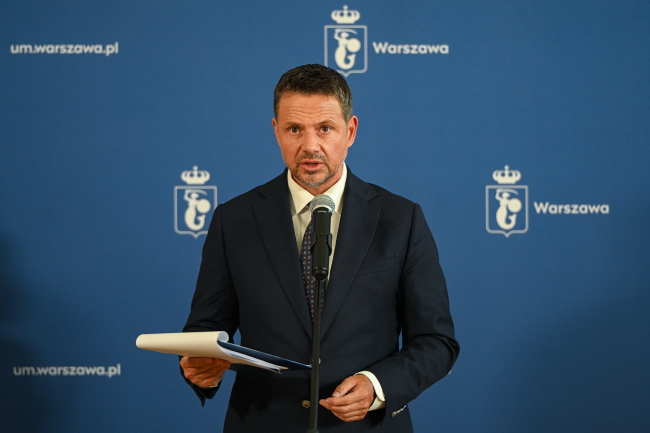


On Thursday, the Warsaw Regional Court granted the organizer’s appeal and overturned the Warsaw mayor’s decision refusing to extend an assembly outside the Constitutional Tribunal, Poland’s top constitutional court.
Judge Anna Bonkowska-Kubek explained the ruling by addressing, among other things, City Hall’s objection to the timing of the notice of extension. She said such a request should be measured against the first day of the planned session, and that this requirement was met.
According to City Hall, the organizer exceeded the 30-day limit set by law when filing the notice. The request was submitted on Nov. 10 for an assembly planned through Jan. 5. “Under the Law on Assemblies, notice of intent to hold an assembly must reach the municipal authority no earlier than 30 days and no later than 6 days before the planned date of the assembly,” City Hall wrote, adding that a notice covering the period after Dec. 10 was therefore premature.
Judge Bonkowska-Kubek also said the Warsaw authorities’ statements “gave no grounds to conclude that holding the assembly violates the rules for organizing assemblies or may endanger the life or health of people or property on a large scale.”
– First of all, it should be noted that, in the court’s view, the mayor of Warsaw did not in any way indicate in the decision that the conditions referred to in Article 14, point 1 of the Law on Assemblies had arisen (concerning, among other things, violations of the freedom of peaceful assembly – PAP). – As for Article 14, point 2 of the law, under that provision the municipal authority issues a decision banning an assembly if holding it may endanger the life or health of people or property on a large scale – the judge said.
She noted that these conditions “must exist on the day the ban is issued, and in light of the Constitutional Tribunal’s case law, these circumstances must be highly probable.”
She stressed that, in the court’s view, these conditions had not been met.
The judge also addressed City Hall’s arguments. It had cited complaints from residents and negative opinions from emergency services, which argued that vehicles could not pass because Aleja Szucha, where the Constitutional Tribunal is located, was blocked.
Judge Bonkowska-Kubek found that City Hall had not verified the residents’ complaints and had not wanted to cooperate with the organizer of the assembly. She also took up the issue of vending at the assembly site.
– It should be noted that the law provides for penalties both for disturbing public order and for trading in prohibited places. However, that cannot be grounds for banning an assembly – she said.
– The court shares the view that the most radical measure, a ban on a demonstration, can be used only in exceptional cases, and the authorities must always first consider actions and decisions that would allow the planned assembly to take place peacefully – she stressed.
She noted that the duty to ensure that an assembly proceeds lawfully rests with the organizer, who stated at the hearing that he is fulfilling it, but also with state bodies, which are to enable citizens to exercise their right to assemble and express their views.
In its refusal, City Hall pointed out that in the notice the organizer had assured that he would not occupy the roadway, only the sidewalk and the bike path. Yet tents and a stage stand there, among other things. To ensure safety, police had in practice been forced to block the entrance to Aleja Szucha, an important thoroughfare linking Śródmieście with Mokotów, as well as the access route to Trasa Łazienkowska.
According to City Hall, blocking the street also hampers the movement of emergency services in the area. In addition, the assembly site is in the immediate vicinity of “facilities subject to special protection.”
“The unlawful decision by Warsaw Mayor Rafał Trzaskowski banning the assembly in front of the Constitutional Tribunal has been overturned by the court,” Law and Justice (PiS) leader Jarosław Kaczyński commented on the X platform, adding that “on Sunday we are meeting at 3 p.m. in front of the Constitutional Tribunal.”
“Freedom of peaceful assembly is our constitutional right, not a privilege granted by the authorities. Rafał Trzaskowski has an obligation to respect it. I am glad the court confirmed that today. We will continue to protest peacefully, whether those in power like it or not,” Piotr Duda, head of the Solidarity trade union, wrote on X.
The protest outside the Constitutional Tribunal’s headquarters is an initiative supported by circles tied to right-wing media and the “Gazeta Polska” Clubs. A stage used by Telewizja Republika, which covers the events and gives protesters a space for public speeches, has been set up on site. The “Gazeta Polska” Clubs are involved in organizing the protest. One of the main figures of the event is Adam Borowski, chairman of the Warsaw “Gazeta Polska” Club, who is also named as the organizer of the assembly. Politicians linked to PiS have been the most active in the protests, and supporters of Konfederacja and Konfederacja Korony Polskiej have also been present at the demonstrations.
The protest originated with the tent camp set up in September 2026 in front of the Tribunal’s headquarters, whose participants declared their opposition to what they described as an attempt by the government to take over the Tribunal by force.
The Warsaw City Hall has 24 hours to appeal Thursday’s decision of the Regional Court to the Court of Appeal. (PAP)