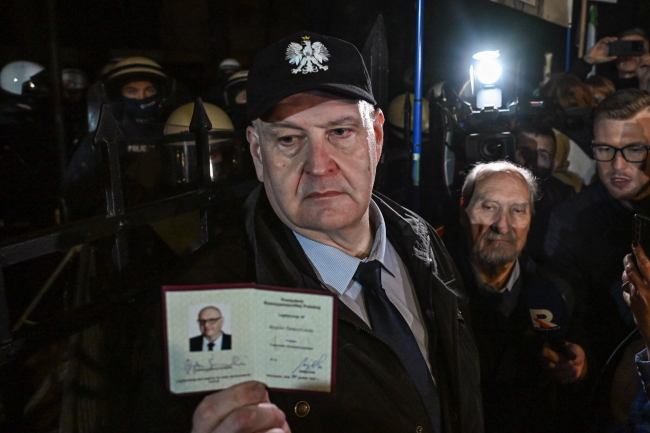


The disciplinary court of the Constitutional Tribunal (TK) has decided to suspend Tribunal President Bogdan Święczkowski from his duties as a Tribunal judge for 12 months, presiding judge Magdalena Bentkowska announced on Thursday. The attorney for the Tribunal president said the ruling “was written in the KPRM,” the Chancellery of the Prime Minister.
In explaining the ruling, Judge Bentkowska said the court believes a one-year suspension of Święczkowski “will allow for the disciplinary proceedings to be conducted.” Those proceedings, she added, “will ultimately decide on the charges made against Judge Bogdan Święczkowski, as a judge of the Constitutional Tribunal and acting president.”
The TK disciplinary court, chaired by Judge Bentkowska and made up of Krystian Markiewicz and Maciej Taborowski, announced its ruling Thursday afternoon. The decision followed a two-day public hearing, held Wednesday and Thursday at the Warsaw Regional Court building.
The TK disciplinary court was reviewing the immediate suspension of TK judge Bogdan Święczkowski’s duties that Anna Korwin-Piotrowska ordered on Oct. 30.
The case continues a chain of events that began late on the evening of Oct. 30. Korwin-Piotrowska then issued orders suspending the official duties of both President Święczkowski and TK Vice President Bartłomiej Sochański. That same day, representatives of the group of people chosen as TK judges by the Sejm, Poland’s lower house of parliament, in its current term said that she, as the longest-serving judge, had become head of the Tribunal.
At the first TK general assembly of judges, which Korwin-Piotrowska called for Nov. 3, the panels of disciplinary courts that would review those suspension orders were chosen by lot, among other business.
The disciplinary court’s hearing on Święczkowski’s suspension was scheduled for Wednesday, but it was interrupted after Michał Skwarzyński, the attorney representing Święczkowski, filed a motion to recuse all three members of the disciplinary court panel. At the start of Thursday’s hearing, Judge Bentkowska said the motion had been considered and rejected by Maciej Berek.
The hearing, resumed on Thursday, lasted nearly three hours. Then, after more than two hours of deliberation, Judge Bentkowska announced that the TK disciplinary court had decided to “suspend TK judge Bogdan Święczkowski from his duties for a period of 12 months.”
Among the reasons for the decision, the presiding judge listed Święczkowski’s refusal to allow Marcin Dziurda, Anna Korwin-Piotrowska, Krystian Markiewicz, Maciej Taborowski and Maciej Berek to rule on cases. They have been TK judges, she said, since the day the Sejm elected them.
In addition, Judge Bentkowska said in her explanation, “the actions of the Constitutional Tribunal judge acting as TK president undisputedly led to the Constitutional Tribunal’s draft budget not being adopted by Oct. 30, 2026, which could have meant that from Jan. 1, 2027, the Tribunal might not have been able to function.” She noted that this mattered not only for the rights of TK employees but also for retired judges.
“Above all, however, it is about ensuring the functioning of a constitutional body that has its constitutional tasks, including, among other things, hearing citizens’ complaints,” Bentkowska stressed. She added that the TK currently has a backlog of about 1,100 cases, some of which have been waiting to be heard for many years.
In explaining Thursday’s decision, Judge Bentkowska also addressed the constitutional right to a court, which, she noted, requires that a case be heard by an independent and impartial court, as well as by a court with proper jurisdiction. “This means assigning adjudicating panels in cases according to objective, previously known rules (…) without manual steering,” she said.
“Bypassing any of the judges elected by the Sejm this year who took an oath before the president means that every panel is a defective panel, and thus violates the constitutional right to have cases heard by the Constitutional Tribunal in a proper composition,” said the presiding judge of the disciplinary court panel. After these words from Judge Bentkowska, attorney Skwarzyński began to clap.
Among the reasons for Thursday’s ruling, Judge Bentkowska also listed “Judge Święczkowski’s allowing politicians to move freely on the premises of the Constitutional Tribunal.”
“Appealing to the Chancellery of the President for an interpretation of the legal act of five judges taking their oath was a breach of the dignity of the office of judge and TK president,” Bentkowska continued. She added that this constitutes a “violation of the principle of the separateness of the judiciary.”
“The Tribunal has a duty to oversee the executive branch, not to settle with it the interpretation of legal provisions concerning the judiciary, including the status of Constitutional Tribunal judges,” she stressed.
Stanisław Piotrowicz, a TK judge chosen by lot for the case, did not take part in Wednesday’s and Thursday’s hearings. Święczkowski was also absent. After the disciplinary court announced its decision, he stated in a post on the platform X that “no one can be a judge in his own case.”
He was referring to the argument that one of the reasons for the suspension, as explained, was his refusal to allow five people elected by the Sejm in this term as TK judges to rule on cases. Among those five, who later took their oaths “before the president” in the Sejm, were Markiewicz and Taborowski.
Bentkowska said that once the written explanation of the decision is delivered, Święczkowski’s attorneys will have the right to appeal. Skwarzyński, after leaving the courtroom, announced he would use “all appeal measures available in this situation.”
Speaking to reporters, the attorney described Thursday’s ruling as “expected.” He added that, in his view, it was “written in the Chancellery of the Prime Minister,” even before the first people were elected as TK judges by the current Sejm in March of this year.
“This is the execution of a certain kind of plan (…) the goal is to pacify all institutions that can exercise any form of oversight over the current government. The Constitutional Tribunal was such an institution; now the TK will rule in the interest of this government,” Skwarzyński said.
Asked whether the appeal measure he would use in this case would be a complaint to the TK, the attorney replied that “under normal conditions (…) yes.” “Will that be the case in this situation? We’ll see, after the written explanation,” attorney Skwarzyński added.
In addition, one of the subsequent TK judges’ assemblies convened by Korwin-Piotrowska last week lifted the immunity of Święczkowski and Sochański in connection with requests the prosecutor general sent at the end of October for consent to hold them criminally liable. These decisions entail a reduction in the two judges’ salaries and, independently of the earlier decisions to remove them from their duties, their suspension.
Święczkowski stated last week that “there was no general assembly and no resolutions were adopted.” “In no way am I suspended,” he stressed.
The TK disciplinary court’s hearing on the order suspending Sochański’s duties was also supposed to take place on Thursday. It was canceled, however, because TK judge Rafał Wojciechowski, a member of the disciplinary court panel assigned to the case, had requested leave.
Ewa Fiutka, Marcin Jabłoński (PAP)