
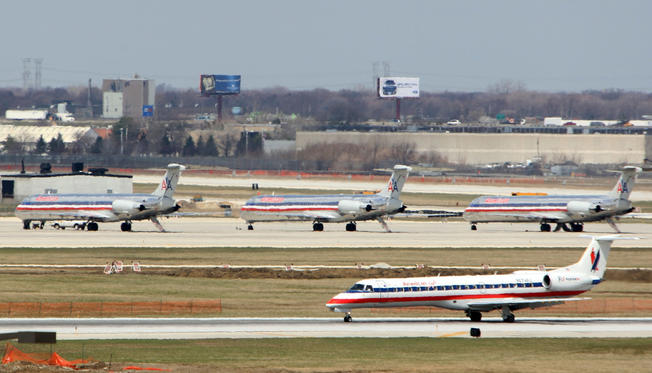


This summer, authorities arrested a Chinese national who, they say, was instructed to photograph aircraft and infrastructure at O’Hare International Airport. Federal investigators noted that he is the latest person charged in a case that they say is evidence of Chinese intelligence activity in the Chicago area.
Weiheng Zeng, a Chinese citizen living in Canada, was arrested in August after, according to federal authorities, surveillance footage captured him photographing aircraft and facilities at Chicago’s largest international airport while he was in a private FedEx parking lot on O’Hare grounds.
Zeng was questioned by U.S. Customs and Border Protection (CBP) and the FBI, and was then charged with making false statements because, investigators said, he changed his account during questioning. Federal authorities said Zeng admitted to FBI investigators that he had been working online with a Chinese contact whose name has not been disclosed. According to the FBI, that person asked him to photograph specific aircraft at O’Hare and to take pictures of the interior of a FedEx facility. He was allegedly to be paid for the photos.
Investigators also said Zeng admitted that he knew his contact worked for Chinese security services and was interested in information about transportation and logistics in the United States, including air freight logistics, bus and rail routes, and timetables, all of it allegedly for “research” purposes. John Cohen, a former head of intelligence at the Department of Homeland Security (DHS), said the case bears the hallmarks of an intelligence operation. “It is completely clear that this was a counterintelligence investigation and that the suspect used operational techniques typical of intelligence agents seeking to obtain sensitive information,” Cohen said.
He added that the case reflects broader Chinese espionage efforts, which have long focused on Illinois because of its large number of universities, research institutions and technology companies. “The fact that Illinois is home to centers conducting advanced research, universities and businesses involved in work on modern technologies makes this state one of the main targets of intelligence activity,” he said. According to Cohen, the aim of these efforts is to obtain confidential information and intellectual property. “All of this serves to obtain companies’ trade secrets, which can then be used to support their own technology development, as well as to obtain state secrets,” he added.
BK
Source: Polski.FM
