
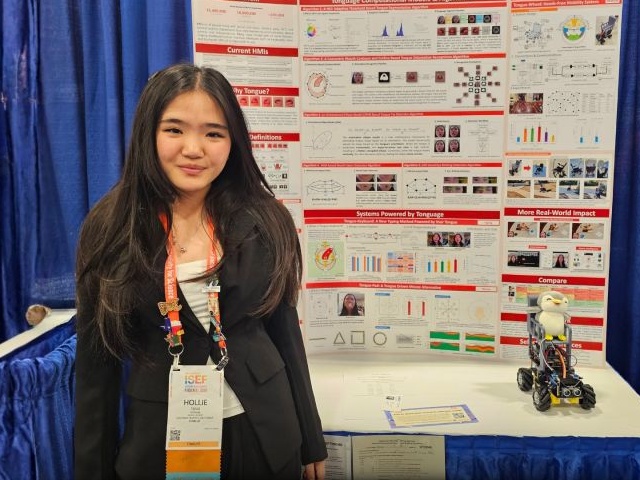


Hollie Tang, a student at Wilson High School in Hacienda Heights, California, has won the top 2026 IEEE Presidents’ Scholarship, worth $10,000, for developing “Tonguage,” a system that lets people with motor disabilities operate computers and other devices using their tongue and eye movements. The project was honored at the Regeneron International Science and Engineering Fair (ISEF), held in May in Phoenix.
The technology Tang created uses computer vision to track the position and movements of the tongue, as well as eye blinks. Tongue movements let the user steer the cursor, while a blink can serve as a mouse click. The system was also designed with electric wheelchairs and robotic arms in mind.
It requires only a standard laptop camera, with no need for specialized sensors attached to the body or implanted under the skin. The solution can also recognize a specific user and ignore the movements of other people in the camera’s field of view, which matters for safety when controlling devices.
Tang initially set out to create an alternative to the traditional keyboard and mouse. After learning about the difficulties faced by people with limited mobility, however, she expanded the project’s uses to other everyday activities, including entertainment.
The student stressed that people with disabilities should also be able to enjoy entertainment freely. She explained that a visit to a rehabilitation center helped her better understand the needs of future users. According to the World Health Organization (WHO), more than 1 billion people, or about 16 percent of the world’s population, live with some form of disability.
“We focus so much on giving people independence in basic tasks that we often overlook things like games,” she told IEEE Spectrum.
Second place and a $600 prize went to Partap Sidhu of Bethpage High School in New York. He developed NeuroGait, a lower-limb exoskeleton controlled by brain signals. The device uses electroencephalography (EEG) and a neural network to recognize the intention to move, then sends commands to a 3D-printed exoskeleton. According to the results presented, the system achieved 95.2 percent accuracy in 500 trials, and it cost only $276 to build.
Third place and $400 were awarded to Calvin Shang Hung of El Cerrito High School in California for a six-legged robot designed to move across unstable terrain, including areas with collapsed buildings.
Editor: JŁ
