
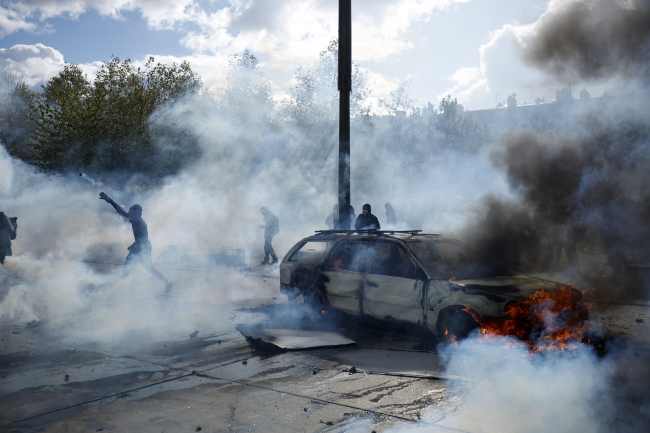


French expert Blanche Leridon told PAP that similar incidents to last Saturday’s occurred in France in earlier years of Emmanuel Macron’s presidency. In her view, Saturday’s events were a buildup of those “episodes of anger and violence” to which the authorities have found no answer.
The expert stressed that the riots overshadowed the demands of the participants in Saturday’s demonstrations.
“Similar events have occurred in France since the beginning of (President Emmanuel) Macron’s first five-year term. What we saw on Saturday was a kind of summary, an accumulation of all those episodes of anger and violence to which the executive branch has been unable to respond over the past 10 years,” said Leridon, research director in France at the Paris-based Institut Montaigne and a specialist in democratic and institutional issues.
The first such episode, she noted, was the “yellow vests” protests, particularly the riots of December 2018, when social discontent erupted over the high cost of living. Shop windows were smashed and barricades were built in city centers. The second such moment was the demonstrations that began after the death of 17-year-old Nahel, who was shot by a police officer in Nanterre. “Back then, the targets were not so much shops as town halls, buses, police stations and mediatheques (multimedia libraries – PAP),” the expert recalled.
She added that the third comparable event was the moments in 2025 and 2026 when “vandals on the streets of Paris overshadowed the images of euphoria after (soccer club) PSG’s victory in the Champions League final.”
“What we saw on Saturday is the culmination, a summing up of all these already familiar phenomena, in proportions and with an (intensity) of violence that stunned the French,” the expert said. She cited in particular “attacks on buildings that embody the Republic, such as the town hall in Limoges.”
“These acts of violence completely overshadowed the demands – though they were legitimate – of high school students and of all those who demonstrated on Saturday against the high cost of living,” the researcher stressed. In her view, the government and political parties should try in the coming days to answer the question of “how to make sure the demands are heard and attempt to respond to them,” without letting them be overshadowed by “random extreme violence.”
“What distinguishes the events of October 17 from the previous episodes I mentioned is the fact that Emmanuel Macron is not, in fact, the target. In six months he will be gone (he will complete his second and final presidential term – PAP),” the expert noted. At the same time, she said, the president is not a “potential savior or mediator” either, nor someone who will “defuse” the situation, “because there is a lack of time, legitimacy, a (government) majority in parliament (– PAP) and a budget.”
According to Leridon, the president’s evening address was met with considerable disappointment because it contained “few new and concrete announcements.”
In the expert’s view, “what is needed now is for all political forces to realize the (gravity of the) situation and call for calm, so that tensions subside and legitimate demands can be presented within the republican order (i.e., with respect for the institutions and values of the Republic – PAP).”
On Saturday, demonstrations across France, called to protest rising living costs, turned into riots. The perpetrators attacked public buildings and looted shops and retail outlets. Clashes with police and attempted looting also took place Sunday in Paris and Marseille; police units were not able to stop the attacks everywhere.
From Paris, Anna Wróbel (PAP)
