
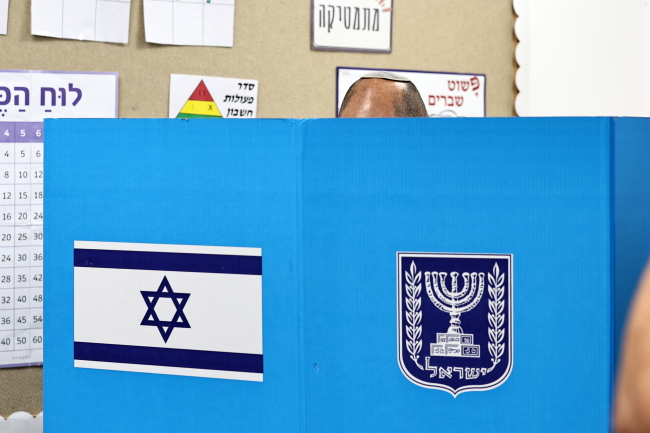


The campaign ahead of Tuesday’s parliamentary election in Israel was fought in a tense atmosphere. The main rivals traded accusations and insults, and also used graphics, including AI-generated fakes.
Two days before the election, Prime Minister Benjamin Netanyahu posted on X an AI-created graphic showing an atomic bomb exploding over Tel Aviv. In the accompanying text, he quoted one of the commentators friendly to him, who warned that if Israelis do not vote for Netanyahu, they face a “second Holocaust.”
It is one element of the campaign by the prime minister and his right-wing Likud party, which is trying to convince Israelis that Netanyahu is the only person capable of ensuring the country’s security.
“Netanyahu is a hysteric. As in every election campaign, he is using the same tactics of lies and intimidation,” responded his main rival, former armed forces chief of staff Gadi Eisenkot, leader of the centrist Straight party.
“Keep him (Netanyahu – PAP) away from social media. He and his entourage have already lost control of themselves under growing pressure,” added Yair Golan, chairman of the left-wing Democrats party.
In the final days before the vote, the temperature of the heated dispute on Israel’s highly polarized political scene rose even further. According to media reports, Netanyahu was said to be considering carrying out military operations before the election that could provoke retaliation from Iran. Chief of the General Staff Lt. Gen. Eyal Zamir was said to have objected to taking such action without additional consultations.
“I have no doubt that Netanyahu wants to drag Israel into military action by force in order to prevent the election. This behavior amounts to treason against the state and its security,” said another opposition leader, Avigdor Liberman, head of the right-wing Our Home Israel party.
Likud member and Defense Minister Israel Katz had warned even earlier that opposition leaders who “constantly attack the prime minister” would bear responsibility for “any future attack on Israel.” “A defense minister blaming political rivals for the enemy’s terrorist attacks before they even happen is absurd and an unprecedented low point in public debate,” Eisenkot replied.
Security issues were among the main themes of the campaign. The opposition criticizes the prime minister, accusing him of failing to react to warning signs ahead of the Oct. 7 Hamas attack, the bloodiest terrorist attack in the country’s history, and of using the war that followed for political purposes.
On Netanyahu’s birthday last week, Eisenkot published a video on X. In the AI-generated clip, a smiling Hamas fighter hiding in a tunnel in the Gaza Strip wonders what else he can wish for the man who “protected him for 20 years.” The video refers to the opposition’s accusations that Netanyahu’s earlier policies allowed Hamas to arm itself and maintain power in the Gaza Strip, which the prime minister firmly denies.
Netanyahu’s wife, Sara, suggested in an interview in early September that Yair Golan might have known in advance about the Hamas attack. Golan, a retired general, went on his own initiative to the site of the invasion shortly after Palestinian fighters began their incursion into the south of the country and helped rescue civilians under attack. The leader of the left-wing party sued the prime minister’s wife for defamation and accused the Netanyahu family of “trying to rewrite history and portray those who rushed into hell to save others as traitors.”
Nearly all Jewish parties running in the election broadly agree on policy toward the Palestinians, including ruling out, at the current stage, the creation of an independent Palestinian state. Most parties have also said they will not enter a coalition with Arab parties, which are also running for parliament. Palestinians make up about 20% of Israel’s citizens.
In its campaign, Likud displayed a series of billboards with photomontages of opposition politicians and the leader of the Arab Raam list, Mansour Abbas, with the caption “Right or Palestine.” The materials suggested that an opposition victory would make the government dependent on Arab politicians.
As early as July, Netanyahu shared on X an AI-created video showing Eisenkot running across a meadow toward a young man, then passing him at the last moment and falling into Abbas’ arms. The video caused outrage in Israel, and many viewers felt the young man resembled Eisenkot’s son Gal, who was killed in the war with Hamas in the Gaza Strip.
Likud denied that the figure in the clip was meant to resemble the opposition leader’s slain son. Eisenkot said he feels “deep contempt for Netanyahu and his entourage.”
According to the latest polls, neither Likud and its allies nor the parties unequivocally opposed to Netanyahu will be able to win a majority in parliament on their own. The election could therefore end in a stalemate lasting weeks, during which attempts would be made to form a new government and, in an extreme case, a new vote would be called.
Even if the election leads to a change of government, no fundamental shift should be expected in Israeli policy toward the Palestinians, Iran and other conflicts in the Middle East, because the positions of Netanyahu’s main rivals on these issues are close to his own. (PAP)
Jerzy Adamiak (PAP)
