
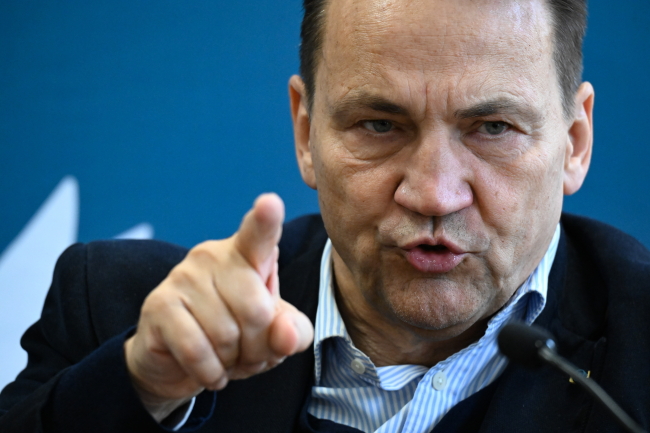


Deputy Prime Minister and Foreign Minister Radosław Sikorski said on CNN that ending Russia’s war against Ukraine requires putting more pressure on the aggressor, not on the victim of aggression. He warned that Russia is waging a hybrid war against Poland and other European countries in which people are dying, and that it is planning to escalate it.
In an interview published Sunday, CNN commentator Fareed Zakaria asked Poland’s top diplomat to respond to “a clear shift in the position of the United States, which openly says that Russia is doing more for peace than Ukraine.”
“In Poland and Europe, we consistently believe that to end the war, more pressure must be put on the aggressor, that is, (Russian leader) Vladimir Putin, and not on the victim of aggression. Of course, any war can be ended by capitulation, but the terms on which it ends matter,” the deputy prime minister said. He added that Ukraine must emerge from the conflict “with borders that can be defended, and as a country to which people will want to return.”
Sikorski was asked whether Europe has a strategy in case the U.S. limits intelligence sharing and access to the Starlink and Starshield systems, and delays sales of weapons that have already been paid for. The foreign minister replied that the U.S. has not financed Ukraine since January of last year, and that it is Europe that covers the entire cost of maintaining the Ukrainian state, supplying weapons to Kyiv and producing arms in Ukraine’s defense industry.
In the foreign minister’s assessment, Europe’s bargaining chips are the Russian central bank assets frozen on its territory, as well as the more than 20 sanctions packages that the European Union has imposed on Russia so far. The most painful blow to Moscow, he stressed, was the loss of the lucrative European oil and gas market.
Sikorski also addressed the speech by Russian Foreign Minister Sergey Lavrov at the U.N. Security Council in September. Lavrov accused European leaders of provoking the war and accused Europe of causing the collapse of the “Anchorage understanding,” which, according to him, was reached in August 2025 during the meeting between U.S. President Donald Trump and Putin in Alaska.
In the Polish foreign minister’s view, Lavrov’s “tirade” against Europe suggests that Russia is beginning to understand that Europe matters, both financially and in the security sphere.
“We demand a say in how this (war – PAP) ends,” he stressed.
The minister noted that Russia is already waging a hybrid war against Europe, that is, one just below the threshold of an open armed invasion, but one that is nonetheless devastating.
“People are dying,” he said. He listed attacks in Poland, the United Kingdom and Germany, arson attacks, and an attempt to blow up a train on a high embankment, which, as he put it, failed to derail only because of the incompetence of the “terrorists.”
In November 2025, acts of sabotage occurred on the Warsaw–Dorohusk rail line. In the town of Mika in Garwolin County, an explosion destroyed a section of track. In another location, near the Gołąb railway station in Puławy County, a train carrying 475 passengers had to brake suddenly because of a damaged line.
Sikorski stressed that in Poland, cyberattacks on hospitals and on the financial and energy systems, as well as drone incursions, occur every day. He recalled that a Russian cruise missile with a warhead exploded in Poland (this refers to a Kh-101 cruise missile that fell and exploded near Tarnawa in Lublin Province at the end of July – PAP). He added that there is also espionage and the mapping of critical infrastructure at sea.
“This is happening constantly. We know which specific unit of the GRU (Russia’s military intelligence – PAP) is behind it, and we know that they are planning an escalation,” the deputy prime minister said.
Asked whether Europe should respond more sharply to Russian provocations, the foreign minister noted that European countries do not use Russia’s methods. “We don’t have departments for wet work, as they call it, meaning assassination squads. We don’t send drones or terrorists to Russia, because we are peaceful democracies,” Sikorski said.
He added that Poland would like to be left alone, along with Ukraine, and for Russia to honor the security guarantees given to Ukraine in the Budapest Memorandum and in the bilateral border treaty.
“We believe that the best response to Russian provocations is more help for Ukraine,” Sikorski concluded.
From Washington, Oskar Górzyński (PAP)
