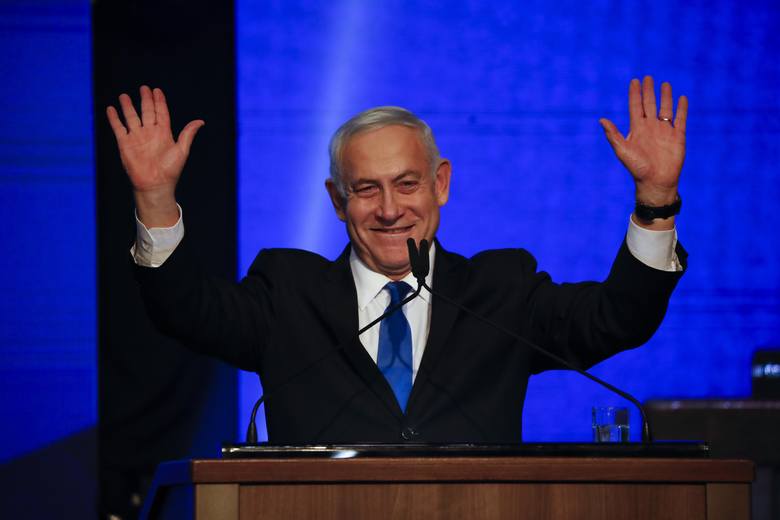
Netanyahu, Israel’s Long-Serving ‘Magician,’ Fights for Another Term Under ICC Warrant
Benjamin Netanyahu is known as “the magician” for his ability to escape crises. He became the first leader of a democratic state to be made subject to an arrest warrant by the International Criminal Court. In Tuesday’s election, Israel’s 77-year-old prime minister will once again fight for his political survival.
For more than three decades, Netanyahu has remained at the center of Israeli politics. His decisions have shaped not only the Middle East but also world politics, making him one of the most influential figures on the international stage.
In November 2024, the International Criminal Court (ICC) in The Hague issued arrest warrants for Netanyahu and former Israeli Defense Minister Yoav Gallant, accusing them of war crimes and crimes against humanity in connection with the war in the Gaza Strip.
The war began after an attack by Hamas and other Palestinian terrorist groups on southern Israel on Oct. 7, 2023. About 1,200 people were killed and 251 were taken hostage.
In response to the attack, Israel launched airstrikes on the Gaza Strip, followed by a ground operation in the territory. According to local authorities, more than 44,000 Palestinians were killed during the first year-plus of the war, and more than 74,000 to date. As a result of the conflict, the Gaza Strip is in ruins, a humanitarian crisis is under way, and most residents have had to flee their homes.
The ICC found there were grounds to believe that both Israeli politicians bear responsibility for “the war crime of starvation as a method of warfare and crimes against humanity of murder, persecution, and other inhumane acts.”
Organizations that have described Israel’s actions in the Gaza Strip as genocide include Amnesty International, Human Rights Watch, Doctors Without Borders (MSF), and the Israeli groups B’Tselem and Physicians for Human Rights–Israel. Since 2024, the International Court of Justice (ICJ) has been handling a case in which South Africa, among others, accuses Israel of genocide.
Netanyahu has consistently rejected all of these accusations. Authorities in Jerusalem stress that in the Gaza Strip they are fighting terrorist groups whose members deliberately hide among civilians and use civilian infrastructure to attack Israel.
Although the ICC arrest warrant did not undermine Netanyahu’s standing in Israel, where war crimes allegations are widely dismissed, the prime minister remains one of the most controversial and polarizing figures in the country’s history.
He provokes extreme emotions: to supporters, he is a charismatic leader and guarantor of security; to opponents, a politician who deepens social divisions and seeks to subordinate state institutions to his control.
In 2019, the Israeli daily Globes, in a critical article, called him “the most powerful, most influential, decisive and charismatic politician in Israel’s history, with the possible exception of David Ben-Gurion and Menachem Begin.”
Netanyahu was born in 1949 in Tel Aviv. His father, Warsaw-born Benzion Netanyahu, was an activist in the nationalist current of Zionism, from whose tradition today’s Israeli right wing descends.
“Bibi” initially grew up in the United States, where his father taught. At 18, he returned to Israel for military service. For five years he served in Sayeret Matkal, an elite special forces unit of the Israeli army. He went to the U.S. to study and, after the outbreak of the Yom Kippur War in 1973, returned home to fight as a reservist.
One of the most important events of his life was the death of his older brother, Jonathan, who in 1976 led the operation to rescue Jewish hostages held at the airport in Entebbe, Uganda. Jonathan, the only Israeli soldier killed in the raid, became a national hero.
Netanyahu then founded an institute in his name devoted to the subject of terrorism and organized international conferences, which brought him recognition and contacts in political circles.
In 1982, he became deputy chief of Israel’s diplomatic mission in Washington, and two years later, ambassador to the United Nations. Thanks to his fluent English, oratorical skills and ease in front of the cameras, he became a recognizable spokesman for Israel in the American media.
After six years, he returned home and became a member of parliament for the right-wing Likud, and in 1993 he took over as party leader. Even then, he showed an ability to control the media narrative. Blackmailed with the threatened release of a compromising recording, he went on television himself and admitted to an extramarital affair.
In the early 1990s, Yitzhak Rabin’s left-wing government held negotiations with the Palestine Liberation Organization that led to the creation of the Palestinian Authority in 1994. The peace process deeply divided Israeli society, and the country was suffering terrorist attacks.
Netanyahu became one of the leading opponents of the agreements, arguing that concessions to the Palestinians threatened Israel’s security. After Rabin was assassinated by a Jewish extremist, Netanyahu won the 1996 election, becoming, at 46, the youngest prime minister in the country’s history and the first born after the establishment of the independent state.
Three years later he lost an election to the left, but in a subsequent right-wing government he served as foreign minister and finance minister. In the latter post, he carried out liberal economic reforms. Free-market policy, along with a hard line toward the Palestinians, became one of the pillars of his political program.
In 2009, he returned as prime minister for 12 years. Removed from power in 2021, he took office again a year and a half later, forming the most right-wing government in Israel’s history.
Over the years, his position on the Palestinians has become increasingly uncompromising. Today, Israel’s prime minister rules out the creation of a Palestinian state.
Since the 1990s, Netanyahu has presented Iran and its nuclear program as one of the greatest threats to Israel. He has made stopping Tehran a priority of his foreign policy and of Israeli military strategy. In 2025, Israel attacked Iranian nuclear facilities, and in 2026 it carried out another offensive together with the U.S., killing the highest-ranking representatives of Iran’s government and military command. Netanyahu argues that these operations destroyed Iran’s nuclear capability, although independent experts question the scale of the destruction.
Under his leadership, Likud has changed from a party with strong internal institutions into a group dominated by one politician. Netanyahu marginalized potential successors and strengthened his control over the party. Since 2009, Likud has not even issued a traditional election platform.
Corruption allegations have accompanied Netanyahu since his first term. In 1999, he was suspected of charging private expenses to the prime minister’s office and accepting gifts, but no charges were brought against him.
In 2020, he became the first sitting Israeli prime minister to stand trial in a criminal case, accused among other things of accepting expensive gifts and offering benefits in exchange for favorable media coverage. He denies the charges, calling the trial a “witch hunt.”
Since the start of his career as prime minister, he has also been accused of trying to bring independent institutions under his control. As early as 1997, his government was at the center of a scandal over the appointment of an attorney general, which was allegedly driven by the political interests of coalition partners.
In recent years, mass protests have been sparked by changes to the judiciary pushed by his government, which critics saw as an attempt to weaken the independence of the justice system and limit checks on power.
From the start of his career, Netanyahu has carefully crafted his public image, controlling the narrative about his private life, his appearance and his appearances before the cameras. He even hides under makeup a scar above his upper lip left from childhood.
The Hamas attack of Oct. 7, 2023, however, undermined one of the most important pillars of Netanyahu’s image. While the war crimes allegations over the Gaza Strip play no significant role in the election campaign, because they are widely rejected in Israel, Netanyahu, who has for years presented himself as the guarantor of the country’s security, must face accusations of negligence that made the largest terrorist attack in its history possible.
Despite calls from the opposition and some victims’ families, among others, the prime minister has not agreed to establish an independent commission of inquiry to examine the matter. Accusations that Netanyahu ignored signals reaching him about preparations for the attack intensified in the final phase of the election campaign.
The way the war with Hamas has been conducted has also stirred controversy in Israel. Netanyahu was criticized above all for rejecting proposals for a ceasefire that could have saved some of the hostages. During mass demonstrations, protesters alleged that for the prime minister, keeping a shaky coalition together mattered more than the hostages’ lives; his far-right allies would not accept any concessions toward Hamas.
Ahead of Tuesday’s election, his future remains uncertain. Polls give Likud a strong position, but the current coalition may not win a majority in the Knesset, Israel’s parliament. Yet “Bibi” has repeatedly proved that he can survive crises that would have meant the end of a career for other politicians.
Jerzy Adamiak, Joanna Baczała (PAP)