
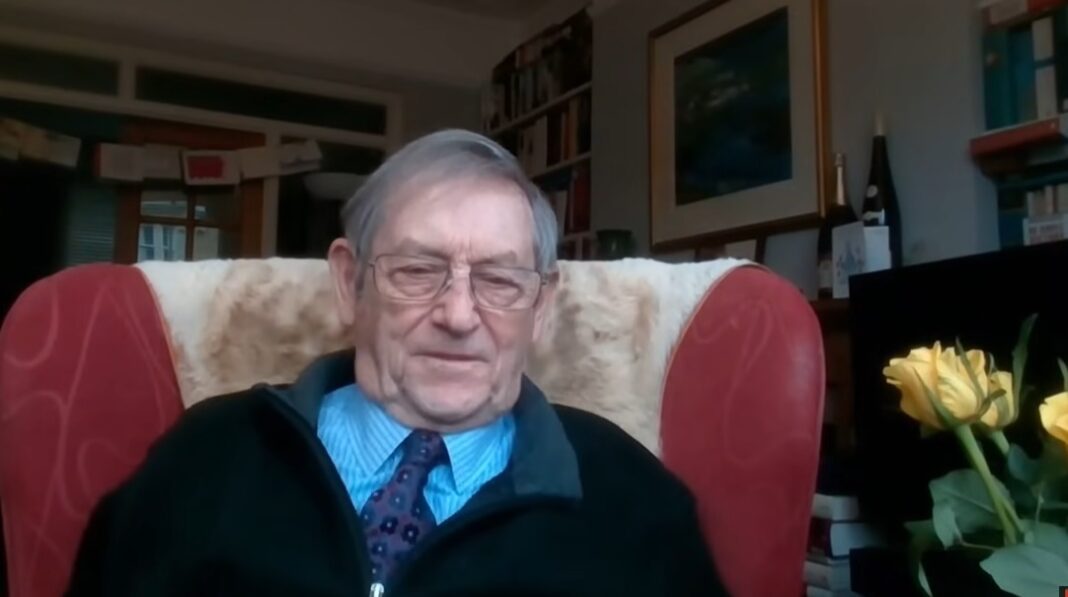


Poland today is a safe and prosperous country that has gained importance in Europe, but its political scene is plagued by problems, British historian Prof. Norman Davies told PAP. In his view, Russia is in decline and will be the next empire after the British to collapse.
PAP: Professor, you have been studying Poland for half a century. Is that long enough to figure it out?
Prof. Norman Davies: I am constantly learning something new about Poland, because it is not a simple country. Polish history is complicated, and the present is full of surprises. But I think I have come to know Poland quite well.
PAP: Since you first came to Kraków in the 1960s, has it changed beyond recognition?
N.D.: Of course. Above all, the entire system has changed radically, from the Polish People’s Republic (PRL) to liberal democracy. All countries change, but Poland has become a country that is better to live in. When I came here more than 50 years ago, it wasn’t cheerful at all…
PAP: If you wrote another chapter of “God’s Playground” covering the last 10 to 15 years, what would you title it?
N.D.: I haven’t thought about it, but that chapter would certainly be about the contrast between the country’s economic and material development and the corruption of its political scene. It looks as though Poland is able to prosper in spite of Polish politics…
PAP: Don’t you think that, compared with other Western countries, Poland is an oasis of calm?
N.D.: That’s true. Poland is a safe country with a relatively high level of prosperity, and, most important, Poles feel good about themselves. You can see it when you walk out onto the street. When I first came to Kraków, I was struck by the poverty. Drunks wandered the streets. People were poorly dressed. I was twenty then. I sat down on a bench in the Planty park and crossed my legs. A woman came up to me and asked if she could buy my shoes…
Today Kraków has developed enormously, especially the districts outside the center. Magnificent tall buildings are going up everywhere. New companies and bank headquarters are opening.
PAP: Is Poland having its moment in the sun?
N.D.: Poles don’t realize how far they have pulled ahead of their neighbors. And not just their neighbors. Take Britain, which is in the doldrums while Poland is flourishing. It is not only about material development but also about prestige, about growing international importance. The world sees that Poland is developing.
PAP: For centuries Poles had a complex about Germans: enemies, occupiers, rich neighbors. Today the German media write that “Poland is the new Germany.” Does that surprise you?
N.D.: (laughs) It’s very good that they see it that way. Do Poles fully realize the significance of the fact that the Polish army is more powerful today than the German one? It probably won’t last long, because Germany is, after all, arming itself, but surely this must have a positive effect on the Polish psyche? Poles feel that they have finally become somebody in Europe.
PAP: What is behind this Polish success? You say that political corruption has not halted economic growth…
N.D.: Fortunately, only certain circles of Polish politics are corrupt. In others, politicians have been able to make good decisions. As for the Polish phenomenon, I don’t entirely understand it myself. Poland certainly owes a great deal to European Union membership and EU funds. Without them, even those magnificent highways would not exist.
PAP: Other EU countries have also received EU support. I’m thinking, for example, of the Czechs and Slovaks, who today envy Poland its infrastructure development.
N.D.: Indeed, it’s extraordinary. Poles are ambitious, and they worked hard for this success. The beginnings were difficult. In the early 1990s the economy was in terrible shape and Poles’ earnings were low. After joining the EU, you managed to achieve solid economic growth and a good standard of living. Not all countries were able to make use of EU membership.
PAP: Would it be an exaggeration to say that Poland is today living through the best period in its more than thousand-year history?
N.D.: It’s hard to say, because over the centuries Poland has changed a great deal. For example, today it is smaller than before World War II, but much wealthier. There has indeed never been such prosperity across the whole of Poland as there is now.
In the 20th century, Poland’s great misfortune was that its two biggest neighbors, Germany and Russia, were both its enemies. Today only Russia is a bad neighbor. And that is enough. Unfortunately, Poles still suffer from the syndrome of the German as eternal enemy. I remember very well the communist propaganda that instilled in Poles the idea that Germany was a hostile country that constantly threatened Poland. They kept repeating this thousand years of “Drang nach Osten.”
All of that left a mark on the Polish psyche. Perhaps that is why some of society finds it hard to understand that there are no more Prussians, no more Nazis, and that Germans are completely different than they once were.
PAP: Although those in power today do not scare Poles with Germany, political relations between the two countries are not the best. Don’t you think that is a paradox?
N.D.: It happens for various reasons. But it seems to me that the main blame lies with the part of the Polish political scene that absolutely must have Germany as an enemy.
PAP: What do you think of the idea of German financial compensation for the war? Law and Justice (PiS) is demanding 1.3 trillion euros.
N.D.: And what about war reparations from Russia? If there are to be reparations, why only from one side?
PAP: We have already talked about Poles’ strengths. What is our greatest weakness?
N.D.: Probably various complexes and fears. Poles fear an imaginary enemy in the German. In a sense that is understandable, because the traumas of war and occupation pass from generation to generation. But it seems to me that Poland is coming out of it. God willing, the war in the East will not end badly. Poles have never before in history known such a long period of peace. Nor have Poles ever had so much hope that their fate has finally changed for the better.
PAP: In a 2006 interview you said that you can have democracy without political culture even on an island of cannibals, because its citizens will democratically vote that cannibalism is the system in force, and after the elections the rulers will eat the opposition. Today those words sound like a prophecy fulfilled. Aren’t we living in a time of political cannibals?
N.D.: It looks that way. After all, Donald Trump is ready to “devour” his opponents. Culture, broadly understood, is something higher than the democratic system. Democracy works only when everyone follows the same rules. We often hear that democracy is the most important thing. I remind you that Hitler was democratically elected.
PAP: Will democracy survive?
N.D.: Not necessarily. In the world everything is temporary. There are no solutions for thousands of years. We will see. For now, some democracies are flourishing and others are collapsing. The balance in Europe has been changed by the countries that joined the EU in 2004, including Poland. Thirty years ago that part of Europe counted for little, and now it has a growing influence on the rest of Europe.
PAP: During a recent lecture at the Gdynia Cultural Center, you said that you were born in an empire that no longer exists, but that Britain has come to terms with its imperial past. What will happen if the empire of Putin’s Russia falls apart?
N.D.: Russia would first have to suffer an enormous defeat in order to understand its history and its position. In Moscow, imperial beliefs still linger that Russians are better than other peoples, in particular Ukrainians, whom they do not consider a nation, only rebels.
Sooner or later Russia will lose. Everyone in Europe is afraid of Putin, but he has not achieved any success. He wanted to rebuild the Soviet empire, but he has managed to rebuild less than 1 percent of it. What is more, it seems to me that the Chinese may move into Russia’s Far East. And that part of Russia is defenseless; Russians are leaving it in droves.
PAP: On Chinese maps, Vladivostok is again called Haishenwai…
N.D.: True, which means “Sea Cucumber Bay.” I think the Chinese have been wondering for quite some time whether to move on Taiwan or on Vladivostok. Taiwan is a tough nut to crack, but the Russian Far East is essentially wide open. And everything China needs is there: oil, various minerals, fresh water resources, timber. The Russians are not able to exploit it, except perhaps for oil. There are no roads, no adequate infrastructure.
If China moves into the Far East, Russia will crack. It will be torn apart by horror, by a sense of unimaginable defeat. After so many years of expansion, the empire will suddenly begin to shrink. Mentally, for many Russians it will be an unbearable state.
We went through this in Britain. As a child I read books saying that we were the largest empire in the world, that what was ours was the best and the biggest, that the highest mountain on Earth was on our territory. It didn’t matter that Mount Everest was not in India but in Nepal. What counted was the belief that it was ours. All of that changed within 20 years. Today we live in a completely different world.
PAP: Which country is the greater threat to the West in the longer term: Russia or China?
N.D.: China. Russia is in decline. It is the next global empire after the British to fall apart. Seventy different nationalities live in the Russian Federation. Putin suppressed the Chechen rebellion, but the next one will come soon. Russia is weak, mired in a war it cannot win. Russia’s Muslim world is growing more populous and stronger, and sooner or later it will raise its head.
Many ask why Putin invaded Ukraine. I think it was also to increase the population of Slavs, whites, Europeans in Russia. He wanted in this way to offset the growth of the Asian population, which is diluting Russia and weakening it from within.
The war in Ukraine will accelerate technological, social and political change, but human nature will not change. Humanity has within it a strange mixture of elements of good, evil and indifference. We live in the age of artificial intelligence and we don’t know where it will take us. I probably won’t live to see how it all ends, but I think that for now we have more problems with AI than benefits.
As a historian, I know that the future is hard to predict. But I deeply believe that Ukraine will win, though it is not yet known how or when. All I know is that it will be a very unexpected ending. I have written many times about the great surprises in history. All significant changes in history are abrupt and come in leaps. I have often compared them to an Alpine avalanche. At first everything seems permanent, frozen forever, but a moment comes when the whole mass of snow and ice crashes down into the valley. It will be the same with the war in Ukraine.
What is more, even if by some miracle Russia wins militarily, Ukraine will survive. No one in the world has done more for that country than Putin, by strengthening Ukrainian national identity. Ukrainians know perfectly well who they are. Society is not as divided as it was before the invasion. So even if a period of imperial repression comes, the future belongs to Ukraine, not to Russia. Sooner or later the empire will fall.
* Norman Davies (born June 8, 1939, in Bolton) is a British-Polish historian, professor emeritus at SSEES-UCL in London, an honorary fellow of St Antony’s College, Oxford, and a member of both the British Academy and the Polish Academy of Learning (Akademia Umiejętności). He has written more than 20 books, chiefly “God’s Playground: A History of Poland,” as well as “White Eagle, Red Star” (1972), “Europe: A History” (1996), “The Isles: A History” (1999), “Microcosm: Portrait of a Central European City” (about Wrocław, 1999), “Rising ’44” (2003) and “Europe at War 1939–1945: No Simple Victory” (2006). The Polish premiere of his latest book, “Historiomachia. Bitwy o historię” (literally, “Historiomachy: Battles Over History”), is scheduled for October 28, 2026.
