
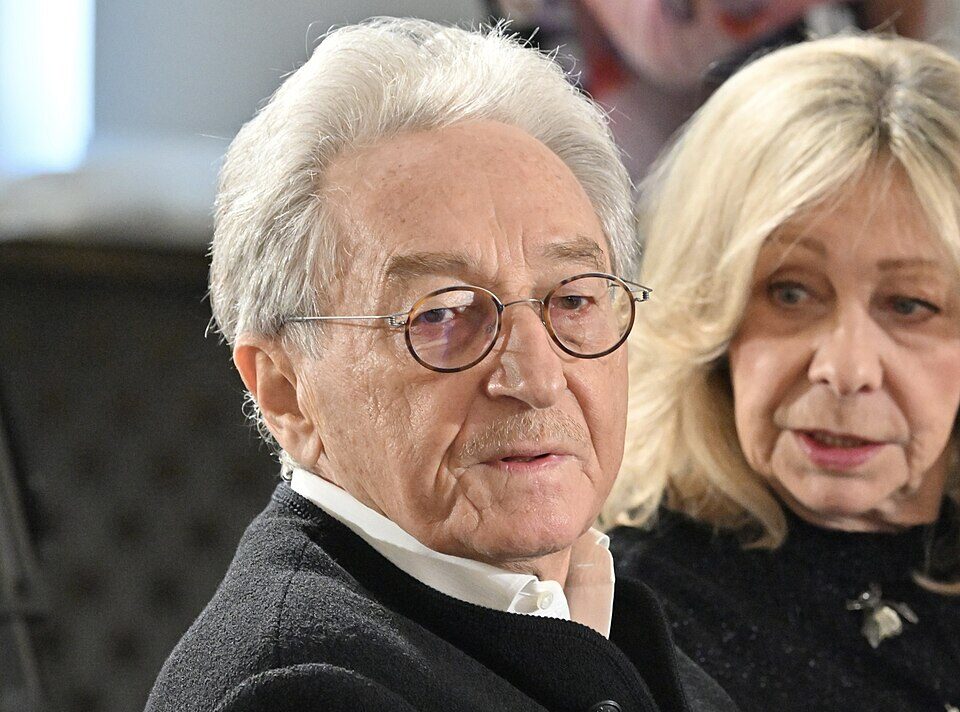


“I don’t want to live to see a world, already dehumanized, in which artificial intelligence creates films with generated actors,” production designer Allan Starski, an Oscar winner for “Schindler’s List,” told PAP. He hopes, however, that art will be saved by the human relationships on which film is built.
PAP: In interviews you have often spoken about the demiurgic power of cinema, meaning that it creates new worlds. Ultimately, they are built from technical drawings, sketches, with hammers and cranes, out of plastics, cardboard, wood and so on. And now artificial intelligence is arriving… What do you think about AI that can develop the concept of a film, a design, even a digitally generated interior?
A.S.: First let me talk about my task as a production designer, which is to build the backdrop of the whole story, both for the actor and for the viewer. In this work the beginning is very important: the conversation with the director and the cinematographer, the search for the concept of the film and the choice of the era. Then how that era will be interpreted in the film: in what range of colors, what we want to accentuate, which elements of the design will help the viewer better understand the story we are telling. How to create interiors in which actors feel comfortable enough that they know they are in a particular era, whether it’s the protagonist’s apartment, a pub or a parliament.
I say all this because, whether I design everything myself or use the appropriate computer programs, I am still carrying out a particular artistic vision. I often used various technological aids, including computer “fill-ins,” because they made my work much easier, for example by completing the background or hiding some modern elements.
PAP: And now AI has hugely expanded these possibilities…
A.S.: I think it’s natural that I now have concerns about artificial intelligence, because it is something completely different from the technological support we have had until now. The broad discussion comes down to how far we can control artificial intelligence now and how far we will be able to control it in the future. That also applies to design. If it turns out that artificial intelligence can design better than, say, a production designer, then of course that will be a great loss for me and my fellow artists: cinematographers, directors. After all, we are the ones who create the concept of a film. That vision terrifies me. Although it seems to me that as long as there are actors, as long as there is a story about real characters, and a director who, when hiring an actor, knows that the actor has already built relationships with the audience or can build those emotional relationships, all of this is still manageable.
Above all, I hope human relationships won’t disappear. Film is what you said, but film, especially the kind we watch in a cinema, in a dark room, also doesn’t exist without a fantastic relationship between its creators and an audience fascinated by what it sees on the screen, an audience that follows the story and creates its own historical and emotional references. That is the essence of true film art. I don’t want to live to see the time of an already dehumanized world, in which a completely artificially generated story, with generated actors, is enough for the viewer. If the audience also comes to love those generated actors, that will be a catastrophe not only for film but for our civilization in general.
It’s a world that, all in all, doesn’t… It’s not that it doesn’t interest me, because of course it does, but it isn’t a world in which I would want to still do something, to create.
PAP: You grew up among screenplays and you worked with outstanding screenwriters. What do you think about screenplays written by artificial intelligence? And about what Olga Tokarczuk said, which caused such a storm in Poland, that she asks artificial intelligence questions to analyze a problem?
A.S.: It seems to me that writing a novel or creating an artistic film is still something more than AI’s answers to high school final exam (matura) assignments. Such essays are, in a way, repetitive; they follow a well-worn pattern. Good artists don’t stick to such patterns; every artist has their own artistic stamp. After Tokarczuk’s statement, some terrible, nasty scandal broke out. But anyone can put their text through a certain test! Films are tested, too. American ones, for example, are shown to a closed audience, which judges which ending is better. The same question can be put to artificial intelligence.
If I write a text and want to polish it, I can ask artificial intelligence how it would do it. I can read its proposal and throw it in the trash. What matters, though, is that in creative work the first thought comes from the artist.
PAP: You said “the artist’s stamp.” What is your “artistic stamp”?
A.S.: I think it is production design that people believe in, that doesn’t get in the way either during the screening or in the judgment of the film. When you go to a film with good production design and good costumes, you don’t have to wonder whether you are in the right era. Good production design is one in which the era is interpreted with, overall, historical fidelity, but also in an artistically interesting way. After all, behind every set stands a specific choice of elements that fit our story and the director’s temperament, and at the same time the set is also my story and my point of view. And I should stress that the essence of my work is collaboration with the director. I work with different directors, with different temperaments, historical knowledge and sensibilities. Some interpret history; others expect a very exact re-creation of it.
My colleagues in the production design world know that when they go to see one of my films, they will understand that the design serves a purpose, that it works together with the drama of the film, with the directors, with the actors, with the light. Oh, that is very important to me, the light! When I build a set, I immediately think about how it will be lit, with what kind of light, warm or cold, how historical lamps will light an actor’s face. I really like working with the cinematographer, because together we create the image.
PAP: You spoke of production design as a backdrop, and two films came to my mind: yours and Wajda’s “The Maids of Wilko,” where you notice that the glasses are crystal and the cups are porcelain, and the whole film is shot through with nostalgia. And there is Lars von Trier’s “Dogville,” where the almost theatrical set is simply drawn. I wonder whether production design can act.
A.S.: First, about “The Maids of Wilko”: the manor house was a certain interpretation. When we were making that film, the synonym for a manor house was white walls, with sabers on them, portraits of ancestors or pseudo-ancestors. I, however, created a very modest manor, from the 1920s, with a porch overgrown with grapevines, dark walls, and beautiful light coming through the window. The costumes, in turn, were light. The sunlight was invented too, because we were shooting in a rainy September. That is what artistic interpretation is about.
And to answer your question: production design always works together with the director’s concept. A few production designers wanted to be directors, and some even became directors, and most often terrible duds came out of it, because of excessive attachment to detail, to the prop. Let’s not forget that the camera follows the actors’ emotions, not the set. And I really accept that. I never had the ambition to become a director. The only great director who was once a production designer is Ridley Scott.
In “Dogville” they adopted a convention borrowed from the theater, a rather eccentric one in film. Here the viewer wants to be surprised by symbols more than by a “realistic” image. And one more thing: what is the whole secret of film? If I have the chance to work with a director who is truly a great artist, the secret is that we jointly manipulate reality. But we do it in such a way that the viewer, watching the film, believes in the reality of the world opening up before them, even though it is completely different from the world the viewer has around them.
PAP: Another film has just come to mind: Kieślowski’s “A Short Film About Killing.” Its set, depicting an oppressive world, makes an enormous impression.
A.S.: But there the light, the color, the set work together with the whole drama, bringing out precisely that oppression. Here we are talking about higher art. I believe a production designer should also be a good craftsman. The best ideas and concepts were the ones my colleagues and I had when we studied at the Academy. They were fantastic, but we could only execute them on paper, make some models. A production designer, meanwhile, has to physically produce those wonderful ideas. In a film that seems classical, “Oliver Twist,” which I did with Roman Polański, I managed to create nineteenth-century London at the Barrandov studios in Prague: all the interiors, poor and rich, the streets and alleys, all of it was built in the studio. And it wasn’t only the viewer who was convinced by that image, but the actors, too. One of them looked down from the rooftops of my London at a little street and said he used to go to school there! That is a kind of art of illusion, but for a noble purpose.
PAP: In that case I have to ask you about the Palace of Culture in Warsaw, a controversial building that many wanted to tear down, and you used it…
A.S.: Yes, in Agnieszka Holland’s “Europa, Europa.”
PAP: Was that your idea?
A.S.: First I looked for former German schools in the Wrocław area. They were very dilapidated and didn’t have the oppressive power of a totalitarian monument. That’s how I came up with this controversial idea! After all, the Palace of Culture was built in a totalitarian system similar to Nazism, to show people the power of that system. It has an oppressiveness, huge, depressing interiors. That is why I perversely used the Palace of Culture as an SS school for young adepts of that formation. And I even managed to put a swastika on the bottom of the palace’s swimming pool, which immediately took on a different meaning, and the scene stayed in people’s memory.
PAP: In Poland, back under the previous system, you worked with wonderful directors. What was it about that country marked by censorship, a place not very pleasant to live in, even gloomy, that produced such good cinema, which doesn’t age?
A.S.: I think it is simply the achievement of a few young, talented people from the film school who, entering that gloomy, oppressive world, were fascinated by world cinema and world culture. Andrzej Wajda went to every exhibition until the end of his life, knew all the museums, and was fascinated by every form of art. All that creative manipulation, using the absurdities of that system and showing them in such a way that the censors were, in the end, dumbfounded because they didn’t even understand certain symbols, allowed those films to be made in Poland!
When I began working with Andrzej, he was simply an oracle to me. “Ashes and Diamonds” was one of the greatest experiences of my life when I was still in school. “The Promised Land,” “Kanal”… They are such fantastic films! When I went out into the world to make films, I used the knowledge I had gained in Poland, and it worked. It turned out that artists, if they truly represent something, are comparable to one another everywhere. The only difference is the subjects they take up here and there.
My favorite film is “Man of Marble,” truly fantastic; Andrzej liked it very much too. We shot in an atmosphere in which I didn’t believe the film would be distributed at all, because the biggest unrest was going on in Radom at the time. We thought it would end up on the shelf. But I have to say there is something in people such that, regardless of the worldview they represent, artists impress them. They impressed the people of that regime, too, all those ministers and censors. They knew they were dealing with exceptional people. In a sense, that art intimidated them as well.
PAP: We are speaking in Madrid at an event that also brought you here: screenings of Wajda’s films on the occasion of the 100th anniversary of his birth. How are Wajda’s films received outside Poland?
A.S.: Very well. The simplest answer to the question of why that is: they are good films. But the subjects also convince people and are still relevant. For example, “Ashes and Diamonds” is such a powerful and expressive film that it reaches everyone. “Danton” is, on the one hand, a story of the French Revolution, but also a very timely one. All those monologues and interior details pierce you with their relevance. “The Maids of Wilko,” when it came out, was mistaken for Bergman’s films because of its mood, its psychology, the beauty of the image, but also the fantastic acting. It is a story that is not really tied to any country; it is a story of departing youth. So these are universal films: they take up subjects that are close to people everywhere.
PAP: Finally: do you still feel like doing something? Are you working on any project?
A.S.: I don’t think so, not anymore. The world is becoming different. It’s not that I don’t understand it, but in this world I no longer have the same enthusiasm for getting involved in something. There are a great many young, cool directors, and I think they often want to make a film with someone more experienced. But I think to myself: let them make those films, and I will gladly watch them, often. I try to stay open to them. I have many meetings with young people, and I teach masterclasses in various countries. I try to do smaller forms, for example theatrical ones. I have a feeling that it would be hard for me right now to find a film challenge that would make me throw myself once more into this work, which is, after all, very hard, very stressful and physically exhausting.
Interview by Justyna Wojteczek (PAP)
