
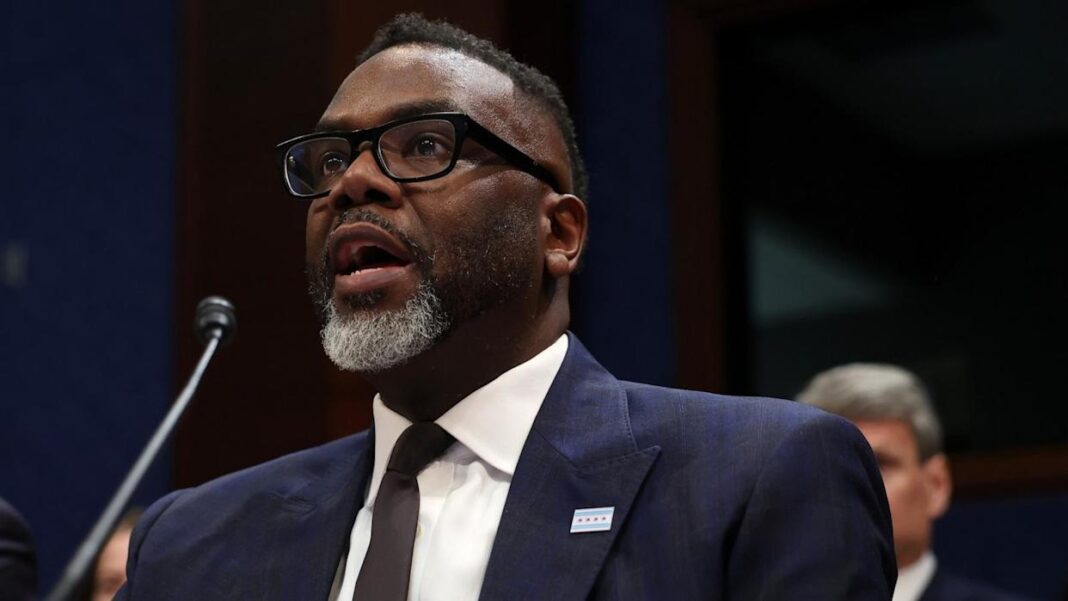


Mayor Brandon Johnson is defending his proposed 2027 budget for Chicago, which he presented Wednesday before the City Council. It is Johnson’s fourth budget proposal, and he will seek reelection in next year’s election.
The mayor calls his spending plan the “Chicago’s Fair Share Budget.” Among other things, it includes investments in mental health services. Critics, including the Civic Federation, condemn the plan, however, calling it an unacceptable evasion of responsibility for dealing with the fiscal realities the city faces.
In the $17.6 billion budget proposal presented Wednesday, the mayor also returned to his proposal for a tax based on the number of employees (a head tax). Under it, businesses with at least 125 full-time employees would have to pay $25 a month for each of them. Brandon Johnson said the heart of the matter is that “corporations and the wealthiest” must do more for Chicago, and added that the vast majority of the city’s residents share that view.
“That is, without a doubt, what the people of Chicago are demanding. That is why my fourth budget continues the effort to secure the resources needed to improve the quality of life for working people,” he said. “And what have we achieved as a result? More young people with paid summer jobs, mental health clinics reopened, support and funding for public schools, and an improved quality of life. What’s more, these investments are accompanied by a drop in violence. So even if someone criticizes us, they cannot dispute the concrete results,” the mayor said.
Borrowing hundreds of millions of dollars to cover police misconduct settlements does not make corporations or the wealthiest bear a greater financial burden. It also raises concerns, especially given the $882 million budget gap. Mayor Johnson, however, expressed hope that reforms of the Chicago police will, over time, reduce cases of officer misconduct and, as a result, the number of settlements.
“It is no secret that police misconduct and the related settlements have been a serious burden and a source of losses for our budget. But the critics don’t suggest how we should deal with the debt of the past or the challenges our police force faces,” he said. “Here is how I approached it: from now on, the guiding principle of policing is full respect for citizens’ constitutional rights. So I expect that, over time, the budget will be less and less burdened by the costs of responding to these regrettable, glaring cases of abuse of power,” Johnson said.
Referring to a slogan he often used during his first campaign for mayor, Johnson stressed that his 2027 budget, like the previous three, was designed with investing in people in mind. “Corporations made $483 billion in profit in the second quarter alone. They are not suffering at all,” Johnson said. “Do you know who is suffering? Working mothers and working fathers, people who work hard every day in Chicago and still have to struggle to afford basic needs, like food,” the mayor continued.
After the proposal was blocked last year, Johnson is again calling for a head tax to help balance the budget, which would be possible for the second year in a row. The mayor said the tax would bring in $101 million, helping to close the budget gap. Critics, however, argue that the tax would hurt job growth and discourage companies from investing in Chicago.
Some aldermen believe the proposal will not pass. Last month, 29 aldermen informed the mayor in a letter that they would not support such a solution. Some critics call the 2027 budget proposal an “election-year budget” that, in its current form, has no chance of passing. They point to the mayor’s plan to take on $480 million in debt to pay off police misconduct claims faster, as well as his intention to spend the entire $75 million the city received from the sale of its parking meter system within a single budget year.
BK
Source: Polski.FM
