
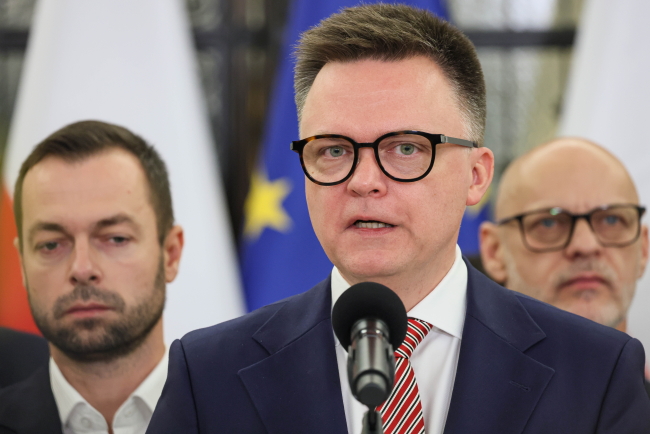


Polska 2050 caucus leader Szymon Hołownia said that Katarzyna Pełczyńska-Nałęcz has so far not formally resigned as party chair and, as far as he knows, has not resigned as minister either. He added that Polska 2050 remains in the governing coalition and should continue to be responsible for the funds ministry.
Katarzyna Pełczyńska-Nałęcz, the minister of funds and regional policy and leader of Polska 2050, announced on the platform X on Thursday that she is leaving the government. “I am leaving Donald Tusk’s government because values matter more to me than cushy posts,” she wrote. She added that she is “leaving the party in the hands of its founder, who left but nevertheless came back.” She was referring to Szymon Hołownia, a deputy speaker of the Sejm, Poland’s lower house of parliament, and the party’s former leader.
At a press conference in the Sejm on Friday, Hołownia stressed that, for now, the party has received no formal resignation from Pełczyńska-Nałęcz as its chair. “To the best of my knowledge, no documents on this matter have reached either the prime minister’s office or our party,” he said. He noted that Pełczyńska-Nałęcz chose to announce her decision through social media.
Hołownia declared that he and the other members of the parliamentary caucus are staying in Polska 2050, and that the party is staying in the governing coalition and carrying out the provisions of the coalition agreement. “Our parliamentary caucus is the pillar and guarantor of the stability of this coalition and this government. Without us, there is no coalition and no government,” he said.
“As long as I am here, Polska 2050 will be a party of peace, not war. Polska 2050 will be a loyal, responsible partner in the government, but it will also say that we should talk with the president about issues important to us, not fight him,” he added.
Ewa Schädler, a member of the Sejm and the party’s first vice chair, said the party respects Katarzyna Pełczyńska-Nałęcz’s decision. She added, however, that Pełczyńska-Nałęcz had informed neither the party’s board nor its caucus of the decision.
“As we were heading to this press conference, the party had not received her written resignation as chair of Polska 2050,” Schädler said.
She said that as soon as the party receives a resignation, it will take the steps required by its bylaws to prepare for the election of a new chair. She assured reporters that no other member of the national board has left their post.
Hołownia thanked Pełczyńska-Nałęcz for seven years of work together building the party. At the same time, he acknowledged that he did not always agree with her decisions. He added that he “doesn’t quite understand” her decision to step down as party leader.
Asked whether Polska 2050 could merge again with the Centrum caucus, he replied that the split that followed Pełczyńska-Nałęcz’s takeover of the party’s leadership appears “difficult to heal.”
“There is openness on our side. (…) Nothing would make me happier than for us to be able to work together for the good of Poland. And I hope my colleagues will hear this appeal and will also assess the situation realistically. Polska 2050 is still the entity with the potential to rebuild and unite that part of the political scene which the Confederation cannot be allowed to occupy. We cannot let the Confederation and its appendages become the ‘third way,'” Hołownia said.
Asked about a possible run in elections with the PSL (the Polish People’s Party) or KO (the Civic Coalition), he indicated that talks on electoral lists will realistically take place in February and March of next year.
“Today, all political groups are trying to build the best possible negotiating position ahead of the next negotiations,” he said. He also said that the PSL is a difficult partner to work with and that in the next parliamentary elections Poles should have a choice wider than two political options.
Hołownia also addressed remarks by Prime Minister Donald Tusk, who is on a visit to India, that he has two “great” candidates for the post of head of the Ministry of Funds and Regional Policy (MFiPR).
The Polska 2050 caucus leader stressed that on the division of responsibility among coalition partners for individual ministries, “the coalition arrangements apply.” He added that he deeply believes they will be honored.
“I believe that this post, since it fell to Polska 2050 in that division of responsibility, should remain with Polska 2050,” Hołownia said. He recalled that under the coalition agreement, the October 15 coalition makes “all decisions (…) by consensus.” “I expect that a consensual decision will be made on this matter as well,” he added.
Hołownia said that he, too, has candidates for the post of minister of funds and regional policy. He expressed hope that once the head of government returns from India, they will have an opportunity to talk about “what Polska 2050’s scope of responsibility for the Polish state in the government should look like.”
Pressed on whether Polska 2050 would leave the coalition if no consensus is reached on the choice of MFiPR head, Hołownia said no. “We will not leave the coalition, but we will not take part in the work of the government,” he said. He added that he does not assume such a scenario will occur.
Hołownia was also asked whether, in such a situation, the other ministers belonging to Polska 2050 would also leave the government “as a sign of solidarity.” “That is what I will recommend,” Hołownia replied.
He declined to say whether he plans to return as head of Polska 2050. “This is not the time to make a decision on that. Now is the time for us to meet with our activists, both remotely and in person, (…) and count our sabers,” Hołownia said.
Pełczyńska-Nałęcz became minister of funds and regional policy when Donald Tusk’s government was formed in December 2023, joining the government with the backing of Szymon Hołownia’s Polska 2050. Early this year, she defeated Climate and Environment Minister Paulina Hennig-Kloska in an internal party election for chair. She succeeded the party’s founder, Szymon Hołownia, who was Sejm speaker from 2023 to 2025 and is now a deputy speaker.
After Pełczyńska-Nałęcz’s victory in February, Polska 2050’s parliamentary representation split into two camps: the 15-member Polska 2050 caucus, now led by Hołownia, and the 15-member Centrum caucus, led by Paulina Hennig-Kloska, which includes lawmakers who left Polska 2050 with her. (PAP)
