
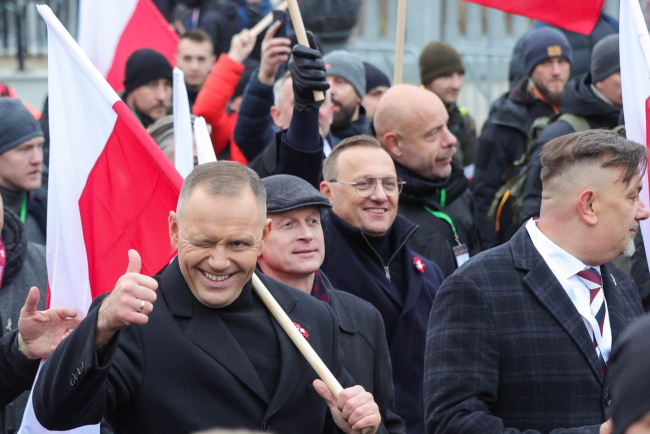


About 250,000 people took part in Warsaw’s Independence March, including President Karol Nawrocki. Celebrations of National Independence Day, held in the shadow of the attack in Kraków, passed safely across the country.
Data from the Warsaw Security Center show that this year’s Independence March was 2.5 times larger than last year’s (last year, Warsaw City Hall estimated turnout at the march at around 100,000 people, including at 250,000). The march organizers, for their part, estimated that turnout may have reached half a million, or even a million, people. While the head of the march reached the grounds by the National Stadium, the rear had not yet set off from Dmowski Roundabout.
President Karol Nawrocki took part in the march. Participants greeted him by chanting, “Czołem, panie prezydencie” (“Hail, Mr. President”). He was accompanied by his older son and his closest associates. Nawrocki walked with the march across the Poniatowski Bridge and left it on the Praga side. Politicians from Law and Justice (PiS) and Confederation (Konfederacja) also took part in the march.
Participants dressed in white and red chanted, among other things: “Glory to great Poland,” “Honor and glory to the heroes,” and “This is Poland, not Brussels. Here Tusk isn’t supported.” A group of demonstrators with green flags bearing the falanga, a symbol of national radicals, carried a banner reading “Make Europe white again” (translated by PAP as “Uczyńmy Europę znów białą”).
Despite a ban, flares and loud firecrackers were set off.
Foreign news agencies reported on Wednesday on the mass turnout of Poles at the march marking National Independence Day. They repeatedly described it as a march that brings together far-right groups. Posting a photo from the demonstration on the platform X, Reuters called it a “far-right Polish march.”
Jacek Wiśniewski, a spokesman for the Warsaw Police Headquarters, said that only two minor incidents were recorded in Warsaw during National Independence Day. Fifty-nine people were detained, and pyrotechnics were found on 86.
This year’s National Independence Day celebrations took place in the shadow of the tragic events of Saturday, when a man drove a car onto the Main Square in Kraków and opened fire on random passersby. Six people were killed and 15 were wounded, including two police officers who neutralized the attacker. The same day, police found the bodies of the attacker’s father, mother and sister, with gunshot wounds, in his apartment.
Interior Minister Marcin Kierwiński assured the public that the services and police were prepared to ensure the safety of all gatherings on Nov. 11, including the Independence March. Polish cities stepped up security measures ahead of the observances.
Andrzej Fijołek, spokesman for the National Police Commander, said on Wednesday evening that National Independence Day celebrations across the country had passed safely.
Earlier, at noon, the central National Independence Day observances were held at Piłsudski Square in Warsaw, attended by the president and by the deputy prime minister and defense minister, among others.
President Karol Nawrocki, Deputy Prime Minister Władysław Kosiniak-Kamysz and Prime Minister Donald Tusk, who spent the day in Szczecin, all referred in their speeches to the tragic events in Kraków and Ostrowiec Świętokrzyski.
President Nawrocki stressed that “independence is a great responsibility, including for a fellow citizen, for another Pole.” “In recent days we have witnessed enormous responsibility for independence from people who were ready to sacrifice their lives and health for a fellow citizen. This responsibility in independence has the face of Jakub Kulik and Artur Morański, it has the face of nurses, doctors, municipal guards, firefighters and ordinary residents of Kraków who, without hesitation, were ready in this tragic situation to help another citizen,” the president recalled.
Deputy Prime Minister Kosiniak-Kamysz, referring to the tragic events in Kraków, said in his speech that what was meant to be a symbol of evil showed unity in the face of danger. “No one asked: ‘Whom did you vote for? What are your views?’ Doctors and nurses saved the health and lives of the victims,” the deputy prime minister said.
Prime Minister Tusk, who took part in Szczecin in the christening ceremony of the ferry Bursztyn Unity, said that the recent tragic days in Kraków show that what “we won with such effort: freedom, independence, the safety of our families, children and homes, is not something guaranteed once and for all.”
The head of government also invited President Nawrocki to his home in Sopot for a pre-Christmas meeting. “Let’s share the opłatek [Christmas wafer] before Christmas Eve and talk. My apartment is small, but there will be room for the two of us in the kitchen at the table, and we’ll talk the way people used to say, as one Pole to another,” he said.
President Nawrocki, for his part, referring in his speech to constitutional issues and the conflict over the Constitutional Tribunal, said that “in recent weeks the prestige of the Constitutional Tribunal has been completely buried.” Addressing the deputy prime ministers present, among others, he said it must be rebuilt “through a joint effort.”
He stressed at the same time that the issue of national security must be excluded from political disputes.
During the National Independence Day observances, President Nawrocki presented Gen. Wiesław Kukuła with his nomination for a second term as chief of the General Staff of the Polish Armed Forces; ten other officers received promotions to general rank.
Before the ceremony at Piłsudski Square, the president presented the highest state decorations at the Presidential Palace. The Order of the White Eagle went to Wiesław Kęcik, a philosopher and activist of the democratic opposition in communist-era Poland, and to neurosurgeon Prof. Dr. Hab. Mirosław Ząbek of the Centre of Postgraduate Medical Education (CMKP). The Grand Cross of the Order of Polonia Restituta was awarded to stage and film actress Halina Łabonarska and Prof. Krzysztof Szwagrzyk, and the Officer’s Cross of the Order of Polonia Restituta to Brig. Gen. Andrzej Kowalski.
On National Independence Day, representatives of other countries and communities sent their wishes to Poland. European Council President Antonio Costa posted a message in Polish on X: “Najserdeczniejsze życzenia z okazji Narodowego Święta Niepodległości!” (“Warmest wishes on the occasion of National Independence Day!”).
Ukrainian President Volodymyr Zelensky also sent his wishes. “On the occasion of National Independence Day, we extend our warmest wishes to Poland, President Karol Nawrocki, Prime Minister Donald Tusk and all Poles!” he wrote on X.
Hungarian Foreign Minister Anita Orban posted a joint photo with Poland’s top diplomat, Radosław Sikorski, on X, captioned “Polak, Węgier, dwa bratanki!” (a traditional Polish saying about Poles and Hungarians being brothers), along with greetings: “Serdecznie pozdrawiam naród polski z okazji Dnia Niepodległości Rzeczypospolitej Polskiej” (“I warmly greet the Polish nation on the occasion of the Independence Day of the Republic of Poland”), Orban wrote in Polish.
Wishes were also sent to Poland by the U.S. Mission to NATO, Lithuanian Prime Minister Mindaugas Sinkeviczius and U.S. Ambassador to Poland Tom Rose, among others.
National Independence Day is celebrated on Nov. 11 to commemorate Poland’s regaining of independence in 1918. The date refers to the Regency Council’s transfer of supreme command of the Polish Army to Józef Piłsudski. (PAP)
