
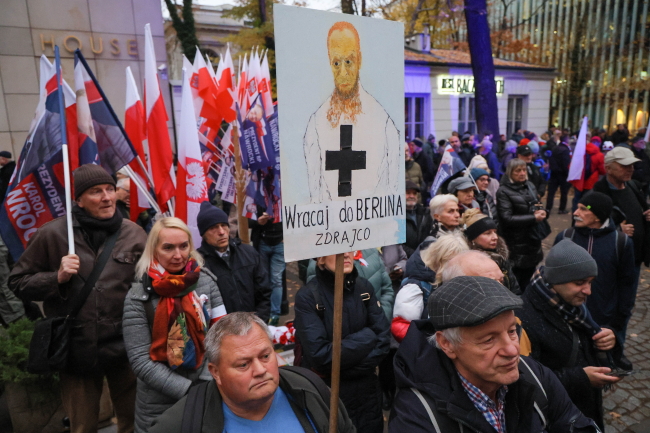


The events of recent days surrounding Poland’s Constitutional Tribunal are an understandable, but risky, attempt by Donald Tusk’s government to enable the Tribunal to operate in line with the constitution, the Swiss daily Neue Zürcher Zeitung assessed on Tuesday.
“In Poland, the long-running, bitter dispute over the Constitutional Tribunal has escalated because Prime Minister Donald Tusk wanted to make the country’s highest court operate in accordance with the constitution,” the newspaper writes in a commentary published Tuesday. “From a political standpoint, the attempt to solve the problem is understandable,” it notes, recalling that Tusk promised during the election campaign to restore the rule of law.
After taking power in 2015, the Law and Justice (PiS) government tried to take control of the judiciary, which was criticized both by the opposition in Poland and by European institutions.
After the change of government in 2023, Tusk failed to restore the independence of the Constitutional Tribunal, NZZ writes. President Karol Nawrocki, who considers himself the “(political – PAP) heir” of PiS leader Jarosław Kaczyński, deepened the crisis by insisting on “unlawful conduct,” it adds.
In the newspaper’s view, “the suspension of the Tribunal’s president and his deputy by one of the judges was a controversial but acceptable attempt to overcome the paralysis of the Constitutional Tribunal.” With its “forceful intervention,” however, the government achieved little beyond political symbolism: “Tusk is not (…) idle in the face of the elections (parliamentary elections in 2027 – PAP); he is doing everything to fulfill his campaign promise.” “But the price is high,” NZZ writes.
The newspaper says the escalation of the dispute is deepening polarization in Poland and forcing undecided parties to pick a side. In that context, it points to Mateusz Morawiecki’s Rozwój Plus, which “suddenly finds itself once again on the same side of the barricade as Kaczyński and the far-right Grzegorz Braun.” Until now, Kaczyński had rejected cooperation with Braun, but “now ranks are closing,” which could improve PiS’s chances of returning to power next year.
“The losers in these disputes are the institutions,” NZZ concludes. “The Constitutional Tribunal will still not play its proper role in the institutional system and will not regain nonpartisan credibility. Tusk’s use of force will not change that,” NZZ writes in its conclusion.
The dispute over the Constitutional Tribunal flared up on Oct. 30, when representatives of a group of judges elected to the Tribunal by the current Sejm, the lower house of Poland’s parliament, announced that Anna Korwin-Piotrowska had become head of the Constitutional Tribunal and had issued an order for a break in the duties of the Tribunal’s president and vice president. (PAP)
