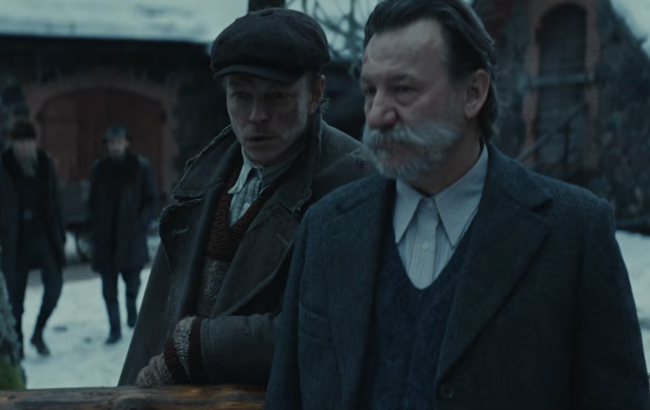
Jan Holoubek’s ‘Dziki, dziki wschód’ to Open Kamera Akcja Festival in Łódź
Jan Holoubek’s film “Dziki, dziki wschód” (“Wild, Wild East”) will open the 17th Kamera Akcja Festival in Łódź on Thursday. Festival audiences can choose from 80 films, many of them premieres, as well as debates and workshops with experts at Monopolis, the Kinematograf cinema and the Film School.
Held in Łódź since 2010, the Kamera Akcja Festival (FKA) is an event devoted to film criticism in which movie lovers are full-fledged participants. This year, from Oct. 22 to 25, organizers have prepared more than 80 films for them, including nearly 40 preview screenings, and meetings with 90 guests from Poland and abroad. The theme of this edition is “The Wave.”
“We are not interested in cinema that leaves everything in its place. We are looking for films, conversations and experiences that move us, provoke thought and change perspective and form. ‘The Wave’ symbolizes that energy – the moment when we step outside well-worn patterns and open ourselves to new ways of seeing,” said FKA director Przemek Glajzner.
The festival’s opening film will be “Dziki, dziki wschód,” directed by Jan Holoubek and starring Robert Więckiewicz and Itay Tiran. The film combines historical drama with elements of a western and a crime story. It transports viewers to 1943, to a small town in the General Government, the German-occupied part of Poland, from which the Germans have deported the Jewish residents. A mysterious official from Berlin, Martin Wolff (Itay Tiran), arrives in Zalesie Małe. Officially, he is there to solve the mystery of a lawyer’s disappearance; in reality, his arrival is linked to a search for hidden gold. An atmosphere of fear and distrust grows in the town. The mystery of the missing gold becomes the starting point for a story about people living in a world where moral rules are fading. After the screening at Monopolis, a conversation with the film’s screenwriter, Aleksandra Takuska, is planned.
In the “Critical Premieres” section, viewers will see the most talked-about titles of the past festival season, including “Minotaur” by Andrey Zvyagintsev, which won the Grand Prix at Cannes; “Yellow Letters” by Ilker Çatak, winner of this year’s Golden Bear at the Berlinale; “Daleko od brzegu” with Juliette Binoche, honored with the Silver Bear Jury Prize at the Berlinale; and “Niezbyt wygórowane oczekiwania,” shown at Cannes as part of the Directors’ Fortnight.
The “Polish Wave” section, in turn, includes “Cudze rzeczy” by Grzegorz Dębowski, which won a screenwriting award at the Venice International Film Festival; “Hot Spot” by Agnieszka Smoczyńska, which received four awards at the Polish Film Festival in Gdynia; and “Czarna godzina,” Filip Bojarski’s feature debut, which was also honored in Gdynia.
The program of the “Romanian Paragraph” section, prepared in cooperation with the Romanian Cultural Institute, will include “La Gomera” by Corneliu Porumboiu and, in a preview screening, “Na własną rękę” by Tudor Cristian Jurgiu, who was honored at this year’s Berlinale.
Special awards at the 17th edition of the festival will go to film critic Tadeusz Sobolewski, who will be recognized for his many years of contribution to the development of film art, and to sound director Laia Casanovas, a winner of the European Film Award and the Goya Award and an Oscar nominee.
“We want to show that sound direction does not begin and end with the technical side of a film. It is the conscious building of narrative, emotion and space. Laia Casanovas is a great example of an artist who can completely change her language depending on the film,” said FKA director Malwina Czajka.
Experts say Casanovas’ body of work shows a variety of approaches to sound. In “Sirât,” directed by Oliver Laxe, sound becomes part of the physical experience of space and a tool for building tension. In “The Good Manners” by Celia Rico Clavellino, silence, the acoustics of a home and the seemingly ordinary sounds of everyday life matter more. Casanovas will talk about how to build space, tension and emotion with sound during a masterclass led by Katarzyna Szczerba of the Department of Sound Direction at the Film School in Łódź.
Kamera Akcja is the only event in Poland where talking and writing about cinema are considered as important as making it. Competitions help discover new talent in the field. “Krytyk pisze” (“Critic Writes”) is aimed at debut authors (up to age 26) of film reviews, essays and analyses, while “Krytyk mówi” (“Critic Speaks”) is a poll in which the audience decides the winner.
There is also an international competition, “Authors Spotlight,” in which short films of up to 30 minutes compete: student films, animations and other short forms by filmmakers from around the world.
At the closing gala on Oct. 25 at Monopolis, festival audiences will be the first in Poland to see “Kobieta nieznana” by May el-Toukhy. The film, which won the Golden Lion at the Venice International Film Festival, takes viewers to postwar Copenhagen and tells the story of a woman trying to break free from a role imposed on her in a world governed by the judgment of others. Mathilde Arcel, who plays the lead, received the Volpi Cup for best actress in Venice, and the film is Denmark’s entry for the Oscars.
The 17th Kamera Akcja Festival is funded by the city of Łódź, as well as by the Minister of Culture and National Heritage, the Polish Film Institute and the University of Łódź, the festival’s patron.
The Polish Press Agency is a media patron of the event. (PAP)