
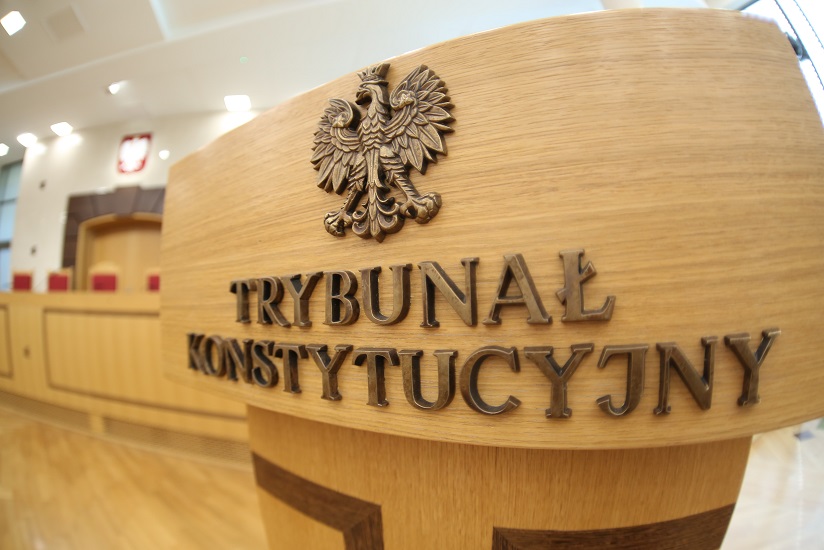


The current judges of the Constitutional Tribunal (TK) fall into several groups: those elected before 2023; those elected in 2026 whom the president invited and before whom they took the oath; and those the president did not invite, who took the oath in the Sejm, Poland’s lower house of parliament. The Tribunal also includes one so-called “doubler” judge.
Seven of the Constitutional Tribunal’s current judges were elected during the previous term of the Sejm. The longest-serving is Jarosław Wyrembak, a former attorney and notary, and a member of Law and Justice (PiS). The Sejm elected him on Jan. 30, 2018, to replace the late Henryk Cioch.
Cioch was one of three so-called doubler judges. The problem with doubler judges arose because, before the end of the seventh term of the Sejm, the ruling Civic Platform (PO) and Polish People’s Party (PSL) elected five judges to replace those whose terms were ending in November (three) and December (two). President Andrzej Duda, however, did not accept their oaths of office.
After winning power in 2015, PiS elected five new judges in their place, and the president accepted their oaths. A day later, the Tribunal itself ruled that, of the five chosen in the seventh term, the three November judges had been elected properly, while the two December judges had not.
As a result, the three judges elected to seats that had been properly filled were called doublers. Two of them, Lech Morawski and Henryk Cioch, died before the end of their terms. The doubler label thus passed to those elected to replace them: Justyn Piskorski and Jarosław Wyrembak.
The terms of the judges for whom the doublers were elected expired in 2024. That means Wyrembak’s successor, who is to be elected in January 2027, will no longer be a doubler. Nor is Maciej Berek, who was elected in September to replace Justyn Piskorski.
The other six TK judges elected in the previous term of the Sejm are Wojciech Sych (since May 2019), Stanisław Piotrowicz and Jakub Stelina (both since December 2019), Rafał Wojciechowski (since January 2020), Bartłomiej Sochański (since April 2020) and Bogdan Święczkowski (since February 2022).
Wojciech Sych previously served on courts at various levels in Poznań, and from 2018 he was a judge of the Supreme Court. Stanisław Piotrowicz, in turn, is a former prosecutor from the communist era who, after 2005, became a senator and then a PiS member of the Sejm. As chairman of the Sejm’s Justice and Human Rights Committee in the eighth term, he played a significant role in introducing changes to the judiciary pushed by PiS. Some of those changes were later challenged by European courts.
Jakub Stelina is a labor law specialist and a former doctoral student of Lech Kaczyński at the University of Gdańsk.
Rafał Wojciechowski was a vice rector of the University of Wrocław. At the end of 2021, he won a competition to be a candidate for judge of the Court of Justice of the European Union, to replace the outgoing Marek Safjan, but ultimately withdrew from seeking the post.
Bartłomiej Sochański was mayor of Szczecin in the 1990s, recommended by the Freedom Union (Unia Wolności). In 2018, he ran for the office again, this time as a PiS candidate, but lost the election to Piotr Krzystek.
Bogdan Święczkowski, for his part, headed the Internal Security Agency (ABW) in 2006–2007, during the first PiS government, and from 2016 to 2022 served as national prosecutor and first deputy prosecutor general. He was among Zbigniew Ziobro’s closest associates. In the 2011 parliamentary elections, he won a seat in the Sejm on the PiS list but ultimately did not take it, because he did not want to go into retirement as a prosecutor.
Święczkowski has served as president of the TK since December 2024, and Sochański has been its vice president since February 2025. On Oct. 30, representatives of the judges elected to the TK by the Sejm in its current term announced that Anna Korwin-Piotrowska, as the longest-serving judge, had become acting head of the Constitutional Tribunal and had issued an order suspending the duties of TK President Bogdan Święczkowski and Vice President Bartłomiej Sochański. Święczkowski and Sochański dispute the legality of that decision, and legal experts are divided over whether Korwin-Piotrowska had the right to suspend them. Among those who deemed the decision a violation of the law were First President of the Supreme Court Zbigniew Kapiński and President of the Supreme Administrative Court Jacek Chlebny.
Most of the judges elected before 2023 (Wyrembak, Sych, Piotrowicz, Stelina and Sochański) took part in the Oct. 22, 2020, TK ruling in which the Tribunal held unconstitutional the possibility of terminating a pregnancy because of a severe and irreversible fetal impairment or an incurable illness threatening the fetus’s life. None of them filed a dissenting opinion. The ruling sparked mass public protests.
Some of those judges also took part in issuing other rulings that, after 2023, the governing coalition considered politically motivated.
In September 2024, the TK declared unconstitutional a Sejm resolution establishing an investigative committee on Pegasus spyware. The reason was that Maciej Wąsik and Mariusz Kamiński did not take part in the vote. The panel was presided over by Zbigniew Jędrzejewski, the rapporteur was Stanisław Piotrowicz, and the third panel member was Jarosław Wyrembak.
That was not the only case in which the TK found Sejm decisions unconstitutional because of the absence of Wąsik and Kamiński during votes. Several similar rulings were issued.
In November 2024, the TK ruled that the removal of Dariusz Barski as head of the National Prosecutor’s Office was unconstitutional. The rapporteur was Stanisław Piotrowicz, and the panel, which included Zbigniew Jędrzejewski, Bartłomiej Sochański and Rafał Wojciechowski, was presided over by Krystyna Pawłowicz.
In May 2025, the TK found it unconstitutional that grades in religion classes are not included in a student’s grade point average. The case was heard by a panel of three judges chaired by Jarosław Wyrembak. The rapporteur was TK President Bogdan Święczkowski, and the third judge was Stanisław Piotrowicz.
In July 2025, the TK found unconstitutional the provisions governing the holding of a member of the National Broadcasting Council (KRRiT) accountable before the State Tribunal. The ruling was linked to the intention to bring KRRiT head Maciej Świrski before the State Tribunal. The five-member panel was presided over by Stanisław Piotrowicz.
In April 2026, the Tribunal found unconstitutional two provisions governing the procedure by which the Sejm elects judges to the National Council of the Judiciary (KRS), even though they had been enacted under PiS rule. The case was heard by a five-member panel chaired by Stanisław Piotrowicz. The rapporteur was TK President Bogdan Święczkowski, and the panel also included Vice President Bartłomiej Sochański and judges Jakub Stelina and Rafał Wojciechowski. Stelina filed a dissenting opinion.
At the end of July 2026, the TK found unconstitutional a regulation concerning the templates of documents for same-sex marriages contracted abroad. The ruling was unanimous and was issued by a three-member panel chaired by TK President Bogdan Święczkowski. Judge Piotrowicz was the rapporteur. Judge Wojciech Sych also sat on the panel.
Seats on the TK were already up for filling in 2024 and 2025, when the terms of Julia Przyłębska, Piotr Pszczółkowski and doubler Mariusz Muszyński ended, followed by Zbigniew Jędrzejewski and Michał Warciński, while Krystyna Pawłowicz resigned from office. The Sejm, however, did not elect anyone to replace them.
Only in March 2026 did the Sejm make a one-time election of six judges. Among them, attorney Magdalena Bentkowska, daughter of former justice minister and prosecutor general Aleksander Bentkowski, was recommended by the PSL. Dariusz Szostek, a civil law specialist from the University of Silesia and a legal counsel, was recommended by Polska 2050. Both took the oath before the president on April 1 of this year.
Elected the same day were Marcin Dziurda, a legal counsel and former head of the Solicitor General’s Office (Prokuratoria Generalna); Maciej Taborowski, an attorney and, after 2023, a member of the supervisory board of public broadcaster TVP; and Krystian Markiewicz, a judge and former president of the “Iustitia” association. All three were nominated on the recommendation of the Civic Coalition (KO). Anna Korwin-Piotrowska, a judge and president of the “Themis” association, was recommended by the Left (Lewica). All four took the oath in the Sejm on April 9, 2026, because they had not received an invitation from the president.
Zbigniew Bogucki, head of the Chancellery of the President (KPRP), explained that the president accepted the oath from only two of the judges because only two began their terms while he was in office. Most legal experts found the head of state’s position to have no legal basis.
Sławomir Patyra, elected in June 2026 and sworn in by the president at the end of July, is a law professor at Maria Curie-Skłodowska University (UMCS) and a constitutional law scholar who, in 2021, was the KO and PSL candidate for Commissioner for Human Rights but was not elected.
Maciej Berek, elected in early September and sworn in at the Sejm on Oct. 14 of this year, was, after 2023, a minister-member of the Council of Ministers in Donald Tusk’s government, and since July 2025 was responsible for implementing government policy. During the current prime minister’s previous governments, he was head of the Government Legislation Center and secretary of the Council of Ministers.
Of those elected in this term, the president, as well as TK President Bogdan Święczkowski, recognize as full-fledged TK judges only those who took the oath at the Presidential Palace: Bentkowska, Szostek and Patyra. None of the judges elected this year has yet begun hearing cases. (PAP)
