


Neither the president nor the president of the Constitutional Tribunal can arbitrarily decide which judges, properly elected by the Sejm, will hear cases, Przemysław Rosati, president of the National Bar Council (Naczelna Rada Adwokacka), told PAP. He added that he sees a problem with the legal basis of the order on a break in the official duties of the Tribunal’s president and vice president.
In an interview with PAP, attorney Przemysław Rosati said he has fundamental doubts about the legal basis of the order issued Friday by Judge Anna Korwin-Piotrowska on a break in the official duties of Tribunal President Bogdan Święczkowski and Vice President Bartłomiej Sochański. He stressed that those doubts do not mean he accepts blocking properly elected judges from carrying out their duties.
Rosati said that under current law, Bogdan Święczkowski remains president of the Constitutional Tribunal. “That is an assessment of his legal status. My assessment of Bogdan Święczkowski’s actions to date and of the way he has exercised his office is unequivocally negative. Those actions contribute to deepening the crisis surrounding the Tribunal,” he said.
He stressed that Anna Korwin-Piotrowska is a judge of the Constitutional Tribunal and should be allowed to hear cases. “The Sejm’s proper election of a judge cannot then be undermined by blocking that judge from performing the duties of the office. Neither the president nor the Tribunal’s president can arbitrarily decide which judges, properly elected by the Sejm of the Republic of Poland, will hear cases. Obstacles placed in this path require unequivocal criticism,” he said.
Referring to Korwin-Piotrowska’s order concerning the Tribunal’s president and vice president, Rosati said his doubts concern both whether the measure it provides for can be applied to Constitutional Tribunal judges and the authority of the person who issued the order.
He explained that Article 19 of the law on the status of Constitutional Tribunal judges is of key importance. That provision says that, in matters not regulated by that law, the rules on the rights and duties of Supreme Court judges apply accordingly to the rights and duties of Tribunal judges. “This is not a reference to the entire structural framework governing the Supreme Court. The legislature expressly limited its scope to the rights and duties of judges. Meanwhile, Article 10 of the law on the Supreme Court, which the order cites, is a general provision referring to the Law on the Organization of Common Courts,” he noted.
As he pointed out, the referring nature of Article 10 does not by itself settle the matter. The fundamental question is whether, within the limits of the reference in Article 19, one can reach Article 130 of the Law on the Organization of Common Courts and derive from it the authority to order a break in the official duties of a Constitutional Tribunal judge.
“Such far-reaching interference in the exercise of a judge’s office requires a convincing legal justification. It is not enough to point to successive referring provisions. One must show that their scope actually allows this particular measure to be applied to a Constitutional Tribunal judge,” he said.
He added that Article 30 of the law on the status of Tribunal judges, which provides for the corresponding application of the Law on the Organization of Common Courts and the Code of Criminal Procedure to disciplinary proceedings, requires a separate assessment.
Rosati stressed that even if one accepts that such a measure may be applied, a separate question remains as to who has the authority to order it. “Article 12, paragraph 4 of the law on the organization of and procedure before the Constitutional Tribunal sets out the conditions for substituting for the president. However, it does not in itself settle that a person invoking that substitution can order a break in the president’s official duties. In addition, Article 130 of the Law on the Organization of Common Courts separately regulates the situation of a court president. One therefore cannot rest on a general invocation of the possibility of substitution,” he explained.
He noted that the substitution provided for in Article 12, paragraph 4 is linked to the inability to authorize the vice president or another judge to exercise particular powers. Whether the statutory conditions for triggering it were actually met in this case therefore also needs to be assessed. “I see a fundamental problem with the legal basis of the order, the authority to issue it and the ability to bring about the effects it describes. Merely drawing up and announcing a document does not determine its legal effectiveness,” he stressed.
At the same time, he cautioned that the law must provide an effective response to violations committed by people holding public office. “My doubts about the order do not change my unequivocally negative assessment of blocking properly elected judges from performing their duties. The president and the Tribunal’s president are also bound by the law. We cannot allow a situation in which the office one holds becomes protection against accountability. No one can be above the law,” he said.
Referring to events involving President Karol Nawrocki, Rosati said the way the president carries out his duties should serve to stop the crisis from escalating. “I consider the president’s conduct during his entry into the Tribunal unacceptable. One should expect the head of state to respect the Tribunal’s independence and to take steps to calm the situation and fulfill constitutional obligations. The president should help resolve the crisis, not deepen it,” he said.
He also commented on Saturday’s orders on the organization of the Tribunal’s work, issued by Korwin-Piotrowska and Święczkowski.
In her order, Judge Korwin-Piotrowska recommended, among other things, that Tribunal judges carry out their duties away from the Tribunal’s headquarters, and that judges and employees summoned to the building use the entrances designated in announcements. Święczkowski, meanwhile, designated Nov. 3 to 6 as days off work with pay for Tribunal employees. He also challenged Korwin-Piotrowska’s order.
“Tribunal employees have been put in a situation of uncertainty as to who is authorized to give them binding instructions. They should not bear the consequences of a dispute over who runs the institution, nor should they have to resolve complex constitutional questions on their own. Even a partial overlap in the content of the documents does not remove the problem of the authority of the people who issued them. No public office should function this way,” he said.
The attorney explained that one must distinguish between the employer as an organizational unit and the person authorized to carry out labor-law actions on its behalf. The dispute therefore also concerns who can effectively take such actions toward Tribunal employees.
Outlining possible ways out of the crisis, Rosati stressed that steps to unblock the Tribunal’s work must be separated from solutions that provide lasting protection for its independence. “The first obligation is to remove the obstacles that prevent properly elected judges from performing their functions, including the president’s fulfillment of his duties related to administering the oath of office. But that will not replace a lasting resolution of the crisis,” he said.
As one option, he pointed to amending the Constitution and shaping the Tribunal with guarantees protecting it from being politically subordinated again. Another proposal is changing the rules for choosing Tribunal judges, including introducing a qualified majority in the Sejm, Poland’s lower house of parliament, and a four-year waiting period after holding certain political offices.
“If the latter solution were to be accompanied by replacing the Tribunal’s entire membership while keeping the current Constitution, it would require the voluntary resignation of the current judges. A change in the law cannot be presented as a sufficient basis for cutting short their constitutional terms,” he stressed.
He added that working out a lasting solution requires constructive dialogue, responsibility for the state and a willingness to give up short-term political gains. “Society needs a Tribunal whose independence is protected no matter who wins elections. Citizens must be certain that their rights are more important than the interests of each successive majority,” Rosati said.
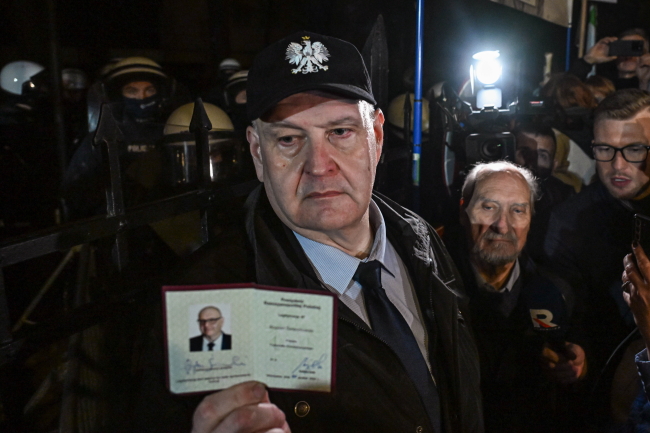
On the evening of Friday, Oct. 30, representatives of the group elected as Tribunal judges during the current term of the Sejm announced that Anna Korwin-Piotrowska, as the longest-serving judge, had become the person leading the Constitutional Tribunal and had issued an order on a break in the duties of Tribunal President Bogdan Święczkowski and Vice President Bartłomiej Sochański. Korwin-Piotrowska said at the time that she and six other people elected as Tribunal judges in this term were at the Tribunal’s headquarters.
A protest outside the Tribunal’s headquarters intensified at that point. Among those who arrived was Bogdan Święczkowski, who declared that as the Tribunal’s president he is the sole administrator of the Tribunal’s building and that “all decisions made by usurpers are unlawful from beginning to end.”
The Warsaw Metropolitan Police Headquarters (Komenda Stołeczna Policji) said at the time that officers were carrying out statutory duties at the Tribunal’s headquarters, following information provided by Anna Korwin-Piotrowska about possible threats to the life or health of Tribunal judges and employees.
Because of the situation at the Tribunal, President Karol Nawrocki cut short a trip to Senegal and returned to Warsaw late Friday night. He met with First President of the Supreme Court Zbigniew Kapiński, among others, and then went to the Tribunal’s headquarters. Early Saturday, the president issued a statement saying, among other things, that “the constitutional order of the Republic of Poland was violated and a constitutional organ of the state was seized by force.” The president then called urgent political consultations; at the Presidential Palace, talks were held with representatives of parliamentary caucuses and groups, except the Civic Coalition (KO) and the Left.
On Saturday evening, Prime Minister Donald Tusk gave an address in which he said, among other things, that the Sejm of the current term “elected new judges, who took the oath,” but that President Karol Nawrocki did not administer the oath to them, that Tribunal President Bogdan Święczkowski prevented them from starting work, and that “when after many weeks of patient waiting they decided to take up their duties (…), they were attacked.” He added that the police “protected the Tribunal from attackers.”
The prime minister also said that “the attack on the Constitutional Tribunal and its judges is another stage in the process of destroying the rule of law in Poland by Law and Justice (PiS) and by Presidents Andrzej Duda and Karol Nawrocki,” and that “the state must be strong and able to enforce justice.”
Marta Stańczyk (PAP)
