
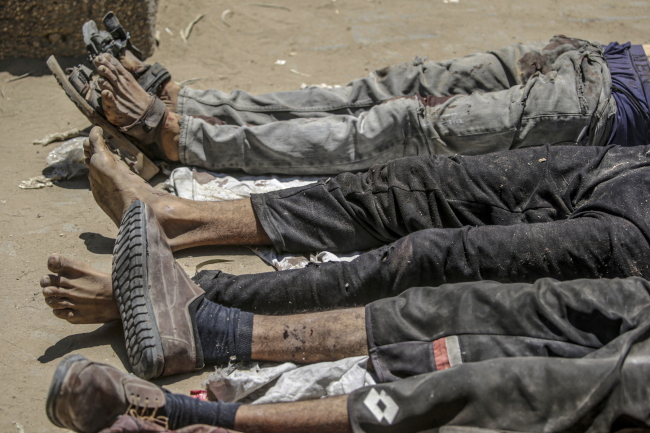


More than 74,000 Palestinians have been killed in the Gaza Strip since the start of the war, and according to local authorities, the Israeli military has destroyed more than 40 cemeteries. Burial space is scarce, and families have buried loved ones in shared graves, gardens, schools and camps for displaced people.
Many graves are merely mounds of sand marked with a stone and a piece of paper bearing the name of the deceased. There is a shortage of space, building materials and money for headstones, so people use rubble from destroyed homes, mud and corrugated metal, Al Jazeera reported.
According to the religious affairs ministry in the Gaza Strip, the Israeli military has destroyed more than 40 of about 60 existing cemeteries by digging them up, leveling them with bulldozers or bombing them. Investigative journalists at Bellingcat have also documented the destruction of the burial grounds using satellite images.
In February 2026, The Guardian determined, based on satellite images and witness accounts, that bulldozers had leveled the burial sites of more than 100 Allied soldiers from World War II who had been stationed in Palestine, mostly Australians but also Britons and Poles. Sections where British soldiers killed in World War I are buried were also damaged.
The Israeli army explained its actions as necessary to destroy Hamas’s underground infrastructure and protect its own soldiers.
Access to some Palestinian cemeteries, especially those in the eastern part of the Gaza Strip, is restricted by the presence of Israeli troops. Some land set aside for burials has been taken over by camps for displaced people.
Many of the roughly 60 cemeteries were overcrowded before the outbreak of the war, which began with Hamas’s attack on Israel on Oct. 7, 2023. The Gaza Strip, home to about 2 million people, had a population density of about 5,600 people per square kilometer. As early as 2002, the manager of one cemetery told local media that he had to turn away families seeking burials because of a lack of space, The Times of Israel reported.
In July 2025, the religious affairs ministry announced that available burial space had practically run out. The cost of a funeral is now between 700 and 1,000 shekels (880–1,250 złotych), partly because of shortages of materials. For many families the sum is prohibitive, because more than 90% of working-age residents of the Gaza Strip are without work.
As The Times of Israel reported, families sometimes leave their loved ones’ bodies in hospital morgues, and it is increasingly common to bury several people in one grave or to reopen old graves.
The situation is further complicated by the Muslim prohibition on cremation, which leaves burial in the ground as the only permissible form of funeral for the vast majority of residents.
Some Palestinian families do not even know what happened to their loved ones’ remains. The Associated Press described the case of a Gaza Strip resident who discovered, after Israeli soldiers withdrew, that the graves of his parents and other relatives at a cemetery in the Bureij camp had been dug up and the remains were missing.
During the first two intense years of the war, thousands of Palestinians were reported missing. Many of the dead were buried in makeshift graves in gardens, in tents, and on the grounds of schools, hospitals and camps for displaced people. After the cease-fire of October 2025, families began recovering remains from under the rubble and moving them from temporary graves to cemeteries.
The Israeli military also destroyed part of the war cemetery in the Tuffah district of Gaza City, where soldiers killed in both world wars are buried.
Tafesz Abu Hatab, 50, a gravedigger with 19 years of experience, told Al Jazeera that the number of graves at one cemetery in Khan Younis has grown from about 60 to 6,000 since the start of the war. At the hardest time, he prepared about 35 graves a day. He buried many women and children, including infants, and sometimes entire families killed in bombings.
“They destroy our homes over our heads, and from the rubble of those homes we build our graves,” he said.
Source: PAP
