
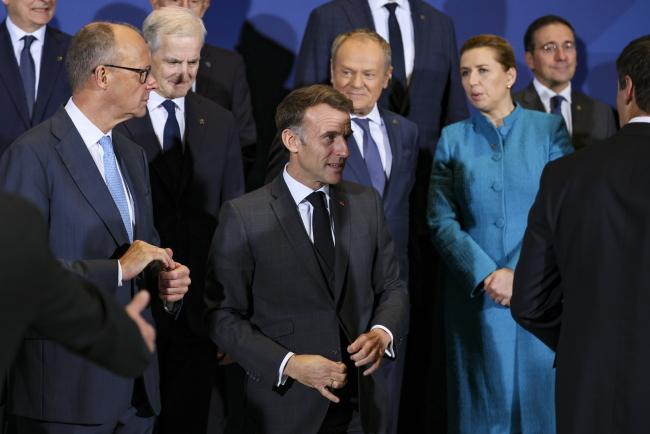


“If only national interests are to count, then let’s shut down the little shop called the European Union,” Prof. Jan Zielonka told PAP. The longtime former Oxford University lecturer was skeptical about the influence Poland and the E5 group will have on decisions related to peace negotiations over the war in Ukraine.
Poland will take part in negotiations to end Russia’s war against Ukraine within the E5 format, which also includes France, Germany, the United Kingdom and Italy, as well as EU institutions. PAP asked for comment from Prof. Jan Zielonka, a Polish-British political scientist and professor of European studies at universities in Oxford (where he taught at St. Antony’s College) and Warsaw.
“Of course it’s better to be at the negotiating table than in the hallway. The fact that we are in the E5 is a success, but it’s a Pyrrhic victory, because Poland will have negligible influence on the most important decisions,” Prof. Zielonka stressed.
In the view of the PAP interviewee, representatives of the six European countries can take part at most in technical talks preparing the actual peace negotiations. “If a Zelensky-Putin-Trump summit finally happens, Europe will be able to be represented there by one person at most. The problem is that it’s not known who that would be,” he noted.
Prof. Zielonka acknowledged that “a leader who could represent the whole Union, or more broadly Europe, has not yet appeared on the horizon.” “The European Commission does not have sufficient powers in security policy. German Chancellor Friedrich Merz is fighting for survival, as is Spanish Prime Minister Pedro Sánchez. French President Emmanuel Macron is leaving the stage. Donald Tusk and Italian Prime Minister Giorgia Meloni have elections around the corner,” he listed.
He acknowledged that “President Alexander Stubb would be a good negotiator, but Finland, which he represents, does not have sufficient political weight.”
Prof. Zielonka said that in his view “the best candidate to represent Europe in peace talks would be British Prime Minister Andy Burnham, for several reasons.” “First, he took office as prime minister only recently, and because there are still three years until the election, he doesn’t have to focus on a campaign. Second, Britain is a nuclear power. Third, the British have no illusions about Russia’s intentions,” he assessed.
“I think he would handle the role of ‘Mr. Europe.’ He is a sharp, popular politician and has a strong hand. But someone has to convince him to step into the world ring,” he explained.
Asked about Poland’s position at the negotiating table, Prof. Zielonka said that “contrary to what is said in Poland, it is not so strong at all,” mainly because, in his assessment, the governing authorities have begun to turn away from Ukraine for domestic reasons.
“When the coalition of the willing was gathering, Poland stipulated that it would not send peacekeeping troops to Ukraine. A few days ago the government suspended payments to NATO’s PURL program, under which the purchase of American weapons for Ukraine is jointly financed,” he argued.
Prime Minister Donald Tusk explained that the decision stems from Poland’s huge budget deficit and large spending on modernizing its own armed forces. “I told the secretary general (of NATO) that we will not be adding money to the PURL project at this time, because we are spending a great deal on our own armaments. We have helped and are helping Ukraine in a really serious way. We have a high deficit, we spend a lot on defense, so I informed him that, as far as financial capacity goes, Poland will certainly not be adding more money, because we have spending related to our own security, and it is one of the highest in Europe,” Tusk said after the informal EU summit in Dublin.
In Prof. Zielonka’s assessment, “regardless of the rational motives, Poland’s behavior is strange, given that supporting Ukraine is an investment in our security.” “We let ourselves be carried away by a wave of anti-Ukrainian nationalism, so mainstream politicians are afraid to stick their necks out with any initiative on behalf of Ukraine,” he added.
In our interviewee’s view, in 2023 partners in the EU had much greater expectations of the government in Warsaw when it came to various initiatives to deepen integration. Meanwhile, as he stressed, “Tusk’s pro-European cabinet is pursuing a rather selfish, sovereigntist policy, putting the emphasis on pursuing a narrowly understood national interest.”
As an example, he pointed to the migration policy of the democratic coalition government, its questioning of the EU Migration Pact, and the fact that Poland does not accept migrants under the EU relocation mechanism. “I live in Italy, and politicians in power there do not hide behind the national interest as often as those in Poland do. If only national interests are to count, then let’s shut down the little shop called the European Union and not pretend that we care about its future,” he said.
He noted at the same time that he “is not a federalist, does not idealize the EU and can be critical of this project,” but that he does not like the course toward sovereigntism. “It’s a dead end,” he said.
EU migration policy is constantly evolving, and Meloni’s government in Italy has tried unconventional solutions in this area. In the fall of 2023, her government signed an agreement with Albania to set up two residence centers in that country, intended to hold 36,000 migrants a year intercepted in the Mediterranean Sea. Although the project ran into legal and logistical barriers in Italy, it became a prototype for broader reforms at the EU level. What is more, a few days ago Denmark, Austria, Germany, the Netherlands and Greece announced that they had reached an agreement with the government of Rwanda on sending would-be asylum seekers there, despite human rights concerns and legal disputes. The first migration center in Rwanda is to open in 2027. Deputy Interior Minister Maciej Duszczyk, who is responsible for migration, said on the social media platform X that Poland is “monitoring this initiative” and is being informed about it in detail by those partners.
At the October EU summit in Dublin, Prime Minister Donald Tusk defended Poland’s migration policy, which was met with understanding from the other leaders. The head of the Polish government stressed that European heads of government understood that some of the rules of the migration pact may be useful, but that “generally the pact was not a response commensurate with the gravity of the (migration) problem.” “It is dawning more and more intensely on European leaders that the methods used so far, including the migration pact, are not an answer to the threat posed by mass, illegal migration,” the prime minister said after the summit.
He said that, in his view, tough though not brutal solutions are needed, because “everything has changed, the statistics are ghastly, the numbers are overwhelming.” In Europe, he added, more and more politicians, political parties and governments understand that traditional solutions are not producing results. “What is the Polish position, a fairly tough one, has actually become the mainstream,” the prime minister remarked.
Prof. Zielonka argued to PAP that “if the principle of ‘every man for himself’ prevails in the EU, it will be the beginning of the end of the Union.” “I’ll give a simple example. If, God forbid, Russia defeats Ukraine and millions of Ukrainian refugees start flowing into Poland, we will expect solidarity from our EU partners and for them to take in some of the refugees. Solidarity is a two-way street,” he argued.
In our interviewee’s opinion, eliminating the problem of illegal migration takes more than introducing passport checks, suspending the right to asylum or building a fence on the border. “To stop the influx of illegal migrants, we have to try to eliminate the sources of migration, and these are armed conflicts, climate change and poverty in the countries of Africa and the Middle East. This is an enormous challenge that must be faced together, as the whole EU. But there is no other way. History shows that no one has managed to stop illegal migration at the border,” he said.
Meanwhile, according to Prof. Zielonka, the EU so far is doing too little to eliminate the causes of illegal migration. Some moves even make the problem worse. “We are withdrawing investment from North Africa and the Middle East instead of supporting transformation and demographic change; we pay the autocrats who rule there to arrest people trying to cross the Mediterranean,” the expert noted.
He also cited the example of the United Kingdom: “The British left the EU, among other reasons, to regain control of their border. They deluded themselves that this would stop migrants, but today they have many more of them than in 2016, even though only the English Channel separates them from Europe.” In his view, Poland should not repeat the mistake of the U.K., which, although it lies much farther from the countries migrants come from, failed to deal with the problem on its own.
According to Prof. Zielonka, “the greatest success of Tusk’s government in domestic policy is keeping anti-European forces away from power.” Asked about successes in Europe, the expert replied that he “does not see any great successes.” In the opinion of EU Budget Commissioner Piotr Serafin, by contrast, one such success is, for example, the SAFE program, approved in mid-February by the Council of the EU but conceived during Poland’s presidency of the Council of the EU.
SAFE (Security Action for Europe) is a new financial instrument of the European Union. Its aim is to make up to €150 billion in loans available to member states for investment in the defense industry. SAFE funds are to finance, among other things, air and missile defense systems, drones, ammunition and missiles, as well as the protection of space assets and the development of artificial intelligence. With PLN 180 billion at its disposal, Poland is the largest beneficiary of the program. “For the past several years the EU essentially did not count in the area of security and defense. When we joined the Union in 2004, the EU did not deal with it at all. The fact that ensuring security and the ability to defend ourselves have become one of the Union’s most important priorities today is largely thanks to Poland,” Serafin told PAP in September. “We played a decisive role here. The SAFE program, which was born during Poland’s presidency of the Council of the EU, is only one example. Another is the structure of the new EU budget, with a significant increase in defense spending,” Serafin stressed.
Prof. Zielonka, for his part, acknowledged that Polish industry benefits from SAFE, but in his view the program itself does not bring the prospect of creating a common European defense any closer. As a positive example, he cited the Orka program, a project to modernize the Polish Navy under which the Swedish company Saab Kockums will build three modern A26 submarines.
“I understand that the priority is Poland’s arms industry and strengthening NATO’s eastern flank. But I would like Poland to be more involved in joint European defense projects. We cannot defend ourselves against Russia alone; we need allies not only across the Atlantic, but above all in Europe. We can no longer count on the U.S. the way we once could,” he argued.
Jacek Pawlicki (PAP)