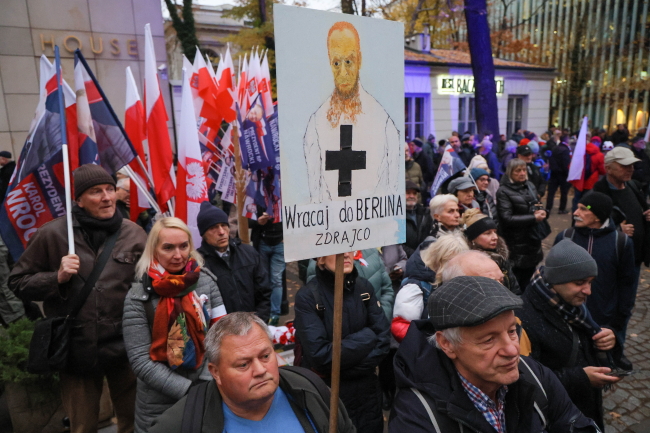


Warsaw City Hall has declined to extend permission for the rally outside the Constitutional Tribunal. That means the gathering can continue only through Nov. 30. The organizers have 24 hours to appeal the decision in court.
In its refusal, the city said that the freedom to organize peaceful assemblies, and to take part in them, is one of the fundamental constitutional freedoms set out in the Constitution of the Republic of Poland but is not unconditional.
It also explained that a municipal authority, in this case Warsaw City Hall, issues a decision banning an assembly if it violates the freedom of peaceful assembly, if holding it could endanger people’s lives or health, or if it is to take place at a site where recurring assemblies are held.
The city noted that, first, the organizer exceeded the 30-day deadline set out in the law when filing the notification. The application was submitted on Nov. 10 for an assembly planned through Jan. 5. “Under the provisions of the Law on Assemblies, notification of an intention to organize an assembly must reach the municipal authority no earlier than 30 days and no later than six days before the planned date of the assembly,” City Hall wrote, adding that a notification covering the period after Dec. 10 is therefore premature.
Another ground for refusal is the expected duration of the assembly, namely 36 days without interruption, which, in the city’s view, would undoubtedly cause further significant disruption for residents and others in the area during that time. “That situation has existed since Sept. 17,” it added. An assembly registered from Oct. 20 is currently under way.
In addition, in its notification the organizer assured the city that it would not occupy the roadway, only the sidewalk and the bike path. Yet tents and a stage, among other things, are standing there. To ensure safety, police have in practice had to block the entrance to Aleja Szucha, an important thoroughfare linking Śródmieście with Mokotów and also an access route to Trasa Łazienkowska.
Blocking the street also hinders the movement of emergency services in the area. In addition, the site of the assembly is in the immediate vicinity of “facilities subject to special protection.”
City Hall also asked the services for their opinions. Police said the planned assembly “may be an undertaking generating a high probability of a threat to public safety and order and may generate a risk of special incidents endangering public safety.” They said numerous complaints and petitions about the assembly had been received by the Śródmieście police station. They also recalled that alert levels remain in force and that people gathering for a long time in one place could lead to dangerous incidents.
The city’s firefighters also gave a negative opinion on holding the assembly, pointing to restrictions on the smooth passage of emergency services. The ambulance service spoke in a similar vein.
“While respecting the freedom to organize peaceful assemblies, one must remember that the same freedom belongs to every other person, which entails respect for the rights of others,” the city wrote in justifying its decision.
Warsaw Mayor Rafał Trzaskowski said on social media that police are conducting 20 proceedings over disturbances of public order at the site. Residents have also filed 37 complaints.
“I want this to be heard clearly. If tents belonging to people with exactly the opposite views stood under the same building for two months, in the middle of the street, blocking traffic, the decision would be exactly the same. Because this is not a decision about views. It is a decision about the safety and rights of the people who live there,” Trzaskowski said in a video posted on social media. He stressed that anyone can protest in Warsaw. “Closing streets, doors, institutions to others for two months — no one can do that,” he added.
The organizers of the assembly have the right to appeal the decision to the Regional Court in Warsaw within 24 hours of the ban being posted on the website of the Public Information Bulletin of the Warsaw city office.
The protest outside the headquarters of the Constitutional Tribunal is an initiative supported by circles linked to right-wing media and the “Gazeta Polska” Clubs. A stage used by Telewizja Republika, which covers the events and gives the protesters a space for public appearances, has been set up on site. The “Gazeta Polska” Clubs are involved in organizing the protest. One of the main figures of the event is Adam Borowski, chairman of the Warsaw “Gazeta Polska” Club, who is also named as the organizer of the assembly. Mainly politicians linked to Law and Justice (PiS) have taken part in the protests, and supporters of Konfederacja and the Confederation of the Polish Crown (Konfederacja Korony Polskiej) have also been present at the demonstrations.
The protest originated in a tent camp set up in September 2026 outside the Tribunal’s headquarters, whose participants declared their opposition to what they described as an attempt by the government to take over the Tribunal by force. The immediate trigger for the escalation was the events of Oct. 30, when police entered the institution’s premises and Judge Anna Korwin-Piotrowska ordered a break in the activities of Tribunal President Bogdan Święczkowski and his deputy. The protesters regarded those actions as unlawful interference in the Tribunal’s functioning and announced that they would remain outside its headquarters in order, as they put it, to defend the institution’s independence. The dispute has a broader background, however, linked to the refusal by part of the Tribunal’s leadership to recognize judges chosen by the Sejm, Poland’s lower house of parliament, whom the president has not sworn in. (PAP)