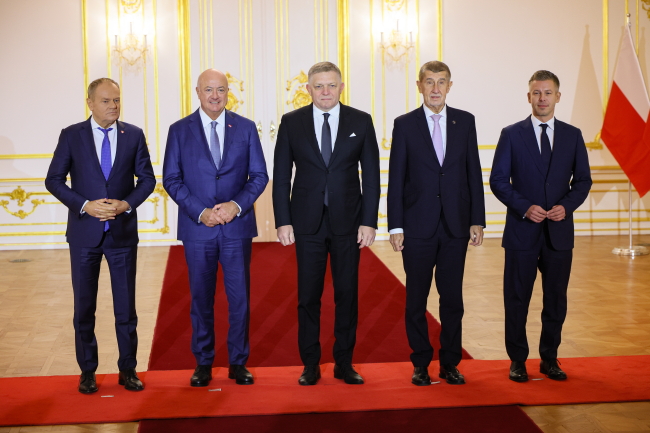


Leaders of the Visegrad Group (V4) countries, including Polish Prime Minister Donald Tusk, have urged the head of the European Commission in a letter to delay the launch of the ETS2 system until 2030. They proposed that the postponement of the new charges on fuel and heating apply to those EU member states that want it.
Slovak Prime Minister Robert Fico, host of the V4 summit in Bratislava, announced the letter on Monday. The prime ministers of the Czech Republic and Hungary, Andrej Babiš and Peter Magyar, also signed the message to European Commission President Ursula von der Leyen. At issue is the extension of the EU Emissions Trading System (ETS), which requires payment for carbon dioxide emissions, to road transport and buildings. Under current rules, that is set to happen in 2028.
In the letter, the text of which was made available to journalists on Tuesday, the V4 leaders warned that ETS2 would mean an additional financial burden of tens of billions of euros. “If we do not address this issue in a timely and effective manner, there is a risk of a decline in household consumption, on which our economies depend to a large extent, which in turn will negatively affect business revenues, employment levels and investment,” they wrote.
The V4 also sees a risk that ETS2 will be perceived as a new European climate tax, which could weaken not only support for climate action but also for the entire European project.
The prime ministers of Poland, the Czech Republic, Slovakia and Hungary called for moving the launch date of ETS2 from 2028 to 2030. They also called for suspending the first auction of emission allowances, already scheduled for January 2027, “until the future of this system is clarified.” According to the V4, the first auction should be postponed in a way that ensures legal certainty.
The V4 leaders also referred to the provisions on ETS2 from the European Union summit in October. In them, EU heads of state and government called on the European Commission to update its assessment of all the effects of ETS2, in particular its structure and safeguards. In their letter to von der Leyen, the V4 countries stressed that it is time to continue that discussion.
“Because work is currently under way on a revision of the EU Emissions Trading System, we call on the Commission to engage in constructive cooperation with the Council so that the revision takes into account the possibility of postponing the launch of ETS2, on the assumption that this would apply only to those member states that express such a wish,” the prime ministers said.
The leaders of Poland, the Czech Republic, Slovakia and Hungary also demand that the Commission present its analysis of the effects of ETS2, preferably before the allowance auction in January and certainly well before any legislative changes are adopted ahead of the start of emissions pricing in 2028.
The letter also states that the situation has changed significantly since the Commission’s last assessment in 2021. In September, eurozone inflation reached 3.8%, energy prices rose 18.9% year over year, and the average price of diesel in the EU at the end of the month was 2.24 euros per liter.
“Households and businesses are bearing the burden of these rising costs, which is leading to a decline in purchasing power and weaker public confidence in our ability to carry out the transition in an economically and socially responsible way. Unfortunately, social tensions stemming from the high cost of living are now also showing up in the form of public protests in many member states,” the heads of government of the Visegrad Group countries wrote.
Eight EU countries, including Germany, the Netherlands, Sweden and Finland, oppose any changes to ETS2. In a letter to the heads of EU institutions on Monday, those countries said ETS2 would lower the cost of achieving the EU’s climate goals while bringing significant revenue to national budgets.
The emissions trading system will be discussed at the EU summit in Brussels on Thursday and Friday, in the context of the proposed EU budget for 2028-2034. Revenue from the ETS is to become a new own resource of the EU and feed the bloc’s coffers in the new financial framework. Poland opposes that idea.
From Brussels, Magdalena Cedro (PAP)