
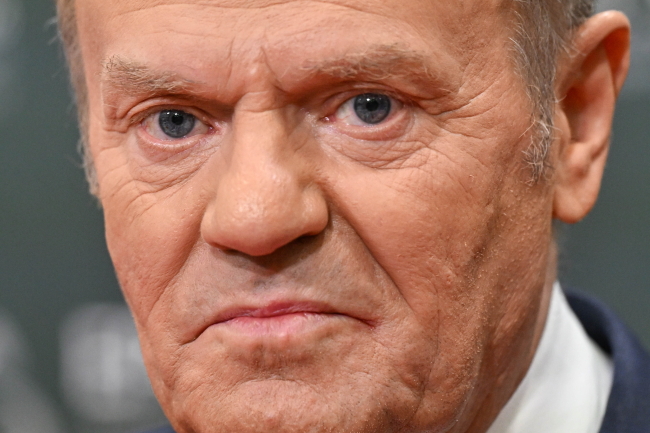


“Be not afraid, Mr. President,” Prime Minister Donald Tusk said Thursday, referring to his invitation to Karol Nawrocki to visit his home. “I won’t do anything to you during such a meeting,” the head of government added.
On Wednesday, at the christening ceremony for the new ferry “Bursztyn Unity” in Szczecin, held on National Independence Day, the prime minister addressed Nawrocki, saying: “Mr. President, we were supposed to meet; I waited a bit for that invitation. But from the heart, then, without waiting any longer, I want to invite you, together with your wife, your family, your children, to my home in Sopot.”
“Let’s share the opłatek [the traditional Christmas wafer] before Christmas Eve, let’s talk. My apartment is small, but there will be room for the two of us in the kitchen at the table, and we’ll talk, as they used to say, Pole to Pole,” Tusk said.
On Thursday, presidential spokesman Rafał Leśkiewicz responded by saying there is no sincerity in Tusk’s invitation and that it is a political gesture. He added that a meeting should take place on the condition that the president’s expectations are met, namely “the withdrawal of police from the Constitutional Tribunal and allowing the judges who have the right to be there to enter the Tribunal, because they are judges of the Tribunal.”
Asked about the meeting on Thursday in Dublin, Prime Minister Tusk acknowledged that he “truly believes in the point of meetings either one-on-one or in an atmosphere that will, at least for a moment, rule out aggressive behavior.”
He repeated that his invitation to meet, even at his home, to “break the opłatek and look at these Polish matters and at one another in a more human way,” still stands.
Tusk recalled that during the recent meeting of the National Security Council (RBN), he and Nawrocki agreed to such a meeting. “It was the president who proposed: ‘I will text you with a proposed date and place.’ I said: ‘OK, I’m waiting.’ And then suddenly something changed,” the prime minister said.
He stressed that he would most like to say: “Be not afraid, Mr. President, I won’t do anything to you during such a meeting.”
“If someone invites someone to share the opłatek, and the other side talks about some conditions, it means something isn’t quite right there,” Tusk added.
On Nov. 3, after the RBN meeting, the prime minister said he had offered the president a one-on-one meeting to consider how to lastingly reduce tensions in the country.
On Nov. 6, Zbigniew Bogucki, head of the Chancellery of the President (KPRP), wrote on X that he had discussed a meeting between the president and the prime minister with Jan Grabiec, head of the Chancellery of the Prime Minister (KPRM), and that he had presented “the position of the President of Poland presented during the RBN: police cordons leave the grounds of the Constitutional Tribunal, legal judges enter the Tribunal.” On the same day, Grabiec said that Bogucki “spoke about some preconditions that should be met,” and that this was not an appropriate approach, because “the president of Poland and the prime minister should be able to talk without setting preconditions.”
On Oct. 30, representatives of the group of judges elected to the Constitutional Tribunal by the current term of the Sejm, Poland’s lower house of parliament, announced that Anna Korwin-Piotrowska, as the longest-serving judge, had become head of the Tribunal and had issued an order suspending the duties of Tribunal President Bogdan Święczkowski and Vice President Bartłomiej Sochański.
Święczkowski called this a usurpation. President Nawrocki also said at the time, among other things, that “the constitutional order of the Republic of Poland had been violated and a constitutional organ of the state had been taken over by force.”
For his part, Prime Minister Donald Tusk stated, among other things, that the current Sejm had elected new Tribunal judges, but the president had not accepted the oath from some of them, and that Święczkowski had prevented them from starting work, and when after many weeks of waiting they decided to take up their duties, “they were attacked.” On Thursday the prime minister added: “The matter is settled as far as the Tribunal is concerned. Settled in the sense that we have a Tribunal, it will issue rulings, I hope. A great many citizens are waiting for rulings and interpretations from the Tribunal.” (PAP)