
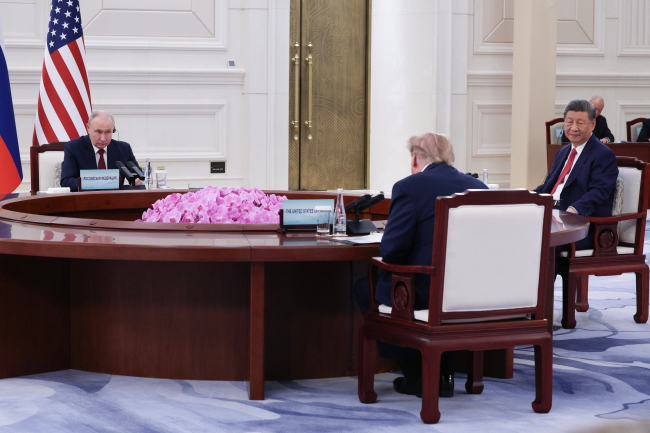


The meeting of the leaders of China, Russia and the U.S. – Xi Jinping, Vladimir Putin and Donald Trump – on the sidelines of the APEC summit in Shenzhen is not Yalta 2.0, nor a “historic” event. It is an opportunity to take photos together, The Economist writes about the talks among the three presidents.
In February 1945, Winston Churchill, Franklin Roosevelt and Stalin met in Yalta to decide the fate of the planet. Historians dispute whether they could have struck a better deal than the one that divided Europe, but it was undoubtedly a historic event. That is unlike what took place in Shenzhen, which gave Trump, Xi and Putin a chance to take photos together, the British weekly writes at the outset.
Although some describe the meeting as a new Yalta, it was most certainly nothing of the kind. Trump, fresh from a defeat in the midterm elections, wanted to appear on television as a strong leader, The Economist explains.
“A Russian despot, humiliated by years of failed attempts to conquer his smaller neighbor, wants to rub shoulders with the real superpowers,” the weekly continues. It adds that Xi was happy to play the role of a dignified, calm emperor hosting quarreling neighbors at his villa.
The weekly predicts that nothing will come of the meeting in the future. Meanwhile, the “real story in geopolitics” that deserved attention, it says, is the deepening cooperation among four autocratic, anti-Western regimes: China, Russia, Iran and North Korea.
The Economist recalls that as early as 2018, Trump’s first defense secretary, James Mattis, warned about this cooperation among hostile satrapies, which is worrying even though it does not translate into a formal alliance.
There are precedents for such informal pacts linking authoritarian states that are culturally very different and geographically distant. The most troubling example is the axis that joined Germany, Italy and Japan in the 1930s. For democracies to face the threat, they must first become aware of it, the weekly concludes.
Xi, Putin and Trump issued a document after the trilateral summit stating that a nuclear war cannot be won and must never be fought. It also stressed that both the Russian and American leaders expressed appreciation to the Chinese side for organizing this “historic” meeting.
The APEC (Asia-Pacific Economic Cooperation) summit, held amid deep geopolitical divisions, became for the first time in years a platform for direct dialogue among the sitting leaders of the U.S., Russia and the People’s Republic of China. (PAP)
